Freedom251 › Mutation Testing Tools
LittleDarwin
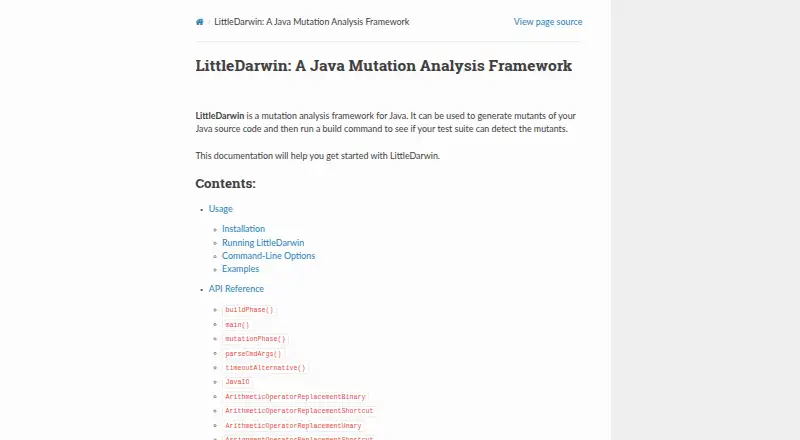
What LittleDarwin is
LittleDarwin is a Java mutation testing framework written in Python for Linux. It creates altered versions of Java source code and runs a build command for each one to check whether the test suite catches the change. Its workflow has a mutation phase followed by a build phase, which records whether each build passes or fails. You can choose null-check or method-level operators, use all operators, or set a mutation order; the guide shows second-order mutations. Whitelist filters include selected packages or files, while blacklist filters leave them out. Project settings include a test project path, test and build commands, a working directory, an initial build, cleanup commands, and a build timeout. A Maven example uses `mvn clean test`. Mutants and full-analysis reports are placed in a `LittleDarwinResults` directory, and surviving mutants are reported. Installation uses pip, and the program runs as a Python module. LittleDarwin is free and open-source software under the GNU General Public License, version 3 or later; the project is supported through donations.
Who it suits
It suits Java teams that want to check whether their test suites detect source-code changes, including deployments where other mutation tools may not work. Its filters and configurable build commands can help tailor analysis to a project.
What it does well
- Supports higher-order mutations, including second-order examples.
- Filters analysis with package or file whitelists and blacklists.
- Reports surviving mutants and full-analysis results.
- Configurable build, test, cleanup, and timeout settings.
What to know first
- Available for Linux only.
- Installation and execution use Python and pip.
- The project is supported through donations.
Plans
| Plan | Billed and limits | Price |
|---|---|---|
| Free and open-source | Supported through donations · Java mutation analysis framework | Free |
As aliparsai.github.io lists them, read 8 Oct 2026. The maker's own page has the final word.
Getting started
- Install LittleDarwin with pip, using `pip3 install littledarwin` as shown in the README.
- Run LittleDarwin as a Python module.
- Set the test project path and test command.
- Provide a build command; the guide demonstrates `mvn clean test` for Maven.
- Optionally configure mutation operators, higher-order mutations, scope filters, and build settings.
LittleDarwin is a configurable mutation-analysis tool for Java projects. It suits teams willing to install a Python package, work from the command line, and connect the tool to their own build and test commands. Its strongest case is a project needing fine-grained mutation and scope controls; teams seeking a turnkey, broadly supported workflow should look elsewhere.
Overview
LittleDarwin creates deliberately changed versions of Java source, then evaluates each version through a build command. By recording whether that build passes or fails, it helps reveal tests that allow defects to slip through, rather than merely confirming that the untouched code compiles.
The framework itself is written in Python but analyzes Java. The maker positions it for deployment in complex systems where other mutation tools may not work. That makes it a candidate for unusual or difficult projects, although its command-driven setup puts responsibility for integration on the user. It is free software under the GNU General Public License, version 3 or later, and the project is supported by donations.
Key features
Selectable mutation strategies
Operators include null-check and method-level mutations, with an option to enable all available operators. The --higher-order setting controls how many mutations are combined; the usage guide demonstrates second-order mutants. This range is valuable when a team wants to target particular fault patterns or increase analysis complexity. It also means results depend on deliberate operator and order choices rather than a single fixed preset.
Build and test integration
You supply the build command used for every mutant; the documentation illustrates mvn clean test in a Maven project. Command-line settings also accept a test-project path and test command, plus a working directory, an initial build command, cleanup commands, and a build timeout. Those controls can accommodate varied Java layouts and build routines, but they require someone who understands the project’s lifecycle well enough to configure them safely.
Scope control and reports
A whitelist limits analysis to named packages or files, while a blacklist excludes them. These filters can keep a large codebase within a practical scope or isolate a troublesome area. Generated mutants, surviving-mutant information, and the full analysis report are placed in a LittleDarwinResults directory, giving teams a concrete output location for review and follow-up.
Pricing
| Plan | Price | What it means |
|---|---|---|
| Free and open-source | free | Java mutation analysis framework; supported through donations |
There are no paid tiers, seat charges, quotas, or trial terms stated for this plan. The trade-off is operational rather than financial: teams must install and configure the software themselves and run the resulting builds.
Platforms
LittleDarwin supports Linux. Installation uses Python’s package tooling: the guide shows pip install littledarwin (and the README also documents pip3 install littledarwin), followed by running it as a Python module. Java teams on other operating systems should not choose it expecting a published native option.
Who it's for
This is a fit for Java developers, quality engineers, and maintainers of complex systems who need to measure test-suite sensitivity and are comfortable supplying build, test, cleanup, and timeout commands. The whitelist and blacklist are especially useful when a complete project run would be too broad. It is a poor match for teams that need graphical operation, turnkey continuous-integration setup, or a platform other than Linux.
Pros and cons
Pros
- Detailed control over analysis: operator selection, higher-order mutations, and package or file filters let experienced teams shape the workload.
- Works with project-specific routines: configurable build and test commands, working directories, initialization, cleanup, and timeouts accommodate established Java processes.
- No licence fee: the GPLv3-or-later project costs 0.00 USD and has no stated usage cap.
- Actionable output: surviving mutants and reports are collected in the LittleDarwinResults directory.
Cons
- Linux-only positioning: the published platform support excludes Windows and macOS users.
- Configuration burden: command-line setup and repeated builds demand build-system expertise.
- Python-based installation for Java work: teams must manage a Python package even though the analyzed code is Java.
- Donation-supported project: the project does not describe paid support or service commitments.
Alternatives
Choose Mutation Testing Tools when you want a broader directory of options before committing to one framework.
ArcMutate is the better choice when you need Linux, macOS, Windows, or self-hosted deployment, with a free open-source licence for open-source projects and a paid Base plan at $8 a month.
MuJava suits teams wanting a free, Apache-licensed Java mutation tool across Linux, macOS, and Windows.
Mutant is worth choosing when public repositories can use its full open-source feature set or when commercial use calls for a 30.00 USD-per-month-per-developer plan.
Mutatest is a free MIT-licensed alternative for Linux, macOS, and Windows.
go-mutesting is a free MIT-licensed option focused on Go and available on Linux or self-hosted setups.
MutPy is a free Linux or self-hosted alternative with no paid plans or usage limits stated.
pymute is a free Linux tool installed with Cargo and requiring Rust and Cargo.
pytest-gremlins is a free MIT-licensed Python package for Linux that requires Python 3.11 or newer.
Verdict
Choose LittleDarwin if you maintain Java on Linux and value precise control over mutation operators, mutation order, scope, and build execution without a licence bill. Look elsewhere if cross-platform support, a simpler setup, or formal commercial support matters more than that flexibility.
Verdict
LittleDarwin offers configurable mutation analysis for Java projects, with filters, build settings, and reports. It is a Linux option for teams comfortable installing and running a Python module.
Questions
How much does LittleDarwin cost?
The listed plan is Free and open-source at no cost. The project is supported through donations.
Which language and platform does it support?
LittleDarwin analyzes Java source code and is available for Linux.
What does the analysis do?
It generates mutants, runs a configured build command for each, and checks whether the build passes or fails. It produces analysis reports and reports surviving mutants.
Can I choose mutation operators and analysis scope?
Yes. Options include null-check and method-level operators, all operators, and higher-order mutations. Whitelist filters restrict analysis to selected packages or files, while blacklist filters exclude them.
How do I install it and configure a project?
Install it with pip and run it as a Python module. You can provide project paths, test and build commands, a working directory, initial build and cleanup commands, and a build timeout.
What license does it use?
LittleDarwin is free software under the GNU General Public License, version 3 or later.
Facts from LittleDarwin's own pages
- Analysis phases
- It has a mutation phase that generates mutants and a build phase that runs a build command for each mutant and checks whether the build passes or fails. · aliparsai.github.io, 8 Oct 2026
- Analysis scope
- A whitelist can restrict analysis to listed packages or files, while a blacklist can exclude listed packages or files. · aliparsai.github.io, 8 Oct 2026
- Build configuration
- Users can provide build and test commands, working directory paths, an initial build command, cleanup commands, and a build timeout. · aliparsai.github.io, 9 Oct 2026
- Build integration
- Users can provide a build command; the documentation gives Maven clean test as an example. · aliparsai.github.io, 8 Oct 2026
- Distribution
- The project README instructs users to install the package with `pip3 install littledarwin`. · github.com, 9 Oct 2026
- Funding
- The maker states that the free and open-source project is supported through donations. · littledarwin.parsai.net, 8 Oct 2026
- Higher order mutations
- The usage guide demonstrates generating second order mutants with `--higher-order=2`. · aliparsai.github.io, 9 Oct 2026
- Install
- The usage guide says to install LittleDarwin with `pip install littledarwin` and run it as a Python module. · aliparsai.github.io, 9 Oct 2026
- Installation
- The documentation says to install LittleDarwin with pip and run it as a Python module. · aliparsai.github.io, 8 Oct 2026
- Integration
- The guide demonstrates running `mvn clean test` for each mutant in a Maven project. · aliparsai.github.io, 9 Oct 2026
- Intended use
- The maker describes LittleDarwin as designed for deployment in complex systems where other mutation tools may not work. · littledarwin.parsai.net, 8 Oct 2026
- License
- The project is free software under the GNU General Public License, version 3 or later. · github.com, 9 Oct 2026
- Mutation and build
- It has a mutation phase that generates mutants and a build phase that runs a build command for each mutant and checks whether the build passes or fails. · aliparsai.github.io, 9 Oct 2026
- Mutation operators
- The command-line options include null-check and method-level mutation operators, as well as an option to use all operators. · aliparsai.github.io, 8 Oct 2026
- Mutation options
- The command line supports higher order, null check, method level, and all mutation operators, as well as whitelist and blacklist filters. · aliparsai.github.io, 9 Oct 2026
- Purpose
- LittleDarwin generates mutants of Java source code and runs a build command to check whether the test suite detects them. · aliparsai.github.io, 9 Oct 2026
- Reports
- A full analysis generates a report in the `LittleDarwinResults` directory. · aliparsai.github.io, 9 Oct 2026
- Results
- The documentation says generated mutants and analysis reports are placed in a LittleDarwinResults directory. · aliparsai.github.io, 8 Oct 2026
- Runtime
- The project describes itself as a Java mutation testing framework written in Python. · github.com, 9 Oct 2026
- Scope filters
- A whitelist limits analysis to listed packages or files, while a blacklist excludes listed packages or files. · aliparsai.github.io, 9 Oct 2026
- Support
- The maker invites users to email the author with feedback or suggestions. · littledarwin.parsai.net, 8 Oct 2026
- Test suite integration
- The command-line options let users specify a test project path and a test command. · aliparsai.github.io, 8 Oct 2026
Where LittleDarwin stands on Freedom251
- Mutation Testing Tools#10 of 25