Freedom251 › Prompt Management Software
Modular Prompt Library
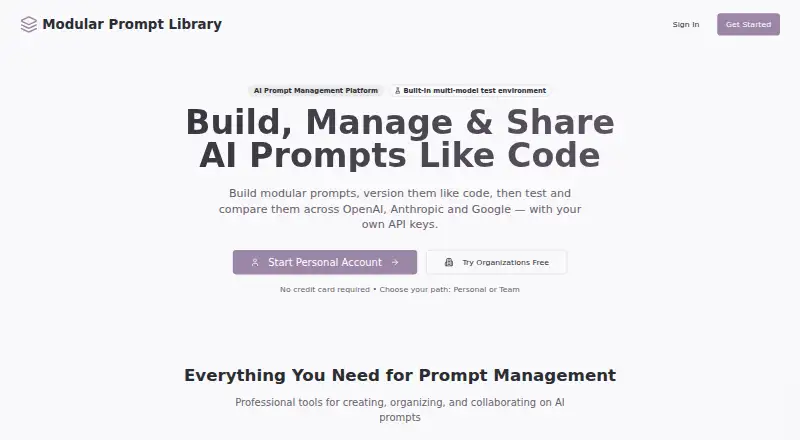
What Modular Prompt Library is
Modular Prompt Library is a web platform for creating, organizing, testing, and comparing AI prompts. Its reusable modules let people assemble prompts from shared components and apply them across projects. Version history tracks edits and allows a return to an earlier version, while shared libraries give teams a place to review changes and develop prompts together.
For testing, users connect their own OpenAI, Anthropic, or Google API keys. They can fill prompt variables, adjust temperature, top-p, and max tokens for each model, and save presets against a prompt version. Comparisons put model responses side by side with latency, token counts, and estimated cost. The site says keys are encrypted at rest, model charges go directly to providers, and prompts, variables, and outputs remain in the user's workspace.
The free Personal Account supports personal use across up to 5 workspaces, with unlimited prompts and modules and testing through personal API keys. Starter is free and includes up to 5 users or 3 workspaces. Growth costs $2.50 a month, and Professional costs $5 a month. Organizational accounts can start a 60-day free trial without a credit card. Team plans include collaboration and access controls, with MFA and JSON export also listed.
Who it suits
It suits prompt engineers and AI content teams who need to build reusable prompts, track revisions, and compare model outputs. Marketing agencies, software development and customer support teams, and educational institutions are also identified as intended users. Personal Account is limited to personal use, while team plans support collaboration.
What it does well
- Reusable prompt components can be shared across projects.
- Version history supports reverting to earlier prompt versions.
- Compare outputs across OpenAI, Anthropic, and Google models.
- Testing displays latency, tokens, and estimated cost.
- Team plans include MFA and granular access control.
What to know first
- Personal Account is for personal use only.
- Testing requires users to connect their own API keys.
- Model usage is billed directly by the provider.
- Enterprise pricing is custom and not published.
Limits
The free Personal Account is for personal use and allows up to 5 workspaces, with unlimited prompts and modules. Organizational accounts have a 60-day free trial; model usage is billed directly by the provider.
Plans
| Plan | Billed and limits | Price |
|---|---|---|
| Personal Account | Up to 5 workspaces · Unlimited prompts & modules · Prompt testing with own API keys · Personal use only | Free |
| Starter | Up to 5 users OR 3 workspaces · MFA · Team collaboration · Granular user access control · JSON export | Free |
| Growth | $2.5/month · 6–10 users OR 4–10 workspaces · MFA · Team collaboration · Granular user access control · JSON export | $2.50 a month |
| Professional | $5/month · 11–30 users OR 11–15 workspaces · MFA · Team collaboration · Granular user access control · JSON export | $5 a month |
| Enterprise | Custom · 30+ users OR 15+ workspaces · MFA · Team collaboration · Granular user access control · JSON export | On request |
As modularprompt.com lists them, read 8 Oct 2026. The maker's own page has the final word.
Getting started
- Open modularprompt.com in a web browser.
- Choose a Personal Account or an organizational plan.
- Start an organizational account's 60-day free trial without a credit card, if applicable.
- Connect your own OpenAI, Anthropic, or Google API keys to test prompts.
Modular Prompt Library is a web workspace for assembling, revising, sharing, and evaluating AI prompts. It fits prompt engineers, content and software teams, agencies, support groups, and schools that need controlled collaboration around reusable prompt assets. The central advantage is one place for modular authoring and cross-model comparison; the main caution is that you supply the provider keys and pay model charges separately.
Overview
Prompts are managed as reusable building blocks rather than isolated snippets. Components can be combined across projects, and version history records edits and permits restoration of an earlier version. That workflow suits teams maintaining prompts over time or reusing the same instructions in multiple initiatives; people with only a handful of static prompts may find the process unnecessary.
Testing connects to OpenAI, Anthropic, and Google through your own API keys. The comparison view places outputs side by side and reports latency, token counts, and estimated cost. Providers charge for that usage directly, so the subscription does not function as a bundle of model credits. The site says keys are encrypted at rest and never shared, while prompts, variables, and outputs remain in the workspace and are not accessed, used, or shared by the maker.
Key features
Modular authoring and history
Reusable modules reduce duplicated editing when a common instruction appears in several prompts. Version tracking and rollback provide a clear way to recover from an unwanted change, which is valuable when multiple contributors work on production prompt sets.
Team review and permissions
Shared libraries let teams review changes and collaborate on development. Organizational plans add multifactor authentication, granular user access control, and organization management. Those controls are more relevant to managed teams than to an individual experimenting alone.
Model testing controls
You can fill prompt variables and tune temperature, top-p, and maximum tokens for each model. Presets can be saved per prompt version, helping teams repeat a comparison with consistent settings. Side-by-side results with latency, token, and estimated-cost figures support practical model selection rather than relying on a single sample.
Pricing
Modular Prompt Library uses a freemium structure. The Personal Account costs nothing and is limited to personal use, but includes up to five workspaces with unlimited prompts and modules plus testing with your own API keys. It is the sensible starting point for an individual; it does not provide team collaboration or organizational controls.
Starter is free for up to five users or three workspaces. It adds MFA, team collaboration, granular user access control, and JSON export, making it a no-cost option for a small group willing to stay within the user or workspace cap.
Growth costs $2.50 a month, billed $2.5/month, and covers six to 10 users or four to 10 workspaces with the same security, collaboration, and export features. Professional costs $5 a month, billed $5/month, for 11 to 30 users or 11 to 15 workspaces. These low-priced tiers fit growing teams, but the either/or limits mean you need to watch both headcount and workspace expansion.
Enterprise uses custom pricing and supports 30+ users or 15+ workspaces, alongside MFA, collaboration, access control, and JSON export. Organizational accounts receive a 60-day free trial across all tiers, with no credit card required to start. In every tier, provider API usage remains a separate bill.
Platforms
The product runs on the web. A support contact form is provided for product questions and help.
Who it's for
AI content creation teams, prompt engineers, marketing agencies, software development teams, customer support departments, and educational institutions are the clearest matches. The combination of reusable modules, reviewable history, permissions, and model comparison rewards groups with recurring prompt work. A casual user seeking bundled inference or a simple personal note store should look elsewhere.
Pros and cons
- Pros: Reusable components can be shared across projects, reducing repeated prompt maintenance.
- Pros: Version history with rollback supports safer collaborative editing.
- Pros: OpenAI, Anthropic, and Google comparisons expose latency, tokens, and estimated cost in one testing workflow.
- Pros: Personal and Starter tiers are free, and organizational trials last 60 days without requiring a card.
- Cons: Model usage is not included; each provider bills your connected API keys directly.
- Cons: Personal use is capped at five workspaces, while team tiers impose user-or-workspace bands.
- Cons: Enterprise pricing is custom, so larger organizations cannot budget from a published rate.
Alternatives
Browse the Prompt Management Software list for more products in this category.
Vellum is a better fit if you need broader platform coverage, including mobile, desktop, extension, or self-hosted options, and prefer a free entry plan with pay-as-you-go credits.
Choose PromptHelm when a gateway-centered service with a 10,000-call monthly hard cap, prompt and version limits, one seat, and seven-day log retention matches your scale.
Agenta suits teams wanting API or self-hosted deployment and a free Hobby tier with two members, 5,000 agent runs per month, 20 evaluations, and one-week trace retention.
Consider Impromptо for API and web access with a Pro Team offer priced at ₹599 a month and unlimited Playground runs.
Langfuse is the alternative when observability-oriented API or self-hosted deployment is the priority, with a free Hobby allowance of 50k units per month and 30 days of data access.
Prompt Assay, PromptDocker, and PromptFluent are other options to compare when their respective workflows better match your needs.
Verdict
Choose Modular Prompt Library if your team needs reusable prompt construction, controlled revisions, shared review, and side-by-side testing across several model providers. Its free Personal and Starter paths lower the entry cost, while inexpensive Growth and Professional tiers add structured team controls. Look elsewhere if you want model credits inside the subscription, need a non-web client, or require a published Enterprise price.
Verdict
Choose Modular Prompt Library if you need a web workspace for reusable prompts, revisions, team review, and side-by-side model testing. Its free Personal Account covers up to 5 workspaces, and organizational accounts have a 60-day trial. Look elsewhere if you need model usage included in the subscription or a published Enterprise price.
Questions
Is Modular Prompt Library free?
Yes. Personal Account is free for personal use, and Starter is listed as free.
What do the paid plans cost?
Growth costs $2.50 a month and Professional costs $5 a month. Enterprise pricing is custom and not published.
Is there a free trial?
Organizational accounts have a 60-day free trial for all tiers, and no credit card is required to start.
Which platforms and model providers does it support?
It is available on the web. Users can connect their own OpenAI, Anthropic, and Google API keys for testing.
Can teams control access and review prompt changes?
Yes. Team plans list collaboration, MFA, and granular user access control; shared libraries support reviewing changes.
How does it handle API keys and prompt content?
The site says keys are encrypted at rest and prompt content stays in the user's workspace. It also says model usage is billed directly by the provider.
Facts from Modular Prompt Library's own pages
- API key handling
- The site says API keys are encrypted at rest, never shared, and model usage is billed directly by the provider. · modularprompt.com, 8 Oct 2026
- Free tier limits
- The Personal Account plan is for personal use and allows up to 5 workspaces with unlimited prompts and modules. · modularprompt.com, 8 Oct 2026
- Intended users
- The site identifies AI content creation teams, prompt engineers, marketing agencies, software development teams, customer support teams, and educational institutions as audiences. · modularprompt.com, 8 Oct 2026
- Model comparisons
- The test environment compares outputs side by side and shows latency, tokens, and estimated cost. · modularprompt.com, 8 Oct 2026
- Model integrations
- Users can connect their own OpenAI, Anthropic, and Google API keys to test prompts across models. · modularprompt.com, 8 Oct 2026
- Organizational security
- Organizational plans list MFA security, granular user access control, and organizational management. · modularprompt.com, 8 Oct 2026
- Product
- Modular Prompt Library is an AI prompt management platform for building, managing, sharing, testing, and comparing prompts. · modularprompt.com, 8 Oct 2026
- Prompt controls
- Users can fill prompt variables, tune temperature, top-p, and max tokens per model, and save presets per prompt version. · modularprompt.com, 8 Oct 2026
- Reusable modules
- Users can build prompts from reusable components and combine them across projects. · modularprompt.com, 8 Oct 2026
- Support
- The site provides a support contact form for questions and help with the product. · modularprompt.com, 8 Oct 2026
- Team collaboration
- Teams can share libraries, review changes, and collaborate on prompt development. · modularprompt.com, 8 Oct 2026
- Trial
- Organizational accounts have a 60-day free trial for all tiers, and the site says no credit card is required to start. · modularprompt.com, 8 Oct 2026
- Version history
- The product tracks prompt changes with version history and supports reverting to previous versions. · modularprompt.com, 8 Oct 2026
- Workspace privacy
- The site says prompts, variables, and outputs stay in the user's workspace and that prompt content is never accessed, used, or shared by the maker. · modularprompt.com, 8 Oct 2026
Where Modular Prompt Library stands on Freedom251
- Prompt Management Software#9 of 26