
Langfuse
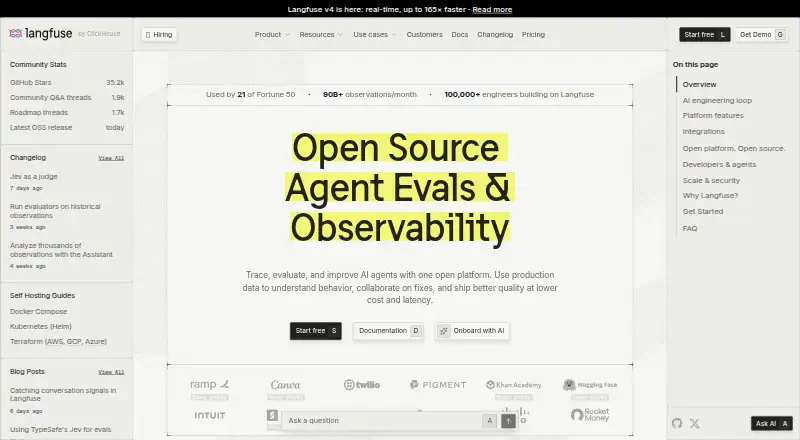
What Langfuse is
Langfuse is an open-source AI engineering platform for teams debugging, analyzing, and iterating on AI agent applications. Its tracing captures prompts, model responses, token use, latency, tool calls, retrieval steps, and metadata. Prompt Management can store, version, deploy, and test prompts, then link them to traces. Evaluation options include LLM-as-a-judge, code evaluators, user feedback, manual labeling, datasets, and experiments. Teams can connect through Python and JS/TS SDKs, OpenTelemetry, API, CLI, MCP Server, and integrations with popular AI frameworks. The MIT-licensed core can be self-hosted on customer infrastructure with Docker, including Docker Compose, Kubernetes, AWS, and Azure options. The free Hobby plan includes 50k units per month, 30 days of data access, and two users. Core costs $29 a month, billed monthly, and includes 100k units per month and 90 days of data access. Langfuse reports security audits, penetration tests, and GDPR compliance; Cloud traffic uses TLS 1.2+ and stored data AES-256 encryption.
Who it suits
Langfuse suits teams building AI agent applications that need tracing, prompt management, and evaluation tools. It offers a free Hobby plan, paid plans, and a self-hosted option for teams running the MIT-licensed core on their own infrastructure.
What it does well
- Tracing captures prompts, latency, tool calls, and retrieval steps.
- Prompt Management versions and tests prompts.
- Evaluation includes datasets, experiments, and user feedback.
- Free Hobby plan includes 50k units monthly.
- Self-hosting options include Docker Compose, Kubernetes, AWS, and Azure.
What to know first
- Hobby includes only two users.
- Hobby data access lasts 30 days.
- Core costs $29 a month, billed monthly.
- Teams Add-on costs $300 a month, billed monthly.
Limits
Hobby includes 50k units per month, 30 days of data access, and two users. Core includes 100k units per month and 90 days of data access; additional usage costs $8 per 100k units. Pro includes 100k units monthly, with additional usage at $8 per 100k units.
Plans
| Plan | Billed and limits | Price |
|---|---|---|
| Hobby | Free · 50k units/month · 30 days data access · 2 users · community support | Free |
| Pro | $199/ month · 100k units/month included · $8/100k additional · 3 years data access · data retention management · unlimited annotation queues · high rate limits · SOC2 & ISO27001 reports · HIPAA-ready region | $199 a month |
| Enterprise | $2499/ month · Everything in Pro and Teams · audit logs · SCIM API · custom rate limits · uptime SLA · support SLA · named lead support engineer | $2,499 a month |
| Core | $29/ month · 100k units/month included · $8/100k additional · 90 days data access · unlimited users · in-app support | $29 a month |
| Teams Add-on | $300/mo · Enterprise SSO · SSO enforcement · fine-grained RBAC · dedicated Slack or MS Teams support channel | $300 a month |
As langfuse.com lists them, read 15 Oct 2026. The maker's own page has the final word.
Getting started
- Visit the Langfuse website
- Choose the web platform or a self-hosted deployment
- For self-hosting, use Docker and select an available deployment option
- Choose Hobby or a paid plan
- Connect through an SDK, OpenTelemetry, API, CLI, MCP Server, or supported framework integration
Langfuse is an open-source AI engineering platform for teams building and refining agent applications. It suits engineers who need observability, prompt lifecycle controls, and evaluation in the same workflow, particularly when self-hosting or compliance controls matter. The main trade-off is that longer retention, larger teams, and advanced access features require paid plans.
Overview
Langfuse connects production behavior with the material used to improve it. Tracing records prompts, model responses, token usage, latency, tool calls, retrieval steps, and metadata, so teams can investigate multi-step agent runs rather than viewing only isolated model requests. Cost and token tracking add a direct way to monitor spend.
The MIT-licensed core can run on customer infrastructure through Docker, Docker Compose, Kubernetes, AWS, or Azure. Langfuse Cloud uses TLS 1.2 or newer for traffic and AES-256 for stored data. The company reports annual SOC 2 Type 2 and ISO 27001 audits, external penetration tests, GDPR compliance, a DPA, and a HIPAA-ready region. Role-based access control is included, while enterprise single sign-on uses OIDC.
Key features
Tracing and evaluation
Agent, LLM, and retrieval tracing covers the calls and intermediate steps that commonly make debugging difficult. Evaluation combines LLM-as-a-judge and code evaluators with user feedback, manual labeling, datasets, and experiments. That mix supports automated regression checks alongside human review, making the platform useful for teams iterating on quality rather than merely collecting logs.
Prompt workflows and integrations
Prompt Management stores, versions, deploys, and tests prompts, then links them to traces. This gives developers a way to relate a prompt change to observed application behavior. Python and JavaScript/TypeScript SDKs, OpenTelemetry, an API, CLI, MCP Server, and integrations with popular AI frameworks provide several integration routes. Self-hosting is the stronger choice for organizations that need infrastructure control; Cloud is more suitable when operating that stack is undesirable.
Pricing
Hobby — free. It includes 50,000 units per month, 30 days of data access, two users, and community support through GitHub. The short retention and strict seat limit make it a sensible sandbox or small proof of concept, not a durable shared workspace.
Core — $29 a month, billed monthly. The plan includes 100,000 units monthly, 90 days of data access, unlimited users, and in-app support. Extra usage costs $8 per 100,000 units. It is the practical starting point for a growing team, although retention remains limited and advanced controls are absent.
Pro — $199 a month, billed monthly. It keeps the 100,000-unit allowance and $8-per-100,000-unit overage, extends data access to three years, adds unlimited annotation queues and high rate limits, and provides prioritized in-app support. Choose it when historical analysis and heavier evaluation workflows justify the substantial increase over Core.
Teams Add-on — $300 a month, billed monthly. This adds enterprise SSO, SSO enforcement, fine-grained RBAC, and a dedicated Slack or Microsoft Teams support channel. It addresses identity and collaboration requirements rather than increasing observability capacity.
Enterprise — $2,499 a month, billed monthly. Enterprise includes 100,000 units monthly, $8 per additional 100,000 units, audit logs, a SCIM API, custom rate limits, an uptime SLA, a support SLA, and a named lead support engineer. It is aimed at organizations that need contractual reliability and centralized administration.
Platforms
Langfuse is offered through its web application and API, with deployment both as hosted Cloud and as self-hosted software. The self-hosted route supports Docker-based deployments on customer infrastructure.
Who it's for
Choose Langfuse for an engineering team operating AI agents that needs traces, prompt versioning, and evaluations tied together. It is especially compelling for regulated or infrastructure-conscious organizations because the core is open source and deployment can remain on your systems. Hobby works for early experimentation; Core fits shared development; Pro and Enterprise suit teams needing longer history, higher limits, stronger support, or governance. It is less suitable if you need only a lightweight prompt library or have no use for application tracing.
Pros and cons
- Pro: One workflow links agent traces, prompt changes, and evaluation results.
- Pro: Open-source MIT licensing and multiple self-hosting targets support infrastructure control.
- Pro: Security and compliance measures, including reported SOC 2 Type 2 and ISO 27001 audits, support demanding deployments.
- Con: Hobby keeps data for only 30 days and permits two users.
- Con: Three-year retention, high rate limits, and unlimited annotation queues start at the much higher-priced Pro tier.
- Con: Enterprise identity, audit, SLA, and provisioning features require the Teams Add-on or Enterprise.
Alternatives
For a prompt-focused catalog, compare Vellum, which offers a free entry plan with included tasks and pay-as-you-go credits across web and many client platforms. PromptHelm is a fit when a gateway-oriented free tier with 10,000 calls monthly, prompt/version caps, one seat, and seven-day logs is enough. Agenta suits small teams wanting a free plan with two members, 5,000 agent runs, 20 evaluations, and one-week trace retention, or its open-source option. Impromptо is an alternative for teams seeking a low-cost playground plan with team workspaces. Modular Prompt Library targets personal prompt organization with free workspaces and testing using your own API keys. Prompt Assay, PromptDocker, and PromptFluent are other prompt-management alternatives with their own free or trial options.
Browse Prompt Management Software, AI Prompt Management Software, API Analytics Software, AI LLM Evaluation Tools, AI LLM Observability Tools, and AI Agent Observability Tools for broader category choices.
Verdict
Langfuse is a strong choice for teams that want prompt operations, agent observability, and evaluation in one extensible platform, with self-hosting available when control is essential. Look elsewhere if your needs stop at prompt organization or if the retention, seats, and governance required for production make its paid tiers disproportionate.
Verdict
Langfuse brings tracing, prompt workflows, and evaluation features into one AI engineering platform, with both hosted and self-hosted options. The free Hobby plan is limited to two users and 30 days of data access; paid plans add higher limits and support options.
Questions
Is Langfuse free?
Yes. Hobby costs nothing and includes 50k units per month, 30 days of data access, and two users.
How much do paid plans cost?
Core is $29 a month and Pro is $199 a month, both billed monthly. Enterprise is $2,499 a month, and the Teams Add-on is $300 a month.
Can I self-host Langfuse?
Yes. The MIT-licensed core can be self-hosted on customer infrastructure using Docker, with options including Docker Compose, Kubernetes, AWS, and Azure.
What platforms does Langfuse support?
Its listed platforms are API, self-hosted, and web.
What integrations are available?
Langfuse supports Python and JS/TS SDKs, OpenTelemetry, API, CLI, MCP Server, and integrations with popular AI frameworks.
Who makes Langfuse?
Langfuse is headquartered in Berlin, Germany, and San Francisco, United States. It joined ClickHouse in January 2026.
Facts from Langfuse's own pages
- Access control
- Langfuse supports role-based access control and enterprise single sign-on through OIDC. · langfuse.com, 30 Sept 2026
- Acquisition news
- ClickHouse announced on January 16, 2026 that it had acquired Langfuse alongside a $400 million Series D financing. · clickhouse.com, 15 Oct 2026
- API
- The public data platform includes APIs for observations, experiments, metrics, prompts, datasets, projects, exports, and an OpenAPI specification. · langfuse.com, 15 Oct 2026
- Cloud regions
- Langfuse Cloud lists US/HIPAA hosting in AWS us-west-2, EU hosting in eu-west-1, and Japan hosting in ap-northeast-1. · langfuse.com, 15 Oct 2026
- Company legal identity
- The legal entity is Langfuse GmbH, registered in Berlin, Germany, with an address on Oranienburgerstraße 91. · langfuse.com, 15 Oct 2026
- Company locations and size
- LinkedIn lists Langfuse as privately held, headquartered in San Francisco, founded in 2022, with 11–50 employees and an additional Berlin location. · linkedin.com, 15 Oct 2026
- Company status
- Langfuse joined ClickHouse in January 2026. · langfuse.com, 30 Sept 2026
- Documentation
- Documentation covers observability, prompt management, evaluation, metrics, APIs, SDKs, integrations, compatibility, deployment, and security with versioned self-hosting guides. · langfuse.com, 15 Oct 2026
- Encryption
- Langfuse Cloud protects traffic with TLS 1.2+ and stored data with AES-256 encryption. · langfuse.com, 30 Sept 2026
- Evaluation
- Evaluation features include LLM-as-a-judge, code evaluators, user feedback, manual labeling, datasets, and experiments. · langfuse.com, 30 Sept 2026
- Evaluations
- Evaluation supports LLM-as-a-Judge, heuristic or code evaluators, human review, annotation queues, and scoring of production data or experiments. · langfuse.com, 15 Oct 2026
- Experiments
- The UI can run prompt or model experiments over datasets and compare results side by side, optionally applying evaluators. · langfuse.com, 15 Oct 2026
- Extensibility
- Langfuse provides a CLI, MCP server, agent skill, REST APIs, query SDKs, and blob-storage exports for scripts, CI/CD, and coding-agent workflows. · langfuse.com, 15 Oct 2026
- Founded and accelerator
- Y Combinator says Langfuse began during its W23 batch in San Francisco while GPT-4 was initially released. · ycombinator.com, 15 Oct 2026
- Funding
- Crunchbase lists one seed funding round with five investors, including Y Combinator, La Famiglia, and Lightspeed Venture Partners, but hides the total amount. · crunchbase.com, 15 Oct 2026
- Headquarters
- Berlin, Germany; San Francisco, United States · langfuse.com, 23 Sept 2026
- Integrations
- Langfuse lists more than 100 integrations spanning OpenTelemetry, Python and TypeScript, model providers, agent frameworks, gateways, and developer tools. · langfuse.com, 15 Oct 2026
- Licence
- Langfuse states that all product features are MIT licensed, while a separate Enterprise license covers governance features such as project RBAC, audit logs, SCIM, and retention policies. · langfuse.com, 15 Oct 2026
- Limit: G2 performance
- The sole G2 reviewer reported that the product had recently become laggy and data sometimes failed to load. · g2.com, 15 Oct 2026
- Limit: Gartner scale and polish
- A Gartner reviewer said bulk queries can remain slow and that some workflows feel less polished as complexity and traffic increase. · gartner.com, 15 Oct 2026
- Limit: independent practitioner reviews
- Enterprise DNA characterized Langfuse as engineer-oriented, requiring infrastructure capability and still having gaps in evaluation depth, UI polish, and compliance coverage. · enterprisedna.co, 15 Oct 2026
- Limit: self-hosting complexity
- Panoply said current self-hosting requires Postgres, ClickHouse, Redis, and S3, and reported slower UI behavior on heavy traces. · panoply.io, 15 Oct 2026
- Metrics
- Metrics cover quality, cost, latency, and volume, with breakdowns by user, session, geography, feature, model, and prompt version. · langfuse.com, 15 Oct 2026
- Notable product news
- Langfuse's June 19, 2026 changelog entry added threshold monitors for cost, quality, and latency with Slack, webhook, and GitHub Actions notifications. · langfuse.com, 15 Oct 2026
Where Langfuse stands on Freedom251
- Prompting Tool#1 of 25
- Llm Developer Tools#2 of 26
- Prompt Management Software#2 of 26
- AI Prompt Management Software#2 of 25
- AI LLM Observability Tools#2 of 23
- AI Agent Observability Tools#3 of 31
- Model Monitoring Software#3 of 24
- API Analytics Software#2 of 16
- AI LLM Evaluation Tools#4 of 30
- Llm Monitoring#4 of 26
- LLM Observability Tools#4 of 26
- Prompt Engineering Tools#4 of 25