Freedom251 › ML Experiment Tracking Software
MLtraq
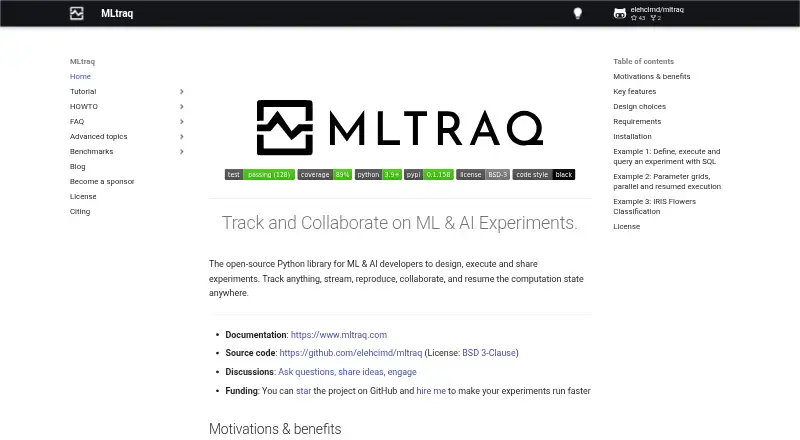
What MLtraq is
MLtraq is an open-source Python library for machine-learning and AI developers to design, execute, track, and share experiments. It supports parameter grids, chained steps, parallel runs, streamed metrics, persisted state, and resuming computation. Experiments can track native Python data and structures as well as NumPy, Pandas, and PyArrow objects. Users can access experiment data through Python, Pandas, and SQL in scripts, Jupyter notebooks, and dashboards. SQLite is the default database, with connections to SQL databases supported by SQLAlchemy also available. Chained execution uses joblib.Parallel with process-based parallelism; Dask, Ray, Spark, and custom cluster-specific backends are named as other options. Experiments can be backed up, merged, shared, and reloaded with computation state. The DataStore interface keeps objects outside the database and uses the filesystem by default. MLtraq is model-agnostic, and arbitrary objects such as model weights and state parameters can be saved and loaded. It is licensed under BSD 3-Clause. Documented requirements include Python 3.9+, SQLAlchemy 2.0+, Pandas 1.5.3+, and Joblib 1.3.2+.
Who it suits
MLtraq may suit Python-based ML and AI developers focused on experimentation, tracking, and sharing computation state. Its FAQ describes MLflow as a possible better fit for users prioritizing MLOps.
What it does well
- Open-source under BSD 3-Clause.
- Supports experiment resumption and run comparison.
- Works with Python, Pandas, and SQL.
- Supports several parallel backends.
- Can track artifacts and model weights.
What to know first
- Requires Python 3.9 or later.
- Documented interfaces may change.
- SQLite is the default database.
- Filesystem is the default object storage.
Verdict
MLtraq offers flexible experiment tracking and data access across Python and SQL workflows. Pin an exact version and verify updates with tests, as its documentation recommends.
Facts from MLtraq's own pages
- Artifact storage
- The FAQ says arbitrary objects, including model weights and state parameters, can be dumped and loaded, with filesystem storage or third-party services and data stores. · mltraq.com, 8 Oct 2026
- Collaboration
- Users can back up, merge, share, and reload experiments with their computation state. · mltraq.com, 8 Oct 2026
- Compatibility caveat
- The documentation says interfaces may change as MLtraq progresses and recommends pinning an exact version and verifying updates with tests. · mltraq.com, 8 Oct 2026
- Database integrations
- The default database is SQLite, and MLtraq can connect to SQL databases supported by SQLAlchemy. · mltraq.com, 8 Oct 2026
- Distribution
- The installation instructions use pip install mltraq --upgrade. · mltraq.com, 8 Oct 2026
- Execution
- It supports experiment runs with parameter grids, chained steps, parallel execution, and resuming from persisted state. · mltraq.com, 8 Oct 2026
- Experiment state
- It can track experiment state, stream metrics, reproduce runs, collaborate, and resume computation. · mltraq.com, 8 Oct 2026
- Interfaces
- Experiments can be accessed with Python, Pandas, and SQL from Python scripts, Jupyter notebooks, and dashboards. · mltraq.com, 8 Oct 2026
- Interoperability
- Experiments can be accessed with Python, Pandas, and SQL using native database types and open formats. · mltraq.com, 8 Oct 2026
- License
- The project is licensed under the BSD 3-Clause License. · mltraq.com, 8 Oct 2026
- Metrics
- Experiments can stream metrics and track native Python data types and structures, as well as NumPy, Pandas, and PyArrow objects. · mltraq.com, 8 Oct 2026
- Model support
- MLtraq is model-agnostic, and its FAQ describes adding a PyTorch model through a scikit-learn-compatible wrapper or a redesigned training step. · mltraq.com, 8 Oct 2026
- Parallel backends
- The documentation names Dask, Ray, Spark, and custom cluster-specific backends as options for computation. · mltraq.com, 8 Oct 2026
- Parallel execution
- Chained execution uses joblib.Parallel with process-based parallelism, and Dask, Ray, Spark, or custom backends can be used. · mltraq.com, 8 Oct 2026
- Purpose
- MLtraq is an open-source Python library for ML and AI developers to design, execute, track, and share experiments. · mltraq.com, 8 Oct 2026
- Requirements
- The documented requirements are Python 3.9+, SQLAlchemy 2.0+, Pandas 1.5.3+, and Joblib 1.3.2+. · mltraq.com, 8 Oct 2026
- Security
- MLtraq's DATAPAK format uses a subset of safe Python Pickle opcodes for listed basic and container types. · mltraq.com, 8 Oct 2026
- Security detail
- The state-storage documentation says its DATAPAK serialization uses only a subset of safe Pickle opcodes for listed basic and container types. · mltraq.com, 8 Oct 2026
- Storage
- The DataStore interface stores objects outside the database and uses the filesystem by default; third-party storage options can be requested through the issue tracker or discussion board. · mltraq.com, 8 Oct 2026
- Support
- The project directs users to GitHub Discussions to ask questions and share ideas. · mltraq.com, 8 Oct 2026
- Supported data
- It supports native Python types and structures, as well as NumPy, Pandas, and PyArrow objects. · mltraq.com, 8 Oct 2026
- Target users
- The FAQ describes MLtraq as a good candidate for experimentation and says MLflow may be a better fit for users prioritizing MLOps. · mltraq.com, 8 Oct 2026
Where MLtraq stands on Freedom251
- ML Experiment Tracking Software#23 of 39
- Experiment Tracking#13 of 22