Freedom251 › Machine Learning Data Catalog Software
OpenML
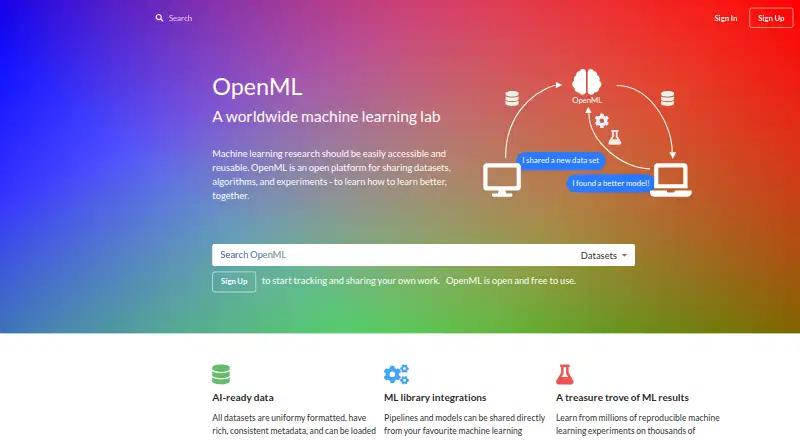
What OpenML is
OpenML is a platform for sharing machine-learning datasets, algorithms, and experiments through the web and an API. Its standardized tasks use fixed evaluation protocols and predefined train/test splits, while experiment records can include the algorithm, hyperparameters, dataset, metrics, and hardware. Datasets are uniformly formatted and versioned. OpenML can track and share pipelines, called flows, and experiment runs automatically, and datasets, flows, and runs can receive DOIs for citation. Its REST API supports uploading and downloading resources through XML and JSON endpoints. Documented integrations include Python with scikit-learn, PyTorch, and TensorFlow, as well as R, Julia, Rust, and .NET. The service is free, with a plan listed as free. Data access does not require an account, but rate limits apply; uploading and managing resources requires an account. API authentication uses a key available in a signed-in user's profile. OpenML lists self-hosted deployment options.
Who it suits
OpenML suits researchers, developers, data scientists, educators, and enthusiasts who share or compare machine-learning work. It is also relevant to users who need versioned datasets, repeatable benchmarks, or citation-ready experiments.
What it does well
- Standardized tasks use fixed evaluation protocols.
- Datasets are uniformly formatted and versioned.
- Automatic tracking covers flows and experiment runs.
- DOIs are available for datasets, flows, and runs.
- REST API offers XML and JSON endpoints.
What to know first
- Unauthenticated data access is rate-limited.
- Uploading and managing resources requires an account.
- API authentication requires a signed-in profile key.
Limits
The free plan is open access, but unauthenticated data access is rate-limited. Uploading and managing resources requires an account, and API use requires a key from a signed-in profile.
Plans
| Plan | Billed and limits | Price |
|---|---|---|
| Free | Open access; account required to upload resources; rate limits apply to unauthenticated data access | Free |
As openml.org lists them, read 4 Oct 2026. The maker's own page has the final word.
Getting started
- Open the OpenML website or API
- Access public data without an account, subject to rate limits
- Create an account to upload or manage resources
- Obtain an API key from the signed-in profile
- Use a listed language integration or REST XML/JSON endpoint
Verdict
OpenML brings datasets, benchmark tasks, experiment tracking, and citation support together for machine-learning work. Consider its account requirement for uploads and rate limits for unauthenticated access when deciding how to use it.
Questions
Is OpenML free?
Yes. The Free plan costs nothing and provides open access.
Do I need an account to use OpenML?
You can access data without an account, subject to rate limits. An account is required to upload and manage resources.
Which integrations are available?
Documentation lists Python with scikit-learn, PyTorch, and TensorFlow, plus R, Julia, Rust, and .NET.
Can OpenML track experiments?
Yes. It tracks algorithms, hyperparameters, datasets, metrics, and hardware, and can share flows and experiment runs.
Does OpenML provide an API?
Yes. Its REST API supports XML and JSON endpoints for uploading and downloading resources, with API authentication using a profile key.
Facts from OpenML's own pages
- Access limit
- Data can be accessed without an account, subject to rate limits; an account is required to upload and manage resources. · docs.openml.org, 4 Oct 2026
- API
- OpenML offers a REST API for uploading and downloading machine learning resources, with XML and JSON endpoints. · docs.openml.org, 4 Oct 2026
- Authentication
- API authentication uses a key available from a signed-in user's profile. · docs.openml.org, 4 Oct 2026
- Benchmarking
- OpenML provides standardized tasks with predefined train/test splits and fixed evaluation protocols. · beta.openml.org, 4 Oct 2026
- Citations
- OpenML supports DOI generation for datasets, flows, and runs so they can be cited. · beta.openml.org, 4 Oct 2026
- Datasets
- OpenML says its datasets are uniformly formatted, versioned, and ready to load. · beta.openml.org, 4 Oct 2026
- Experiment tracking
- OpenML supports automatic tracking and sharing of pipelines, called flows, and experiment runs. · beta.openml.org, 4 Oct 2026
- Integrations
- The documentation lists integrations for Python/scikit-learn, PyTorch, TensorFlow, R, Julia, Rust, and .NET. · docs.openml.org, 4 Oct 2026
- Purpose
- OpenML is an open platform for sharing datasets, algorithms, and experiments for machine learning. · beta.openml.org, 4 Oct 2026
- Reproducibility
- OpenML tracks experiment metadata including algorithms, hyperparameters, datasets, metrics, and hardware. · beta.openml.org, 4 Oct 2026
- Support
- OpenML lists its community discussions and the contact address [email protected]. · beta.openml.org, 4 Oct 2026
- Who it serves
- OpenML describes its community as researchers, developers, data scientists, educators, and enthusiasts. · beta.openml.org, 4 Oct 2026
Where OpenML stands on Freedom251
- Machine Learning Data Catalog Software#4 of 14
- Experiment Tracking#10 of 22
- ML Experiment Tracking Software#21 of 39