Freedom251 › ML Experiment Tracking Software

LUML Flow
What LUML Flow is
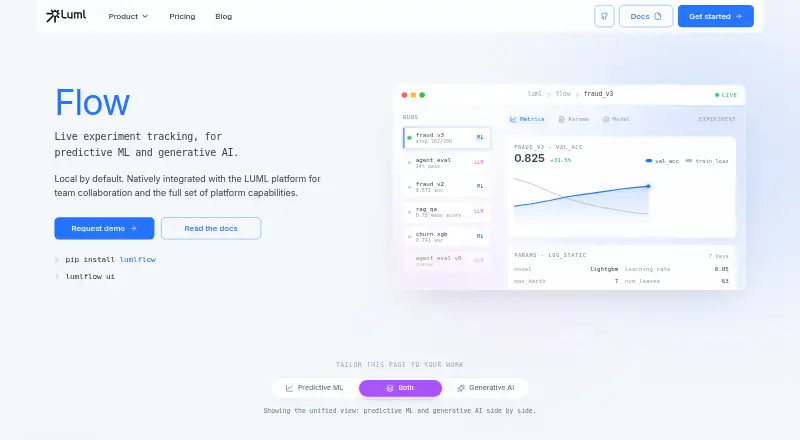
LUML Flow is a live experiment tracker for predictive machine learning and generative AI. It records training parameters, step metrics, model artifacts, AI traces, evaluation samples, and human annotations. Flow runs locally: the `lumlflow ui` command opens a dashboard reading a SQLite store on your machine. You can use it offline indefinitely without an account or telemetry, while a LUML account is needed to upload experiments to a shared workspace. Uploaded models and experiment context become versioned artifacts in the LUML registry for workspace members. Listed integrations include PyTorch, TensorFlow, scikit-learn, XGBoost, LightGBM, CatBoost, JAX, Keras, LangGraph, LangChain, LlamaIndex, and DSPy. OpenAI and Anthropic clients can be traced through OpenTelemetry instrumentors. Experiments may include datasets, plots, prompt files, logs, and evaluation reports. The SDK and UI are publicly available on GitHub. A free Light plan is offered; paid plans start at €79/mo (annual).
Who it suits
It suits machine-learning and generative-AI practitioners who need local experiment logging, artifact tracking, comparisons, or optional team sharing. Teams can upload runs to a shared LUML workspace.
What it does well
- Works offline without an account
- Local experiments stay in SQLite until upload
- Tracks parameters, metrics, artifacts, and traces
- Supports many ML and LLM integrations
- Uploaded runs become versioned registry artifacts
What to know first
- Account required for shared-workspace uploads
- Paid plans start at €79/mo annually
- Local dashboard requires the `lumlflow ui` command
Verdict
Flow combines private local tracking with optional registry sharing and broad framework integrations. Its free local use is distinct from account-based collaboration and paid plan support.
Facts from LUML Flow's own pages
- Account requirement
- Flow can be used indefinitely without signing up; a LUML account is needed to upload experiments to a shared workspace. · luml.ai, 2 Oct 2026
- Attachments
- Experiments can include arbitrary files such as datasets, plots, prompt files, training logs, and evaluation reports. · luml.ai, 3 Oct 2026
- Data handling
- The page says there is no account or telemetry required for local use and experiments remain in the local SQLite store until uploaded. · luml.ai, 2 Oct 2026
- Experiment logging
- Flow logs parameters, step metrics, model artifacts, traces, evaluation samples, and human annotations. · luml.ai, 3 Oct 2026
- Framework integrations
- Flow names scikit-learn, XGBoost, LightGBM, CatBoost, LangGraph, PyTorch, TensorFlow, JAX, and Keras among supported frameworks. · luml.ai, 3 Oct 2026
- Headquarters
- Linz, Austria · luml.ai, 28 Sept 2026
- Integrations
- The page lists PyTorch, LangGraph, XGBoost, scikit-learn, LlamaIndex, TensorFlow, Anthropic, LightGBM, DSPy, JAX, LangChain, and Keras. · luml.ai, 2 Oct 2026
- Intended users
- The page presents Flow for people tracking predictive ML training and generative AI experiments, including teams that want to share runs through LUML. · luml.ai, 2 Oct 2026
- LLM integrations
- Flow says OpenAI, Anthropic, LangChain, LlamaIndex, and DSPy clients can be traced through OpenTelemetry instrumentors. · luml.ai, 3 Oct 2026
- LLM tracing
- Flow routes OpenTelemetry spans into experiment storage and describes instrumentors for OpenAI clients, LangChain, and LangGraph. · luml.ai, 2 Oct 2026
- Local storage
- The local dashboard reads experiment data from a SQLite store on your machine. · luml.ai, 3 Oct 2026
- Local use
- You can install Flow with `pip install lumlflow` and start its dashboard with `lumlflow ui`. · luml.ai, 3 Oct 2026
- Maker identity
- LUML’s legal notice identifies the company as DataForce Solutions GmbH, headquartered in Linz, Austria. · luml.ai, 2 Oct 2026
- Offline use
- Flow can be used offline indefinitely without a LUML account; an account is needed to upload experiments to a shared workspace. · luml.ai, 3 Oct 2026
- Open source
- The Flow SDK and UI are described as available in LUML’s public GitHub repository. · luml.ai, 3 Oct 2026
- Purpose
- Flow is a live experiment tracker for predictive ML and generative AI. · luml.ai, 3 Oct 2026
- Security and privacy
- Flow says it uses no account or telemetry locally and keeps experiments in the local SQLite store until upload. · luml.ai, 3 Oct 2026
- Storage and upload
- Experiments are stored locally in SQLite, and uploaded models and experiment context become versioned artifacts in the LUML registry. · luml.ai, 2 Oct 2026
- Support
- The Flow page links to documentation and offers a request-demo link. · luml.ai, 3 Oct 2026
- Team sharing
- Uploaded experiments become versioned artifacts in the LUML registry, where workspace members can view experiment context. · luml.ai, 3 Oct 2026
- Tracking
- It captures training parameters, step metrics, model artifacts, generative AI traces, evaluation samples, and human annotations. · luml.ai, 2 Oct 2026
Where LUML Flow stands on Freedom251
- ML Experiment Tracking Software#22 of 39