Freedom251 › Python Package Managers
micropipenv
What micropipenv is
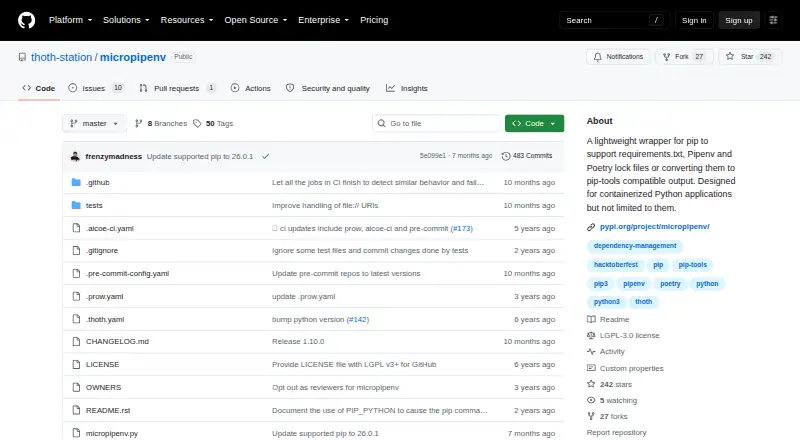
micropipenv is a lightweight wrapper around pip for installing Python dependencies from lock files and requirements files. It supports Pipenv, Poetry, pip-tools, and raw pip requirements.txt inputs. Its requirements command can convert Pipenv and Poetry lock data into output compatible with pip-tools. For Pipenv, Poetry, and pip-tools formats, it can recover automatically when installation order causes a failure. The project is designed for containerized Python applications and also describes use in CI, Kubernetes, and OpenShift. The default installation has no dependencies and supports Pipfile.lock management; the optional toml extra is required to manipulate Pipfile and Poetry-specific files. micropipenv does not resolve dependencies: it uses the resolved dependency stack in the supplied lock file. It also does not create or manage virtual environments, so users must run it inside an activated environment or configure a target Python interpreter. Installation options include PyPI with pip, Fedora with dnf, direct execution of its Python file, and UBI, Fedora, or RHEL-based container images. It is free and licensed under the GNU Lesser General Public License v3 or later.
Who it suits
micropipenv suits developers working with containerized Python applications and teams using CI, Kubernetes, or OpenShift. It is most relevant when dependencies are already resolved in a supported lock file or requirements file.
What it does well
- Supports Pipenv, Poetry, pip-tools, and pip requirements
- Converts Pipenv and Poetry lock data for pip-tools
- Can recover from installation-order failures
- Default installation has no dependencies
- Available free under LGPL v3 or later
What to know first
- Does not implement a dependency resolver
- Does not create or manage virtual environments
- TOML extra is needed for Pipfile and Poetry file manipulation
- Project is described as hibernating
Limits
micropipenv does not resolve dependencies or manage virtual environments. The default installation supports Pipfile.lock management; manipulating Pipfile and Poetry-specific files requires the toml extra.
Plans
| Plan | Billed and limits | Price |
|---|---|---|
| micropipenv | Open source · default install has no dependencies · TOML extra required for Pipfile or Poetry file manipulation | Free |
As github.com lists them, read 8 Oct 2026. The maker's own page has the final word.
Getting started
- Install it from PyPI with pip or through Fedora with dnf.
- Alternatively, run its Python file directly or use a UBI, Fedora or RHEL-based container image.
- Use the appropriate Pipenv, Poetry, pip-tools or requirements.txt input.
- For Pipfile or Poetry file manipulation, install the toml extra.
- For newer Python 3 container images using OpenShift s2i, set ENABLE_MICROPIPENV=1.
Verdict
micropipenv provides a focused way to install dependencies from several existing lock and requirements formats. It relies on a supplied resolved stack and leaves virtual-environment management to the user.
Questions
Is micropipenv free?
Yes. The micropipenv plan is free, and the project is licensed under the GNU Lesser General Public License v3 or later.
Which dependency formats does it support?
It supports Pipenv files, Poetry files, pip-tools requirements files and raw pip requirements.txt files.
Does micropipenv resolve dependencies?
No. It uses the already resolved dependency stack supplied by the lock file.
Does it manage virtual environments?
No. You can run it inside an activated environment or configure a target Python interpreter.
How can I install micropipenv?
Installation routes include PyPI with pip, Fedora with dnf, direct execution of its Python file, and UBI, Fedora or RHEL-based container images.
Who maintains the project?
The repository credits Project Thoth and Red Hat Inc. and names Fridolin Pokorny as the original author.
Facts from micropipenv's own pages
- Dependency recovery
- For Pipenv, Poetry, and pip-tools formats, it can automatically recover when dependency installation order causes a failure. · github.com, 8 Oct 2026
- Environment limitation
- It does not create or manage virtual environments; users can run it inside an activated environment or configure a target Python interpreter. · github.com, 8 Oct 2026
- Install channels
- The project documents installation through PyPI with pip, Fedora with dnf, direct execution of its Python file, and availability in UBI, Fedora, and RHEL based container images. · github.com, 8 Oct 2026
- License
- The repository states that the project is licensed under the GNU Lesser General Public License v3 or later. · github.com, 8 Oct 2026
- Maker context
- The repository credits Project Thoth and Red Hat Inc. and names Fridolin Pokorny as the original author. · github.com, 8 Oct 2026
- OpenShift integration
- For newer Python 3 container images, the README says to set ENABLE_MICROPIPENV=1 to enable micropipenv features in the OpenShift s2i environment. · github.com, 8 Oct 2026
- Optional TOML support
- The default installation has no dependencies and supports Pipfile.lock management; the toml extra enables manipulation of Pipfile and Poetry specific files. · github.com, 8 Oct 2026
- Purpose
- micropipenv is a lightweight pip wrapper for installing Python dependencies from requirements.txt, Pipenv, and Poetry lock files, or converting lock files to pip-tools compatible output. · github.com, 8 Oct 2026
- Requirements conversion
- Its requirements command converts Pipenv and Poetry lock data into output compatible with pip-tools. · github.com, 8 Oct 2026
- Resolver limitation
- micropipenv does not implement a dependency resolver and instead uses the already resolved stack supplied by the lock file. · github.com, 8 Oct 2026
- Security and compliance
- The project pages opened describe licensing and dependency handling but do not state a security certification or compliance program. · github.com, 8 Oct 2026
- Support
- The Thoth Station organization says the project is hibernating and directs people with urgent issues or contribution interest to contact its support repository. · github.com, 8 Oct 2026
- Supported formats
- It supports Pipenv files, Poetry files, pip-tools requirements files, and raw pip requirements.txt files. · github.com, 8 Oct 2026
- Target use
- The project is designed for containerized Python applications and also describes use in CI, Kubernetes, and OpenShift deployments. · github.com, 8 Oct 2026
Where micropipenv stands on Freedom251
- Python Package Managers#10 of 27