Freedom251 › Fund Accounting Software

LineLedger
What LineLedger is
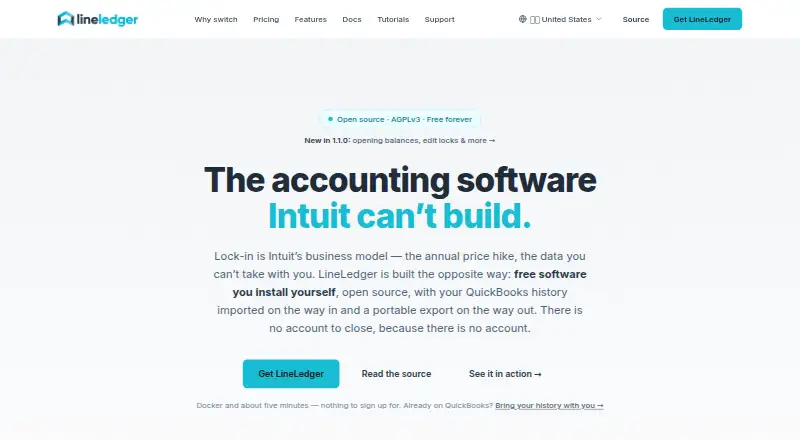
LineLedger is open-source double-entry accounting software that organizations run on infrastructure they control. It covers general ledger work, invoicing, bills and payments, bank reconciliation, financial reports, budgets, inventory, fixed assets, sales-tax tracking, and multiple currencies. Non-profit fund accounting, restricted-fund tracking, and grant tracking are also listed. Organizations can import a QuickBooks chart of accounts and replay general-ledger history from multiple files, with accounts mapped and contacts linked. The customer portal supports Stripe payments, and payroll runs can be posted from Gusto, ADP, Paychex, OnPay, or any US payroll processor. LineLedger includes a REST API and a built-in MCP server with 20 read-only reporting tools; optional agentic writes require human confirmation before posting. Members can use passkeys, two-factor authentication, and section-level roles. Accounting changes enter an append-only, cryptographically chained audit log, and organizations can be exported to ZIP backups. The maker says the software has no telemetry or third-party analytics and does not phone home. The free plan is $0 forever, with unlimited companies, users, and transactions and every feature enabled. The documented quick start uses Docker, Docker Compose, and MySQL, with amd64 and arm64 images.
Who it suits
LineLedger suits sole proprietors, LLCs, partnerships, corporations, and non-profits that want accounting software they can run on their own infrastructure. It is also a fit for organizations needing fund accounting, restricted-fund tracking, or grant tracking alongside general accounting.
What it does well
- Free forever with unlimited companies, users, and transactions
- Includes fund accounting, restricted-fund tracking, and grant tracking
- Imports QuickBooks charts of accounts and multi-file ledger history
- Append-only audit log and portable ZIP backups
- Passkeys, two-factor authentication, and section-level roles
What to know first
- Setup requires Docker and Docker Compose
- Native US payroll, sales-tax filing, and IRS e-file are roadmap items
- The maker says LineLedger is not SOC 2 certified
Plans
| Plan | Billed and limits | Price |
|---|---|---|
| LineLedger | $0 / forever · Unlimited companies, users, and transactions · Unlimited invoices, bills, customers & vendors · Every feature on | Free |
| Free | forever · Unlimited companies, users and transactions · all features included · self-hosted server required · GNU AGPLv3 | Free |
As lineledger.com lists them, read 5 Oct 2026. The maker's own page has the final word.
Getting started
- Use the documented quick start with Docker and Docker Compose
- Run LineLedger with MySQL
- Choose the provided amd64 or arm64 image
- Export an organization to a portable ZIP backup when needed
LineLedger is a free, open-source accounting system for businesses and nonprofits that want to run their books on a server they control. Its mix of full accounting tools and fund tracking makes it an unusually broad option at no software cost, provided your organization can manage self-hosting.
Overview
LineLedger covers the accounting cycle from general-ledger entries through invoicing, bills and payments, bank reconciliation, and financial reports. Budgets, inventory, fixed assets, sales-tax tracking, and multi-currency support extend it beyond a basic ledger. Nonprofits also get fund accounting, restricted-fund tracking, grant tracking, and budgeting.
Organizations run LineLedger on infrastructure they control. The maker says it does not phone home and includes no third-party analytics or telemetry. Accounting changes are recorded in an append-only, cryptographically chained audit log, and organizations can export portable ZIP backups. This gives organizations control over where their accounting system runs, while making its operation their responsibility. LineLedger is not SOC 2 certified; the maker says it does not process users’ accounting data because the software is self-hosted.
Key features
QuickBooks users can import a chart of accounts and replay general-ledger history from multiple files, with account mapping and contact linking. That can help preserve ledger history during a move, though the stated import covers those records rather than promising a full migration of every QuickBooks feature.
The customer portal supports Stripe payments. Payroll runs can be posted to the books from Gusto, ADP, Paychex, OnPay, or any US payroll processor. LineLedger provides a REST API v1 and a built-in MCP server with 20 read-only reporting tools. Agentic writes are opt-in and require human confirmation before posting, a useful boundary for organizations that want reporting access without unattended changes to their books.
Passkeys, two-factor authentication, and section-level role-based access let organizations control how members enter the system and which sections they can use. The audit log adds a record of accounting changes, making the access and change controls relevant for teams that need accountability across users.
Native US payroll, automated sales-tax filing, and IRS e-file are roadmap items. Organizations that need those functions now will need another workflow; sales-tax tracking is included, but automated filing is not.
Pricing
LineLedger: free (billed $0 / forever). The plan includes unlimited companies, users, and transactions, plus unlimited invoices, bills, customers, and vendors, with every feature on. There is no free-trial period to weigh against a later paid tier: the listed plan is free forever. Its unlimited allowances and full feature set suit businesses and nonprofits that want to avoid per-user or transaction caps.
The software fee is not the whole operating picture: LineLedger is self-hosted, and its documented quick start requires Docker and Docker Compose with MySQL. The images support amd64 and arm64. Teams need an environment and capacity to run that stack. Support is self-serve first, through documentation, tutorials, a feature-request board, and a contact option; the maker is not actively soliciting outside issues or contributions.
Platforms
LineLedger is available as a web application, API, and self-hosted software. The quick-start requirements make it a fit for organizations able to administer Docker, Docker Compose, and MySQL; the maker provides images for both amd64 and arm64 systems.
Who it's for
The pricing page names sole proprietors, LLCs, partnerships, and corporations as intended users. For nonprofits, fund accounting, restricted-fund tracking, budgets, financial reports, and grant tracking make LineLedger relevant when an organization needs to distinguish and report on funds. It is most suitable for organizations that value control over their infrastructure and can take responsibility for running it.
Explore our Nonprofit Accounting Software and Fund Accounting Software lists for more options.
Pros and cons
- Pros: The free plan has no listed caps on companies, users, transactions, invoices, bills, customers, or vendors, and turns on every feature.
- Pros: Broad business accounting plus nonprofit fund, restricted-fund, and grant tracking serves more than one kind of organization.
- Pros: Self-hosting, portable ZIP backups, and an append-only chained audit log support data control and traceability.
- Cons: Organizations must operate the self-hosted stack, including Docker, Docker Compose, and MySQL.
- Cons: LineLedger is not SOC 2 certified, which may rule it out for organizations that require that certification.
- Cons: Native US payroll, automated sales-tax filing, and IRS e-file are roadmap items, leaving organizations that need them to use other workflows.
- Cons: Support is self-serve first, and the maker is not actively soliciting external issues or contributions.
Alternatives
For nonprofit budgeting tools, custom charts of accounts, budget forecasting, and Excel export in a mobile and web app, MoneyMinder offers a free edition; its free trial is also an option for evaluating the product.
Grain Ledger may fit teams that want a web-based fund accounting plan with a defined allowance of up to $20k in monthly expenses, one bank connection, three users, unlimited funds, and one active budget at no charge.
Sevastack is another free option for nonprofits, with a plan capped at 50 donors and two projects that includes unlimited 80G receipts, a public donation page, and an NGO directory listing.
Consider Churchsoft Assist 2026 if you want a paid product with a Premier Support Plan priced at $30 a month and unlimited email and toll-free support sessions.
NonProfit+ is a paid alternative with quote-based pricing and unlimited users.
ACS Facility Scheduler is a paid web and Windows option.
Clubtreasurer offers a £7 a year Essentials plan with three user accounts included; membership management is sold separately.
Fund EZ is a paid Windows option with a $295, paid once online training plan, priced per person per class.
Verdict
LineLedger is a strong fit for businesses and nonprofits that want comprehensive accounting, nonprofit fund tools, and unlimited use without a software fee, and have the capacity to run a self-hosted system. Its data control and full feature set are compelling; look elsewhere if your organization requires SOC 2 certification, managed hosting, or native payroll, automated sales-tax filing, or IRS e-file today.
Verdict
Choose LineLedger if you want a free, full-featured accounting system that runs on infrastructure you control, including non-profit fund accounting. It may not suit organizations seeking native US payroll, automated sales-tax filing, or IRS e-file, which are listed as roadmap items.
Questions
How much does LineLedger cost?
The LineLedger plan is $0 forever. It includes unlimited companies, users, and transactions, with every feature on.
Is LineLedger open source?
Yes. LineLedger is open-source software that runs on a server the user controls.
What platforms does it support?
The listed platforms are API, self-hosted, and web.
Can it import QuickBooks data?
It can import a QuickBooks chart of accounts and replay multi-file general-ledger history, mapping accounts and linking contacts.
Does it support non-profit fund accounting?
Yes. Fund accounting, restricted-fund tracking, budgeting, financial reports, and grant tracking are listed.
Is LineLedger SOC 2 certified?
No. LineLedger states that it is not SOC 2 certified.
Facts from LineLedger's own pages
- Access controls
- It supports passkeys, two-factor authentication, and section-level role-based access for organization members. · lineledger.com, 5 Oct 2026
- Accounting features
- It includes a general ledger, invoicing, bills and payments, bank reconciliation, financial reports, budgets, inventory, fixed assets, sales-tax tracking, and multi-currency support. · lineledger.com, 5 Oct 2026
- Accounts payable
- It tracks vendors, bills, payments, vendor credits and printable checks. · lineledger.com, 15 Oct 2026
- Accounts receivable
- It supports customers, invoices, credit memos, receipts and customer statements. · lineledger.com, 15 Oct 2026
- AI features
- Optional AI handles bank-statement imports, receipt OCR, daily insights and Business Q&A over MCP. · lineledger.com, 15 Oct 2026
- API and AI access
- LineLedger offers REST API v1 and a built-in MCP server with 20 read-only reporting tools; agentic writes are opt-in and require human confirmation before posting. · lineledger.com, 5 Oct 2026
- API locking behavior
- API clients must handle HTTP 423 with Retry-After when another user is editing a record. · github.com, 15 Oct 2026
- Audit and backups
- Accounting changes are recorded in an append-only, cryptographically chained audit log, and organizations can be exported to portable ZIP backups. · lineledger.com, 5 Oct 2026
- Audit log
- Accounting mutations are stored in an append-only hash chain that remains verifiable after backup and restore. · lineledger.com, 15 Oct 2026
- Audit trail
- Yes · lineledger.com, 19 Sept 2026
- Authentication
- Passkeys, two-factor authentication and section-level role-based permissions are supported. · lineledger.com, 15 Oct 2026
- Backups
- Organizations can be exported to portable ZIP archives and restored on another installation. · lineledger.com, 15 Oct 2026
- Banking
- Bank registers, statement imports, reconciliation, transfers, deposits and cheque writing are included. · lineledger.com, 15 Oct 2026
- Company founding
- The opened official pages do not state a founding year for Local Foundry Inc. · lineledger.com, 15 Oct 2026
- Company headquarters
- The opened official pages do not state a headquarters location for Local Foundry Inc. · lineledger.com, 15 Oct 2026
- Compliance
- The maker states that LineLedger is not SOC 2 certified and does not process customers’ accounting data. · lineledger.com, 15 Oct 2026
- Customer portal
- Customers can view statements and invoices and pay online through Stripe. · lineledger.com, 15 Oct 2026
- Data handling
- The maker says the software does not phone home and includes no third-party analytics or telemetry; users run it on infrastructure they control. · lineledger.com, 5 Oct 2026
- Data location
- There is no hosted LineLedger service and the maker says installed books never reach its infrastructure. · lineledger.com, 15 Oct 2026
- Documentation
- A public help center covers workflows, administration, self-hosting, upgrades, the REST API and MCP connections. · lineledger.com, 15 Oct 2026
- Fixed assets
- The product maintains fixed-asset registers and depreciation schedules. · lineledger.com, 15 Oct 2026
- Free plan
- Yes · lineledger.com, 19 Sept 2026
- Fund accounting
- Nonprofits can record restricted funds, interfund transfers, grants and donation receipts. · lineledger.com, 15 Oct 2026
- General ledger
- The system provides a chart of accounts, journal entries and a trial balance tied to the general ledger. · lineledger.com, 15 Oct 2026
Where LineLedger stands on Freedom251
- Fund Accounting Software#1 of 70
- Accounting software#1 of 69
- Nonprofit Accounting Software#1 of 25