Freedom251 › AI Image Segmentation Software
LandingLens
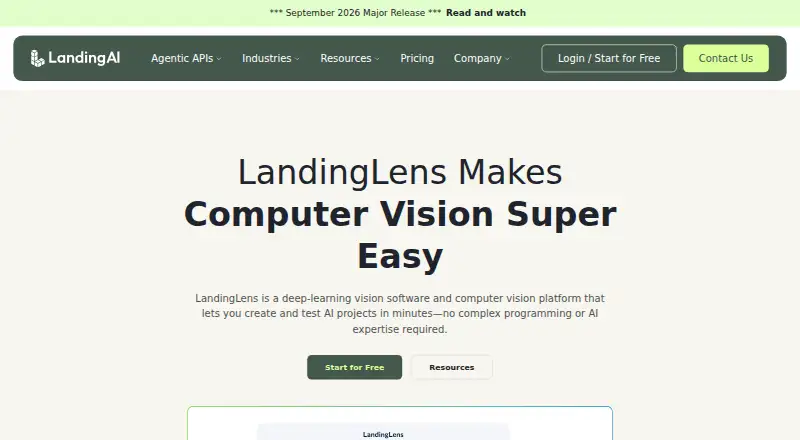
What LandingLens is
LandingLens is a computer vision platform for building, training, and deploying image-based AI models. Users upload and label images, then train a model through a workflow designed for people without complex programming or AI expertise. A label book helps teams align on class definitions, and the labeling technology can detect mislabeled images. Multiple users can label together, while teams can bring data back from deployment for retraining and manage projects across locations.
Deployment choices include cloud and edge options, a Windows App, and a programmatic API. LandingLens is also available as a Snowflake Native App running in a customer’s Snowflake environment, or as a VPC deployment in a customer’s AWS, Azure, or GCP environment on Kubernetes. The Free plan costs nothing and provides 1,000 credits monthly, unlimited projects, three users, and up to 10,000 images per project. Training and inference stop at the credit limit; downloads are limited to one active project and noncommercial use. Enterprise pricing is available by contacting sales. Enterprise includes customer success and commercial model use, with active project downloads starting at five.
Who it suits
LandingLens suits teams creating image classification or object detection models, from a single production line to operations spanning multiple locations and teams. Its collaborative labeling and retraining workflow may fit teams that want to refine models using data from deployment.
What it does well
- Build models through image uploading, labeling, and training
- Label book supports consistent class definitions
- Multiple users can label collaboratively
- Cloud, edge, Windows App, and API deployment
What to know first
- Free plan stops training and inference at 1,000 monthly credits
- Free-plan model downloads limited to one active project
- Free-plan use is noncommercial
- Enterprise pricing requires contacting sales
Limits
The Free plan includes 1,000 credits per month, and training or inference stops when that limit is reached. Model downloads are limited to one active project, with noncommercial use; Enterprise offers commercial model use and active project downloads starting at five.
Plans
| Plan | Billed and limits | Price |
|---|---|---|
| Free | $0 /month · 1,000 credits per month · unlimited projects · 3 users · up to 10k images per project · 1 active project for model downloads; noncommercial use | Free |
| Enterprise | Contact sales for pricing · Custom users · active project downloads starting at 5 · commercial model use · customer success · enterprise security and volume discounts | On request |
As landing.ai lists them, read 4 Oct 2026. The maker's own page has the final word.
Getting started
- Visit the LandingLens website and select Start for Free.
- Upload images to a project and label them.
- Use the labeling workflow to train a model.
- Deploy the model to a cloud or edge environment, through the Windows App, or by API.
- Consider the Snowflake Native App or VPC deployment for those environments.
- Contact sales for Enterprise pricing and commercial model use.
Overview
LandingLens is a computer-vision workspace that takes teams from image annotation to trained models and deployment. It suits organizations building custom vision systems across production lines or locations, especially when several people must label data together. The strongest case is an integrated, low-code workflow; free users face a hard usage ceiling and cannot use downloaded models commercially.
Key features
The workflow covers uploading images, labeling them, training a model, and deploying it. Image classification, object detection, and custom models are supported. One-button training and a visual labeling tool reduce the programming needed to start, although teams still have to define meaningful classes and validate the resulting model.
Annotation controls are a practical strength. A label book gives contributors shared class and label definitions, while the labeling system can flag mislabeled images. Multiple users can annotate collaboratively to reach consensus. These safeguards help distributed teams keep datasets consistent, but they do not decide ambiguous cases for you.
Deployment can run in cloud or edge environments through a Windows App or a programmatic API. Teams can feed data back from deployment and retrain in LandingLens, providing a route for ongoing model improvement. Projects can be managed across locations and teams rather than kept to a single line or site.
Snowflake users can run the Snowflake Native App in their own Snowflake environment, retaining control over data access and retention. LandingLens VPC runs in a customer’s AWS, Azure, or GCP environment on Kubernetes and integrates with LDAP, SAML, and Microsoft Entra ID for single sign-on and centralized user management. LandingAI states that LandingLens offers role-based access control, TLS 1.2-or-higher encryption in transit, AES-256 encryption at rest, SOC 2 Type II compliance, and GDPR compliance. Standard SaaS data is stored in AWS US East (Ohio); SaaS PAYG and subscription data may be used to improve LandingAI services under applicable terms, while enterprise data is used as directed to provide the service.
Pricing
Free
The Free plan costs nothing (billed $0 /month). It includes 1,000 credits per month, unlimited projects, three users, up to 10,000 images per project, and one active project for model downloads. Training or inference stops when the monthly credit allowance is exhausted. Downloaded models are for noncommercial use, so this plan fits learning, prototyping, and internal evaluation rather than a revenue-generating deployment. There is no free trial because the product already offers a free plan.
Enterprise
Enterprise uses custom pricing. It adds custom user counts, active project downloads starting at five, commercial model use under the enterprise agreement, customer success, enterprise security, and volume discounts. It is the appropriate route for production teams that need commercial rights, more download capacity, or managed support; the trade-off is that the price must be negotiated.
Platforms
LandingLens is offered through an API, self-hosted deployments, the web, and Windows. That range covers browser-based work, programmatic integration, Windows edge operation, and customer-controlled infrastructure through VPC or Snowflake deployments.
Who it's for
Choose LandingLens if you need a custom image-classification or object-detection workflow with shared labeling, iterative retraining, and multiple deployment paths. It is particularly suited to organizations scaling from one production line to several locations and teams. It is less suitable when you need unrestricted commercial use on a zero-cost plan, or when a prebuilt recognition API is enough.
Pros and cons
Pros
- End-to-end workflow: Upload, label, train, deploy, and retrain in one platform.
- Better annotation consistency: Label books, mislabeled-image detection, and collaborative labeling support shared datasets.
- Flexible deployment: Cloud, edge, Windows, API, Snowflake Native App, and VPC options accommodate different operational and control requirements.
- Enterprise controls: SSO, role-based access control, encryption, and customer-managed cloud environments support governed deployments.
Cons
- Free usage stops at 1,000 credits: Training and inference halt when the monthly quota is reached.
- Commercial restriction: Free-plan model downloads are noncommercial, ruling out many production uses.
- Limited free downloads: Only one active project can be used for model downloads on Free.
- Enterprise cost is opaque: Production buyers must contact sales, making budgeting harder.
- US SaaS storage: Standard SaaS data resides in AWS US East (Ohio), which may not suit every residency policy.
Alternatives
AI Image Recognition Software is the broader category to explore when you want to compare multiple computer-vision products.
Face++ is a better fit for developers wanting a freemium face-focused API with Android, iOS, web, Windows, and other platform access, plus a free key with API-group QPS limits.
MediaPipe suits teams seeking free, on-device machine-learning solutions and a framework across mobile, desktop, web, and self-hosted environments.
Sighthound AI is an option when a hosted service with a free 24-hour, two-minute allowance or a paid annual Pro plan matches your needs.
Google Cloud Vision API is preferable when you want pay-as-you-go image features through a cloud API, with a monthly tier structure and an initial free allowance.
CompreFace is the alternative for free, open-source, Docker-based deployment with CPU and GPU support.
InsightFace fits research and noncommercial projects needing open-source tooling; commercial model use requires a separate license.
Roboflow is worth considering for a freemium workflow whose free tier includes 10 credits monthly and whose Core plan costs $39 a month.
Amazon Rekognition Content Moderation is the alternative for API-based moderation with a 12-month free tier that includes 60 video-analysis minutes per month.
Verdict
LandingLens is a strong choice for teams that want collaborative labeling, custom model training, and cloud-to-edge deployment in one governed workflow. Its main reason to choose is the path from dataset creation to continuous retraining without demanding extensive AI programming. Look elsewhere if your project needs commercial use within a free plan, exceeds 1,000 monthly credits, or requires a published enterprise price.
Verdict
LandingLens brings image labeling, model training, and several deployment options into one computer vision workflow. Check the Free plan’s credit, download, and noncommercial-use limits against your project needs.
Questions
Is there a free plan?
Yes. The Free plan costs nothing and includes 1,000 monthly credits.
What does the Free plan include?
It includes unlimited projects, three users, up to 10,000 images per project, and one active project for model downloads. Use is noncommercial.
What platforms does LandingLens support?
The listed platforms are API, self-hosted, web, and Windows.
Can teams collaborate on labeling?
Yes. Multiple users can label images collaboratively to build consensus.
Does it integrate with Snowflake?
Yes. Its Snowflake Native App runs in the customer’s Snowflake environment, where the customer controls data access and retention.
How is Enterprise priced?
Enterprise pricing is available by contacting sales. The plan lists custom users, commercial model use, customer success, enterprise security, and volume discounts.
Facts from LandingLens's own pages
- Collaboration
- Multiple users can label images collaboratively to build consensus. · landing.ai, 4 Oct 2026
- Continuous learning
- Users can add data from the deployment environment and retrain their model in LandingLens. · landing.ai, 4 Oct 2026
- Data encryption
- The maker says LandingLens SaaS data is encrypted at rest and in transit. · landing.ai, 4 Oct 2026
- Data quality
- Its label book helps teams align on class and label definitions, and its labeling technology can detect mislabeled images. · landing.ai, 3 Oct 2026
- Data use
- For LandingLens SaaS PAYG and subscription customers, data may be used to improve LandingAI services and products under the applicable terms; enterprise data is used as directed to provide the services. · landing.ai, 3 Oct 2026
- Deployment
- LandingLens offers cloud and edge deployment, with options ranging from a Windows App to a programmatic API. · landing.ai, 4 Oct 2026
- Enterprise download limit
- Enterprise pricing lists active project downloads starting at five; downloaded models may be used commercially under the applicable enterprise agreement. · landing.ai, 4 Oct 2026
- Free access
- The LandingLens product page offers a “Start for Free” option but does not state its price or specify whether this is a free plan or trial. · landing.ai, 3 Oct 2026
- Free plan limit
- The free plan allows up to 1,000 credits monthly, and training or inference stops when that limit is reached. · landing.ai, 4 Oct 2026
- Intended users
- The maker describes LandingLens as a platform that can scale from a single production line to operations across multiple locations and teams. · landing.ai, 4 Oct 2026
- Label quality
- LandingLens provides a label book to align class and label definitions, and its labeling technology automatically detects mislabeled images. · landing.ai, 4 Oct 2026
- No-code model building
- The maker says users can build a computer vision model in minutes using an image-labeling tool and one-button training. · landing.ai, 4 Oct 2026
- No-code workflow
- Users can build a computer vision model by uploading images, labeling them, and training the model. · landing.ai, 3 Oct 2026
- Private deployment
- LandingLens VPC runs in a customer’s AWS, Azure, or GCP cloud environment on Kubernetes infrastructure. · landing.ai, 3 Oct 2026
- Purpose
- LandingLens is a deep-learning computer vision platform for creating and testing AI projects without complex programming or AI expertise. · landing.ai, 4 Oct 2026
- SaaS data location
- The security page says standard LandingLens SaaS data is stored on AWS in the US East (Ohio) region. · landing.ai, 3 Oct 2026
- Scale
- LandingLens supports managing multiple projects across locations and collaborating with other teams. · landing.ai, 3 Oct 2026
- Security
- LandingAI states that it is SOC 2 Type II compliant and GDPR compliant. · landing.ai, 4 Oct 2026
- Security controls
- LandingAI says LandingLens provides SSO and role-based access control, and that data is encrypted in transit using TLS 1.2 or higher and at rest using AES-256. · landing.ai, 3 Oct 2026
- Snowflake
- The security page says the LandingLens Snowflake Native App runs in the customer’s Snowflake environment, where the customer controls data access and retention. · landing.ai, 3 Oct 2026
- Snowflake integration
- LandingLens is available as a Snowflake Native App, where data is stored and processed in the customer's Snowflake account. · landing.ai, 4 Oct 2026
- Support
- The pricing page lists community and in-product support, while customer success is included with Enterprise. · landing.ai, 4 Oct 2026
- Team labeling
- Multiple users can label images collaboratively to build consensus. · landing.ai, 3 Oct 2026
- VPC identity integration
- LandingLens VPC supports external identity services including LDAP, SAML, and Microsoft Entra ID for single sign-on and centralized user management. · landing.ai, 3 Oct 2026
Where LandingLens stands on Freedom251
- AI Image Segmentation Software#2 of 33
- Image Recognition Software#6 of 28
- AI Image Recognition Software#9 of 37