Freedom251 › GPU Overclocking Software
LACT
What LACT is
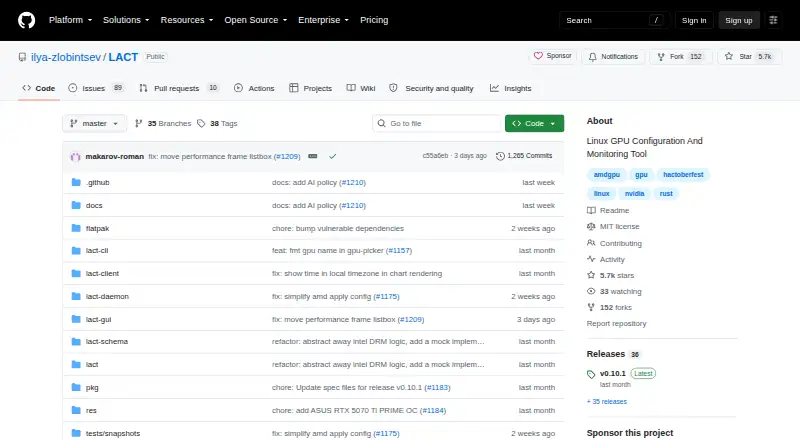
LACT, or Linux GPU Configuration And Monitoring Tool, lets Linux users monitor and configure AMD, Nvidia, and Intel GPUs. It reports hardware details such as VBIOS, VRAM, hardware units, Resizable BAR status, and Vulkan features. Monitoring includes configurable historical charts for power, thermals, and frequency, plus throttling information and CSV export. Available controls include power caps, GPU and VRAM clocks, AMD power states, and custom fan curves on AMD and Nvidia. Undervolting uses voltage offsets on AMD and VF curves on Nvidia. Profiles can activate when specified processes run or gamemode status changes. A system service handles configuration independently of a graphical session and can run headless from a configuration file. LACT also includes an OpenTelemetry metrics exporter and a JSON API over a Unix socket or TCP. The TCP listener is disabled by default, and remote TCP management has no authentication or encryption. Installation options include packages for several Linux distributions, Flatpak, and a Docker service-only setup. Available controls vary by GPU generation, driver, and hardware. LACT is free and MIT-licensed.
Who it suits
LACT suits Linux users who want GPU monitoring and configuration across AMD, Nvidia, or Intel hardware. Its system service and headless mode also suit users who want configuration to run independently of a graphical session.
What it does well
- Monitors GPU details, thermals, power, and frequency.
- Provides fan curves, power caps, and clock settings.
- Profiles can activate based on processes or gamemode.
- Includes an OpenTelemetry metrics exporter.
What to know first
- Available controls vary by GPU, driver, and hardware.
- Remote TCP management has no authentication or encryption.
- Docker installation is service-only.
Limits
Available controls depend on GPU generation, driver, and hardware. The TCP listener is disabled by default; remote TCP management has no authentication or encryption. API configuration changes require confirmation or are reverted after a short period, five seconds by default.
Plans
| Plan | Billed and limits | Price |
|---|---|---|
| LACT | Linux GPU control and monitoring · MIT-licensed | Free |
As github.com lists them, read 4 Oct 2026. The maker's own page has the final word.
Getting started
- Open the LACT project website.
- Choose an installation option for your Linux distribution, or use Flatpak.
- For a service-only installation, the project also lists Docker.
- Run the GPU configuration service; it can operate without a graphical session or headless from a config file.
- Use the available interface or JSON API through a Unix socket; TCP is disabled by default.
Verdict
LACT offers monitoring, tuning controls, profiles, and service-based configuration for Linux GPUs from three vendors. Check hardware-specific control availability, and use remote TCP management only with the stated security limitations in mind.
Questions
How much does LACT cost?
The listed LACT plan is free. LACT is open source under the MIT license.
Which GPUs and operating systems does it support?
LACT documents support for AMD, Nvidia, and Intel GPUs on Linux. Available controls vary by GPU generation, driver, and hardware.
How can I install LACT?
The project lists packages or installation options for Arch, Debian/Ubuntu, Fedora, Gentoo, openSUSE, NixOS, and Solus, as well as Flatpak and Docker service-only installation.
Can LACT be used without a graphical session?
Yes. GPU configuration runs through a system service that does not depend on a graphical session, and the service can run headless from a config file.
Does LACT offer an API?
Yes. Its daemon exposes a JSON API over a Unix socket or TCP. The TCP listener is disabled by default, and remote TCP management has no authentication or encryption.
What happens when an API configuration change needs confirmation?
Changes require confirmation or are automatically reverted after a short period, five seconds by default.
Facts from LACT's own pages
- API
- The daemon exposes a JSON API over a Unix socket or TCP, and the TCP listener is disabled by default for security reasons. · github.com, 4 Oct 2026
- Background service
- GPU configuration runs through a system service that does not depend on a graphical session, and the service can run headless from a config file. · github.com, 4 Oct 2026
- Configuration
- It supports power caps, AMD power states, custom fan curves on AMD and Nvidia, and GPU or VRAM clock configuration. · github.com, 4 Oct 2026
- Configuration safeguard
- API configuration changes require confirmation or are automatically reverted after a short period, five seconds by default. · github.com, 4 Oct 2026
- GPU information
- It reports GPU details such as VBIOS, VRAM, hardware units, Resizable BAR status, and Vulkan features. · github.com, 4 Oct 2026
- Hardware support
- The project documents AMD, Nvidia, and Intel GPU support, with available controls varying by GPU generation, driver, and hardware. · github.com, 4 Oct 2026
- Installation
- The project lists packages or installation options for distributions including Arch, Debian/Ubuntu, Fedora, Gentoo, openSUSE, NixOS, and Solus, plus Flatpak and Docker service-only installation. · github.com, 4 Oct 2026
- Maker
- The repository identifies Ilya Zlobintsev as its owner and describes LACT as a Linux GPU Configuration And Monitoring Tool. · github.com, 4 Oct 2026
- Metrics integration
- LACT includes an OpenTelemetry metrics exporter. · github.com, 4 Oct 2026
- Monitoring
- It provides configurable historical charts for power, thermals, and frequency, throttling information, and CSV export. · github.com, 4 Oct 2026
- Profiles
- Profiles can activate automatically based on running processes or gamemode status. · github.com, 4 Oct 2026
- Purpose
- LACT lets users control AMD, Nvidia, or Intel GPUs on Linux. · github.com, 4 Oct 2026
- Remote management security
- The README says remote TCP management has no authentication or encryption and should be used only on trusted networks or with appropriate firewall rules. · github.com, 4 Oct 2026
- Undervolting
- GPU undervolting is available through voltage offsets on AMD and VF curves on Nvidia. · github.com, 4 Oct 2026
Where LACT stands on Freedom251
- GPU Overclocking Software#6 of 19
- GPU Tuning Software#7 of 16