Freedom251 › Cloud Migration Tools
Konveyor
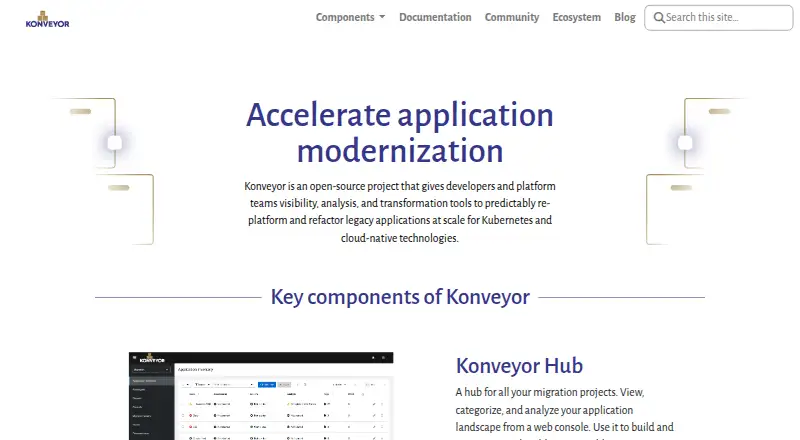
What Konveyor is
Konveyor is an open-source project for developers and platform teams modernizing legacy applications for Kubernetes and cloud-native technologies. Konveyor Hub offers a web console for reviewing and categorizing an application landscape, analyzing applications, and managing migration plans. Its command-line tool, Kantra, performs static code analysis for Go, .Net, Node.js, and Java, and can generate Kubernetes assets.
A questionnaire-based assessment considers modernization suitability and risks, with reports to inform an adoption plan. The analysis module examines source code or binaries and dependencies against predefined or custom rules, then reports issues and effort estimates. Applications for analysis can be retrieved from Git and Subversion repositories and Maven binary repositories. Permissions are divided among Administrator, Architect, and Migrator roles, with administrators managing a secure credential store and architects assigning credentials to applications.
Konveyor AI uses static-analysis context and configurable LLM providers to produce resolutions for detected issues; it can also apply LLM-driven code changes to address Java static-analysis findings. The project provides more than 2,400 analysis rules for Java technologies and supports custom rules. It is self-hosted and can be installed using its Operator on Kubernetes distributions including Minikube. AI setup requires Java 17 or later, Maven 3.9.9 or later, Git, and an LLM API key; enabling the Solution Server requires a 5 Gi RWO persistent volume for its database. The project directs users to community mailing lists and Kubernetes Slack channels for questions.
Who it suits
Konveyor suits developers and platform teams assessing legacy applications and planning or carrying out modernization for Kubernetes and cloud-native environments. It is especially relevant to teams that want source analysis, migration planning, Kubernetes asset generation, or AI-assisted Java code fixes in a self-hosted setup.
What it does well
- Hub provides a web console for application landscape analysis and migration plans.
- Kantra analyzes Go, .Net, Node.js, and Java code.
- Assessment reports cover modernization suitability and risks.
- Supports predefined and custom analysis rules.
- AI can generate resolutions and apply Java code changes.
- Integrates with Git, Subversion, and Maven repositories.
What to know first
- Self-hosted deployment requires a Kubernetes environment.
- AI setup requires Java 17 or later, Maven 3.9.9 or later, Git, and an LLM API key.
- The AI Solution Server requires a 5 Gi RWO persistent volume.
Limits
Enabling the Konveyor AI Solution Server requires a 5 Gi RWO persistent volume for its database. AI setup also requires Java 17 or later, Maven 3.9.9 or later, Git, and an LLM API key.
Getting started
- Visit https://konveyor.io/.
- Install Konveyor with its Operator on a Kubernetes distribution, including Minikube.
- Access the web console and use Hub to review the application landscape and manage migration plans.
- Use Kantra for static analysis or configure repositories for retrieving applications.
- For AI features, prepare Java 17 or later, Maven 3.9.9 or later, Git, an LLM API key, and the required persistent volume.
Verdict
Choose Konveyor if your team needs an open-source toolkit to assess, analyze, and transform legacy applications for Kubernetes, with web, CLI, and optional AI capabilities. It requires self-hosting, and enabling AI brings additional software, API-key, and storage prerequisites.
Questions
Is Konveyor free?
Konveyor is listed as free and open source.
Where can Konveyor be deployed?
It is self-hosted and can be installed with its Operator on Kubernetes distributions, including Minikube.
Which languages does Kantra analyze?
Kantra performs static code analysis for Go, .Net, Node.js, and Java.
Does Konveyor support repository integrations?
It documents integrations with Git and Subversion source repositories and Maven binary repositories for retrieving applications for analysis.
What does Konveyor AI do?
It uses static-analysis context with configurable LLM providers to generate resolutions for detected issues and can apply LLM-driven fixes to Java applications.
What are the AI setup requirements?
The setup guide lists Java 17 or later, Maven 3.9.9 or later, Git, and an LLM API key. The Solution Server also requires a 5 Gi RWO persistent volume for its database.
Facts from Konveyor's own pages
- Access controls
- The documentation describes Administrator, Architect, and Migrator personas with differentiated permissions. · konveyor.io, 9 Oct 2026
- AI code assistance
- Konveyor AI uses retrieval augmented generation with static analysis context to generate code resolutions for detected issues. · konveyor.io, 9 Oct 2026
- AI code fixes
- Konveyor AI applies LLM-driven code changes to resolve issues found through static analysis of Java applications. · konveyor.io, 9 Oct 2026
- AI prerequisites
- The AI setup guide lists Java 17 or later, Maven 3.9.9 or later, Git, and an LLM API key as prerequisites. · konveyor.io, 9 Oct 2026
- AI rules
- The documentation says Konveyor provides more than 2,400 analysis rules for Java technologies and allows custom rules for frameworks or technologies. · konveyor.io, 9 Oct 2026
- AI storage requirement
- Enabling the Konveyor AI Solution Server requires a 5 Gi RWO persistent volume for its database. · konveyor.io, 9 Oct 2026
- Analysis rules
- Konveyor provides more than 2,400 analysis rules for Java technologies, and users can create custom rules. · konveyor.io, 9 Oct 2026
- Application assessment
- Its questionnaire-based assessment evaluates application modernization suitability and risks, with reports that can inform an adoption plan. · konveyor.io, 9 Oct 2026
- CLI
- Kantra performs static code analysis for Go, .Net, Node.js, and Java and can generate Kubernetes assets. · konveyor.io, 9 Oct 2026
- Code analysis
- The analysis module examines application source code or binaries and dependencies against predefined or custom rules, then reports issues and effort estimates. · konveyor.io, 9 Oct 2026
- Community support
- The project directs users to community mailing lists and Kubernetes Slack channels for general and developer questions. · konveyor.io, 9 Oct 2026
- Credential handling
- Konveyor documents a secure store for source control, Maven settings, and proxy credentials, managed by Administrators and assigned by Architects to applications. · konveyor.io, 9 Oct 2026
- Deployment
- Konveyor can be installed with its Operator on Kubernetes distributions including Minikube, and the installation instructions describe accessing a web console. · konveyor.io, 9 Oct 2026
- Editor
- Konveyor AI is available as a Visual Studio Code extension. · konveyor.io, 9 Oct 2026
- Hub
- Konveyor Hub provides a web console to view, categorize, and analyze an application landscape and manage migration plans. · konveyor.io, 9 Oct 2026
- LLM integrations
- Konveyor AI supports configurable LLM providers, with documentation examples for OpenAI, Azure OpenAI, Amazon Bedrock, Google Gemini, Ollama, and OpenShift AI. · konveyor.io, 9 Oct 2026
- Privacy limitation
- Konveyor's privacy statement says information disclosed in its public forums becomes public information. · konveyor.io, 9 Oct 2026
- Project affiliation
- Konveyor is a Cloud Native Computing Foundation sandbox project. · konveyor.io, 9 Oct 2026
- Purpose
- Konveyor is an open-source project that helps developers and platform teams analyze and transform legacy applications for Kubernetes and cloud-native technologies. · konveyor.io, 9 Oct 2026
- Repository integrations
- Konveyor documents integrations with Git and Subversion source repositories and Maven binary repositories for retrieving applications for analysis. · konveyor.io, 9 Oct 2026
- Security
- Konveyor's privacy statement says its website uses SSL to encrypt personal information sent through its Gerrit website. · konveyor.io, 9 Oct 2026
- Solution Server storage
- Enabling the Solution Server requires a 5Gi RWO persistent volume for its database. · konveyor.io, 9 Oct 2026
- What it does
- Konveyor is an open-source project that gives developers and platform teams visibility, analysis, and transformation tools to modernize legacy applications for Kubernetes and cloud-native technologies. · konveyor.io, 9 Oct 2026
Where Konveyor stands on Freedom251
- Cloud Migration Tools#9 of 32
- Code Refactoring Tools#10 of 22