Freedom251 › Data Migration Tools

pgloader
What pgloader is
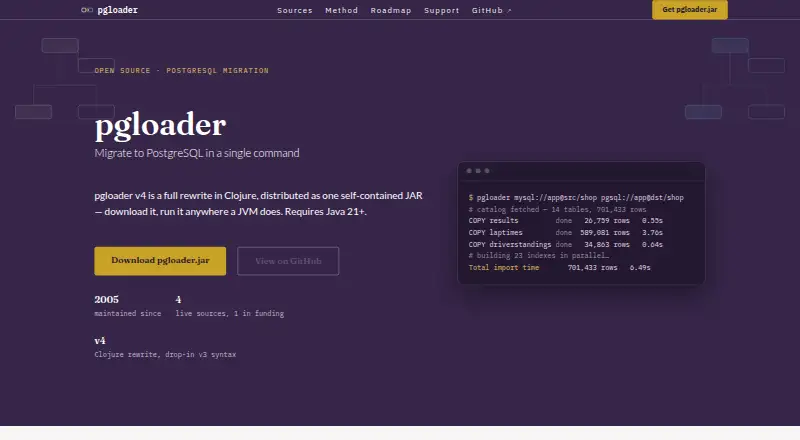
pgloader is a data migration tool for loading databases and flat files into PostgreSQL. It translates schemas, applies casting rules and uses parallel loading across a five-stage process: fetching the source catalog, preparing the target, running parallel COPY, creating indexes in parallel and completing the schema. Listed sources include MySQL, MariaDB, MS SQL Server, SQLite, CSV, fixed-width files and DBF; Oracle support is not built yet. MySQL migrations include enum translation, TINYINT(1)-to-boolean conversion, zero-date handling and credential lookup in .my.cnf. The MS SQL Server path includes Azure AD authentication, sequence migration and multi-column foreign keys. File imports can separate rejected rows after failed COPY transactions so accepted rows can continue loading. Custom casting rules go in a .load file. The stable packaged release is v3 in Common Lisp; v4 is a pre-release JAR requiring Java 21 or later. It runs on Linux and is self-hosted. The free Community tier receives best-effort GitHub help; paid support starts at €100/mo.
Who it suits
pgloader suits teams moving supported database or flat-file data into PostgreSQL, especially those able to run a self-hosted Linux tool. It offers custom casting rules and support tiers for users who need more than best-effort community help.
What it does well
- Supports database and flat-file migration sources.
- Parallel COPY and index creation.
- Custom casting rules in .load files.
- Free Community tier with GitHub support.
What to know first
- Oracle support is not built yet.
- Continuous replication is not supported.
- Version 4 is a pre-release.
- Version 4 requires Java 21 or later.
Limits
The free Community tier is intended for evaluation or non-critical use and provides best-effort help through GitHub. Paid support starts at €100/mo; higher tiers add priority handling and other support benefits.
Plans
| Plan | Billed and limits | Price |
|---|---|---|
| Community | Evaluating or non-critical use · Best-effort support through GitHub | Free |
| Supporter | €100/mo · Priority queue · Answered within a few days | €100 a month |
| Per-Release Sponsor | €10,000/release · Prioritized PRs and features · Credited in release notes · One sponsor per release | €10,000, paid once |
| Sponsor | €2,000/mo · Roadmap input · Development bandwidth reserved | €2,000 a month |
| Fast-Lane | €3,000/issue · One urgent blocker · Guaranteed resolution in the next release · No subscription required | €3,000, paid once |
| Professional | €800/mo · Patches triaged under an SLA · Land in the next release | €800 a month |
As pgloader.io lists them, read 2 Oct 2026. The maker's own page has the final word.
Getting started
- Visit the pgloader website.
- Choose the stable packaged version 3 or the version 4 pre-release, which requires Java 21 or later.
- Run pgloader in a self-hosted Linux environment.
- Set any custom casting rules in a .load file.
- Choose the Community tier or a paid support plan.
Verdict
pgloader covers several common database and file migration paths, with schema translation, parallel loading and custom casting rules. Check the source coverage and release status: v3 is the stable packaged release, while v4 is a pre-release.
Questions
Is pgloader free?
Yes. Its Community plan costs nothing. Paid support plans start at €100/mo.
Which data sources does it support?
The listed sources are MySQL, MariaDB, MS SQL Server, SQLite, CSV, fixed-width files, and DBF. Oracle support is not built yet.
Which platforms does pgloader run on?
It is listed for Linux and self-hosted deployment.
Which release should I use?
Version 3 in Common Lisp is the stable packaged release. Version 4 is a pre-release JAR that requires Java 21 or later.
Who makes pgloader?
Dimitri Fontaine is identified as its author and maintainer since 2005.
What support do the plans include?
Community receives best-effort help through GitHub. Paid plans offer benefits such as priority handling, SLA-triaged patches, roadmap input, or urgent issue support.
Facts from pgloader's own pages
- Custom rules
- Custom casting rules can be specified in a .load file. · pgloader.io, 2 Oct 2026
- File imports
- For file sources, failed COPY transactions are retried by separating rejected rows while allowing accepted rows to load. · pgloader.io, 2 Oct 2026
- Founded
- 2005 · pgloader.io, 28 Sept 2026
- Limits
- The roadmap says pgloader works from catalog representations and does not currently parse SQL object definitions; view definitions and stored procedures would require SQL translation support. · pgloader.io, 2 Oct 2026
- Maker
- The maker identifies Dimitri Fontaine as pgloader’s author and maintainer since 2005. · pgloader.io, 2 Oct 2026
- Migration sources
- The site lists MySQL, MariaDB, MS SQL Server, SQLite, CSV, fixed-width, and DBF sources; Oracle support is not built yet. · pgloader.io, 2 Oct 2026
- MySQL features
- The MySQL path includes enum-to-type translation, TINYINT(1)-to-boolean conversion, zero-date handling, and .my.cnf credential lookup. · pgloader.io, 2 Oct 2026
- Pipeline
- Its five stages are catalog fetch, target preparation, parallel COPY, parallel index creation, and schema completion. · pgloader.io, 2 Oct 2026
- Purpose
- pgloader migrates data into PostgreSQL from databases and flat files using schema translation, casting rules, and parallel loading. · pgloader.io, 2 Oct 2026
- Runtime
- Version 4 is distributed as a self-contained JAR and requires Java 21 or later. · pgloader.io, 2 Oct 2026
- Security
- The site mentions Azure AD authentication for MS SQL Server but does not state security certifications or compliance attestations. · pgloader.io, 2 Oct 2026
- SQL Server features
- The MS SQL Server path includes Azure AD authentication, sequence migration, and multi-column foreign key support. · pgloader.io, 2 Oct 2026
- Support
- The free Community tier receives best-effort help through GitHub, while paid tiers offer priority handling and related support benefits. · pgloader.io, 2 Oct 2026
- Version status
- The site describes v4 as a pre-release and v3 in Common Lisp as the stable, packaged release. · pgloader.io, 2 Oct 2026
Where pgloader stands on Freedom251
- Data Migration Tools#7 of 25
- Cloud Migration Tools#10 of 32