Freedom251 › Auto Scaling Software
Knative
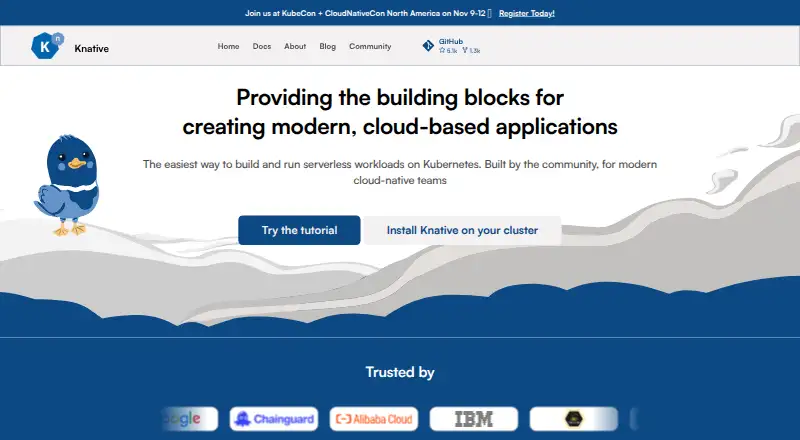
What Knative is
Knative is open-source Kubernetes middleware for building, deploying, and managing serverless workloads. Its Serving component handles deployment, routing, and automatic scaling for stateless HTTP services, including scaling to zero when idle and scaling up in response to traffic. Serving also supports blue-green deployments, canary releases, and traffic splitting between revisions. Knative Eventing routes asynchronous events using CloudEvents over HTTP, while Knative Functions provides a framework for deploying stateless functions as containers. Installation options include a local quickstart or production installation on an existing Kubernetes cluster using YAML or the Knative Operator. The installation guide lists Linux, macOS, and Windows. Knative runs on Kubernetes across cloud providers and on-premises environments, with networking integrations including Istio, Contour, and Gateway API, and messaging integrations including Kafka, RabbitMQ, and NATS. The open-source project plan is free and requires a Kubernetes-based, self-managed installation. Knative relies on Kubernetes security capabilities such as RBAC and namespace isolation; its threat model recommends securing the routing and event transport components in use.
Who it suits
Knative suits teams building and operating serverless workloads on Kubernetes, including those who need HTTP services, event routing, or containerized functions. It is also relevant to teams deploying on cloud-provider or on-premises Kubernetes clusters.
What it does well
- Scales stateless HTTP services down to zero
- Supports canary releases and traffic splitting
- Routes events using CloudEvents over HTTP
- Runs on cloud and on-premises Kubernetes
- Free, open-source project
What to know first
- Requires Kubernetes-based, self-managed installation
- Alpha features may change incompatibly or be dropped
- Security depends partly on routing and event transport components
Plans
| Plan | Billed and limits | Price |
|---|---|---|
| Knative (open-source project) | Kubernetes-based · self-managed installation | Free |
As knative.dev lists them, read 4 Oct 2026. The maker's own page has the final word.
Getting started
- Visit https://knative.dev/.
- Choose the local quickstart or production installation on an existing Kubernetes cluster.
- Install using YAML or the Knative Operator.
- Use a supported installation platform: Linux, macOS, or Windows.
Knative is open-source Kubernetes middleware for running serverless services, events, and functions. It best fits teams already operating Kubernetes that need portable deployment and fine-grained traffic control. Choose it for Kubernetes-native flexibility; look elsewhere if you want a fully managed serverless platform.
Overview
Knative combines three areas. Serving deploys and routes stateless HTTP services, Eventing moves asynchronous CloudEvents over HTTP, and Functions packages stateless functions as containers. The components share a Kubernetes foundation, so workloads can run across cloud providers and on-premises clusters.
That portability is useful for organizations standardizing on Kubernetes or avoiding dependence on one cloud. It also means responsibility for the cluster remains with you. Knative's quickstart supports local installation, while production installation targets an existing Kubernetes cluster through YAML or the Knative Operator.
Key features
Serving and autoscaling
Serving covers service deployment, routing, and automatic scaling for stateless HTTP workloads. It can scale a service to zero when idle and bring it back when requests arrive, which suits intermittent workloads and can reduce idle resource use. The operational cost is the Kubernetes environment that must remain healthy around those services.
Traffic management
Blue-green deployments, canary releases, and traffic splitting between revisions give release teams practical ways to stage changes and limit exposure. These controls are a strong fit for teams that need progressive rollouts without changing platforms. They are less useful if your deployments are simple and you do not need revision-level routing.
Events and functions
Eventing provides asynchronous routing with CloudEvents over HTTP, making it suitable for decoupled producers and consumers. Functions supplies a container-based framework for stateless functions, with runtime support for Node.js, Python, Go, Quarkus, Rust, Spring Boot, and TypeScript. The function model is useful when you want familiar application runtimes while retaining container packaging.
Integrations and security
Installation guidance covers networking integrations such as Istio, Contour, and Gateway API, plus messaging systems including Kafka, RabbitMQ, and NATS. You choose and secure those routing and transport components; Knative relies on Kubernetes capabilities such as RBAC and namespace isolation. Project images and CLI binaries are signed, with an SBOM and SLSA provenance statement. Vulnerability reports go to a private security email list and are investigated by community volunteers.
Custom domains and preview deployments are supported. Alpha features may contain bugs, change incompatibly, or disappear, so they belong only in short-lived testing clusters rather than critical production systems.
Pricing
Knative (open-source project) — free. This is a Kubernetes-based, self-managed installation under a free, open-source model. There are no per-seat or usage charges stated, but the plan does not remove the cost and operational work of running Kubernetes, networking, and messaging infrastructure. Commercial products are offered separately by vendors, whose support terms you should assess individually.
Platforms
The installation guide supports Linux, macOS, and Windows, with CLI-based deployment. Knative runs on self-hosted Kubernetes clusters in cloud or on-premises environments and exposes an API. Its request-based execution model, custom domains, and preview deployments align with teams managing containerized web services.
Who it's for
Knative is for platform and application teams committed to Kubernetes that need scale-to-zero HTTP services, controlled revision traffic, event routing, or containerized functions. It is particularly suitable where portability between cloud and on-premises clusters matters, or where existing Istio, Gateway API, Kafka, RabbitMQ, or NATS investments can be reused.
It is a poor fit for a team that wants a provider to operate the control plane, networking, and event transport. Organizations unwilling to maintain Kubernetes security boundaries should also avoid treating Knative as a turnkey serverless service.
Pros and cons
- Pros: Scale-to-zero and request-driven scale suit sporadic HTTP workloads.
- Pros: Blue-green, canary, and revision traffic splitting support measured releases.
- Pros: Serving, Eventing, and Functions cover services, asynchronous events, and containerized functions in one Kubernetes-native stack.
- Pros: Cloud and on-premises portability reduces dependence on one infrastructure provider.
- Cons: Self-managed Kubernetes leaves cluster operations and associated infrastructure with your team.
- Cons: Security depends on correctly securing selected routing and event transport components.
- Cons: Alpha features are unsuitable for long-lived production clusters because they can break or be removed.
Alternatives
Choose Argo Rollouts instead when progressive delivery is the priority: its free, open-source Kubernetes controller and CRDs focus on rollout management rather than Knative's broader serving, eventing, and functions scope.
KubeVela is another free, open-source self-hosted Kubernetes control plane for teams seeking an application delivery platform.
Pick Northflank when a freemium platform with a web/API experience and a Sandbox allowance of two services, one database, and two cron jobs is preferable to assembling self-managed middleware.
Plural suits teams wanting a managed platform trial: its Sandbox includes essential components for 14 days, with a paid Pro tier listed at 450.
Use AWS CodeDeploy for AWS-oriented deployment automation; EC2 deployments have no additional CodeDeploy charge, while on-premises updates cost $0.02 per instance update.
Octopus Deploy is the alternative when release orchestration across managed targets is the main need, with paid machine and tenant add-ons.
PipeCD offers a free Apache 2.0 open-source delivery option. Weave GitOps is the choice for Flux-based GitOps on Kubernetes, with an open-source edition and a separate enterprise offering.
See the Progressive Delivery Software list for more rollout-focused options.
Verdict
Knative is a strong choice for Kubernetes teams that want scale-to-zero services, revision-aware traffic control, event routing, and functions without giving up cluster portability. Its decisive drawback is the self-managed operating burden, so teams seeking managed serverless infrastructure should choose a provider-run alternative instead.
Verdict
Knative brings service scaling, traffic management, event routing, and functions together for Kubernetes workloads. Teams should account for the self-managed Kubernetes requirement and treat alpha features as suitable only for short-lived testing clusters.
Questions
How much does Knative cost?
The listed open-source plan costs nothing.
Is Knative open source?
Yes. Knative is listed as an open-source project.
Which platforms are supported for installation?
The installation guide lists Linux, macOS, and Windows.
What are the deployment options?
The guide describes a local quickstart and production installation on an existing Kubernetes cluster using YAML or the Knative Operator.
Which integrations are listed?
Networking options include Istio, Contour, and Gateway API. Messaging options include Kafka, RabbitMQ, and NATS.
Who released the project?
A Knative project release post says Google released it in July 2018 in partnership with VMware, IBM, Red Hat, and SAP.
Facts from Knative's own pages
- Autoscaling
- Serving can scale services from zero in response to incoming traffic and scale them back down when idle. · knative.dev, 4 Oct 2026
- Commercial offerings
- Knative lists commercial products from vendors separately and advises users to check with each vendor about what it supports. · knative.dev, 4 Oct 2026
- Deployment options
- The installation guide describes local quickstart and production installation on an existing Kubernetes cluster using YAML or the Knative Operator. · knative.dev, 4 Oct 2026
- Eventing
- Knative Eventing provides asynchronous event routing using CloudEvents over HTTP. · knative.dev, 4 Oct 2026
- Feature maturity
- The feature documentation says alpha features may contain bugs, change incompatibly, or be dropped without notice, and recommends them only for short-lived testing clusters. · knative.dev, 4 Oct 2026
- Functions
- Knative Functions provides a framework for building and deploying stateless functions as containers. · knative.dev, 4 Oct 2026
- Integrations
- Installation documentation lists networking integrations including Istio, Contour, and Gateway API, and messaging integrations including Kafka, RabbitMQ, and NATS. · knative.dev, 4 Oct 2026
- Portability
- Knative runs on Kubernetes clusters across cloud providers and on-premises environments. · knative.dev, 4 Oct 2026
- Project origin
- A Knative project release post states that Google released the project in July 2018 in partnership with VMware, IBM, Red Hat, and SAP. · knative.dev, 4 Oct 2026
- Purpose
- Knative provides Kubernetes middleware for building, deploying, and managing serverless workloads. · knative.dev, 4 Oct 2026
- Security artifacts
- The threat model says Knative signs project container images and CLI binaries and supplies an SBOM and SLSA provenance statement. · knative.dev, 4 Oct 2026
- Security model
- Knative relies on Kubernetes security capabilities, including RBAC and namespace isolation, and its threat model recommends securing the chosen routing and event transport components. · knative.dev, 4 Oct 2026
- Security reporting
- The project asks vulnerability reporters to contact its private security email list, and says reports are investigated by community volunteers. · knative.dev, 4 Oct 2026
- Serving
- Knative Serving manages stateless HTTP services, including deployment, routing, and automatic scaling. · knative.dev, 4 Oct 2026
- Supported install platforms
- The installation guide lists Linux, macOS, and Windows as supported platforms. · knative.dev, 4 Oct 2026
- Traffic management
- Serving supports blue-green deployments, canary releases, and traffic splitting between revisions. · knative.dev, 4 Oct 2026
Where Knative stands on Freedom251
- Auto Scaling Software#3 of 24
- Serverless Platforms#8 of 29
- Progressive Delivery Software#9 of 29