Freedom251 › Kubernetes Cost Management Software
Klustercost
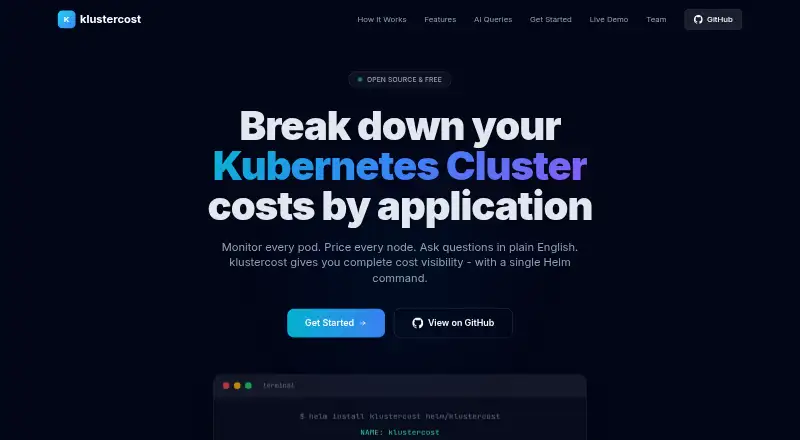
What Klustercost is
Klustercost provides Kubernetes cost visibility by application, with allocation at the workload level. Its Go-based observers use Kubernetes informers and Prometheus to track pods, nodes and namespaces in real time. Pod and node data is persisted to PostgreSQL every 10 minutes, while nodes are enriched with hourly virtual-machine costs from Azure retail pricing APIs. Users can submit plain-English questions and receive natural-language answers alongside structured JSON; the site describes these queries as read-only. Access options include WhatsApp, Teams, Slack, Power BI, an HTTP API and MCP protocol. A Helm chart deploys the monitor, pricing service, database and optional AI layer. The project is open source under GPL-3.0 and has a free plan. Installation requires a running Kubernetes cluster, Helm 3.x, reachable Prometheus, Metrics Server and a StorageClass. Azure cost enrichment is supported, while AWS and GCP support are planned. Natural-language queries through the MCP assistant require an OpenAI API key.
Who it suits
Klustercost suits teams that need Kubernetes cost visibility by workload and use Azure pricing data. It also suits teams prepared to meet its listed cluster and monitoring prerequisites.
What it does well
- Tracks pods, nodes and namespaces in real time.
- Provides workload-level cost visibility.
- Offers several chat, reporting and API access options.
- Open source under GPL-3.0.
What to know first
- AWS and GCP support are planned.
- MCP assistant queries require an OpenAI API key.
- Installation requires Kubernetes, Helm, Prometheus and Metrics Server.
Limits
The free Open source plan costs nothing and is licensed under GPL-3.0. Azure cost enrichment is supported, while AWS and GCP support are planned; MCP assistant natural-language queries require an OpenAI API key.
Plans
| Plan | Billed and limits | Price |
|---|---|---|
| Open source | Open source under GPL-3.0 License | Free |
As klustercost.cloud lists them, read 4 Oct 2026. The maker's own page has the final word.
Getting started
- Open the Klustercost website.
- Prepare a running Kubernetes cluster, Helm 3.x, reachable Prometheus, Metrics Server, and a StorageClass.
- Use the Helm chart to deploy the monitor, pricing service, database, and optional AI layer.
- Provide an OpenAI API key if you want natural-language queries through the MCP assistant.
Klustercost is a free, GPL-3.0 open-source service for allocating Kubernetes costs by workload. It fits teams willing to operate a self-hosted Kubernetes stack, especially on Azure. The strongest case is application-level cost visibility with optional read-only natural-language queries; teams on AWS or GCP will find its current pricing coverage incomplete.
Overview
Klustercost combines real-time cluster observation, a pricing service, PostgreSQL storage and an optional AI layer in one Helm deployment. Its allocation granularity is the workload, so costs can be related to applications instead of presented only as a cluster total. That focus is useful for engineering and platform groups that need ownership-oriented reporting without buying a hosted subscription.
The trade-off is operational responsibility. Installation assumes a running Kubernetes cluster, Helm 3.x, reachable Prometheus and Metrics Server instances, plus a StorageClass. This is a practical fit for Kubernetes operators, not for a team seeking a turnkey SaaS dashboard.
Key features
Go-based observers use Kubernetes informers and Prometheus to follow pods, nodes and namespaces in real time. Pod and node data is persisted to PostgreSQL every 10 minutes, providing a regular historical record for cost analysis while leaving the system less granular than an event-by-event ledger.
Nodes receive hourly virtual-machine prices from Azure retail pricing APIs. Azure users therefore get infrastructure-rate context alongside workload allocation. AWS and GCP enrichment are planned rather than supported now, so multi-cloud teams cannot treat the current pricing view as uniform across providers.
Natural-language questions become plain-language answers and structured JSON. Queries are described as read-only, which suits reporting and investigation where changing cluster state would be unacceptable. Results can be reached through WhatsApp, Teams, Slack, Power BI, an HTTP API and the MCP protocol. The MCP assistant requires an OpenAI API key, so that route adds an external credential and dependency.
The Helm chart deploys the monitor, pricing service, database and optional AI layer together. That packaging simplifies assembling the components, but the underlying prerequisites still make this a platform-managed deployment rather than a plug-in for an existing billing portal.
Pricing
The Open source plan costs 0.00 USD per free. It is open source under the GPL-3.0 License, with no paid tier or seat quota stated. The zero price is compelling for teams that can supply their own Kubernetes, database and observability infrastructure. It does not remove the engineering work of installation, upgrades or operations, and the GPL-3.0 terms matter if you plan to distribute modified software.
Platforms
Klustercost is offered through an API, a self-hosted deployment and the web. Its installation prerequisites center on Kubernetes, Helm, Prometheus, Metrics Server and persistent storage, making those platforms most relevant to organizations already running that stack.
Who it's for
Choose Klustercost if you run Kubernetes on Azure and want workload-level cost attribution, open-source control and several reporting or chat interfaces. It is also a sensible choice for platform teams that value read-only queries and can manage Helm-based services.
Look elsewhere if you need AWS or GCP pricing enrichment today, a managed service with minimal infrastructure work, or a narrowly scoped free tier with explicit resource limits and vendor support.
Pros and cons
Pros
- Free and open source: the GPL-3.0 release avoids subscription charges and permits self-managed deployment.
- Workload allocation: application-oriented costs are more actionable for ownership and chargeback discussions than an undivided cluster figure.
- Azure hourly pricing: retail VM rates add concrete infrastructure context for Azure clusters.
- Multiple access paths: chat tools, Power BI, HTTP API and MCP can fit existing reporting workflows.
- Read-only AI queries: natural-language exploration is designed without write access to the cluster.
Cons
- Azure-only enrichment today: AWS and GCP users lack equivalent current pricing coverage.
- Self-hosting burden: Kubernetes, Helm, Prometheus, Metrics Server and a StorageClass are required before deployment.
- Ten-minute persistence interval: PostgreSQL updates are periodic rather than a record of every instantaneous change.
- AI credential requirement: MCP natural-language access needs an OpenAI API key.
- GPL-3.0 obligations: redistribution plans must account for the project’s copyleft license.
Alternatives
The broader Kubernetes Cost Management Software list is useful when you want to compare more tools. Atmosly Kubernetes Cost Optimization suits a small personal setup: its free plan is billed $0 forever for one cluster, one cloud account, one seat, one project, two environments and ten applications, with cost recommendations view.
KubeAdapt is the better fit when a first 100 vCPU are covered at no cost, all features are included and email support matters; paid startup pricing is $0.60. Choose Krossboard if its freemium offering and API, self-hosted and web platforms match your needs.
OpenCost is a straightforward alternative for open-source Apache 2.0 deployment with Kubernetes and Prometheus. PerfectScale fits teams wanting up to 200 vCPU per month free across unlimited clusters, nodes and pods, with an expert plan priced by quote. CloudBolt is preferable when a broader cloud-management platform with up to 100 resources forever is the priority.
KubeLedger offers free internal use with source code, but it cannot be sold as a managed service. Podledger is an option for a forever-free, self-hosted single-cloud community plan with basic dashboards and pod-level visibility.
Verdict
Klustercost is a strong choice for Azure-focused Kubernetes teams that want free, open-source workload costing and read-only query access under their own control. Its main reason to choose it is the combination of application-level allocation and Azure hourly pricing without a subscription. Its main reason to look elsewhere is equally clear: AWS and GCP enrichment is not available yet, and operating the required Kubernetes-based stack remains your responsibility.
Verdict
Klustercost combines Kubernetes monitoring with Azure hourly cost enrichment and read-only AI queries. Its current cost enrichment supports Azure; AWS and GCP support are still planned.
Questions
How much does Klustercost cost?
The Open source plan is free.
Is Klustercost open source?
Yes. The project is open source under the GPL-3.0 License.
Which platforms does Klustercost support?
Its listed platforms are API, self-hosted, and web.
Which cloud providers have cost enrichment?
Azure cost enrichment is supported. AWS and GCP support are planned.
What does installation require?
The listed prerequisites are a running Kubernetes cluster, Helm 3.x, reachable Prometheus, Metrics Server, and a StorageClass.
Do MCP natural-language queries need an API key?
Yes. The MCP assistant requires an OpenAI API key for natural-language queries.
Facts from Klustercost's own pages
- Cluster compatibility
- The repository says Azure cost enrichment is supported, while AWS and GCP support are planned. · github.com, 4 Oct 2026
- Data storage
- Pod and node data is persisted in PostgreSQL every 10 minutes. · klustercost.cloud, 4 Oct 2026
- Deployment
- A Helm chart deploys the monitor, pricing service, database, and optional AI layer. · klustercost.cloud, 4 Oct 2026
- Integrations
- The site lists WhatsApp, Teams, Slack, Power BI, HTTP API, and MCP protocol access. · klustercost.cloud, 4 Oct 2026
- License
- The project is open source under the GPL-3.0 License. · klustercost.cloud, 4 Oct 2026
- Monitoring
- Go-based observers use Kubernetes informers and Prometheus to track pods, nodes, and namespaces in real time. · klustercost.cloud, 4 Oct 2026
- Optional AI requirement
- The repository says natural-language queries through the MCP assistant require an OpenAI API key. · github.com, 4 Oct 2026
- Prerequisites
- The repository lists a running Kubernetes cluster, Helm 3.x, reachable Prometheus, Metrics Server, and a StorageClass among installation prerequisites. · github.com, 4 Oct 2026
- Pricing data
- Nodes are enriched with hourly VM costs from Azure retail pricing APIs. · klustercost.cloud, 4 Oct 2026
- Purpose
- Klustercost provides Kubernetes cost visibility by application, monitoring pods and pricing nodes. · klustercost.cloud, 4 Oct 2026
- Queries
- AI translates plain-English questions into natural-language answers and structured JSON. · klustercost.cloud, 4 Oct 2026
- Query safety
- The site describes AI queries as read-only. · klustercost.cloud, 4 Oct 2026