Freedom251 › Data Science Platforms
KEEL
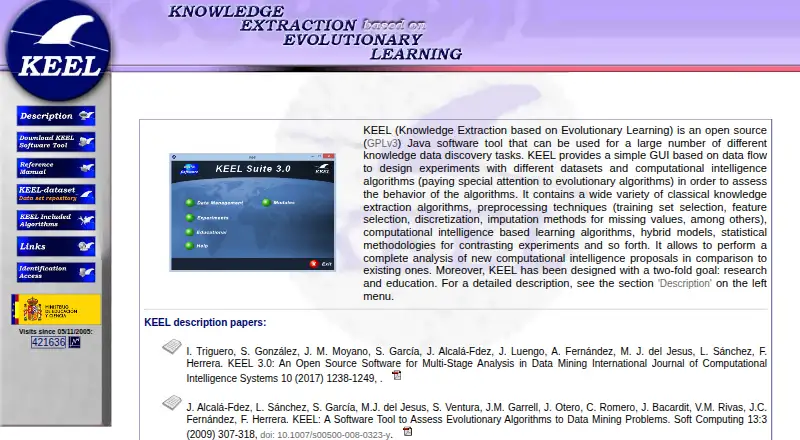
What KEEL is
KEEL is a free Java suite for data mining, designed for research and education. It covers regression, classification, clustering, and pattern mining, with a listed catalog of 518 algorithms. Preprocessing tools include transformation, discretization, instance and feature selection, and noise filtering. Its graphical interface lets users set up experiments using multiple datasets and algorithms, then generates files for offline execution on a machine with a Java Virtual Machine. KEEL also includes a statistical library with parametric and nonparametric tests for comparing results, along with modules for imbalanced and semi-supervised learning, nonparametric statistical analysis, and multiple instance learning. It can convert CSV, ARFF, and plain-text datasets into KEEL format. The download includes a basic dataset package and links to a repository with more than 600 datasets. KEEL is open source under GPLv3. Its release 3.0 download offers source code and a binary; the reference manual says Java 1.7 or later should run the interface and algorithms.
Who it suits
KEEL suits researchers and educators working with data mining experiments and algorithm comparisons. It is also relevant to users who want preprocessing tools and multiple learning modules in a Java suite.
What it does well
- Covers regression, classification, clustering, and pattern mining.
- Lists 518 algorithms.
- Includes parametric and nonparametric comparison tests.
- Converts CSV, ARFF, and plain text datasets.
- Open source under GPLv3.
What to know first
- Requires a Java Virtual Machine.
- The listed binary is release 3.0 dated 2018-04-09.
- Experiments are generated for offline execution.
Plans
| Plan | Billed and limits | Price |
|---|---|---|
| KEEL | Free software under GPLv3 | Free |
As sci2s.ugr.es lists them, read 5 Oct 2026. The maker's own page has the final word.
Getting started
- Visit the KEEL website and open its download page.
- Choose the source code or binary version for release 3.0.
- Install or use a Java Virtual Machine version 1.7 or later.
- Run KEEL on Linux, macOS, or Windows.
- Import data from CSV, ARFF, or plain text, or use the included dataset package.
KEEL is a free, GPLv3 Java suite for data-mining research and teaching. It suits users who need a large algorithm library, repeatable offline experiments, and built-in statistical comparisons rather than a hosted notebook. The main trade-off is a local, Java-dependent workflow, with the downloadable 3.0 release dated 2018.
Overview
KEEL brings regression, classification, clustering, and pattern mining into one desktop-oriented environment. Its research-and-education focus is clear: the package combines data preparation, experiment construction, algorithm execution, and statistical evaluation instead of concentrating on a single modeling task. That makes it a sensible choice for coursework, comparative studies, and researchers who want to run controlled experiments on their own machines.
It is less suitable for teams expecting browser-based collaboration, managed compute, or a continuously updated cloud service. KEEL is self-hosted, requires a Java Virtual Machine, and its listed binary and source release is version 3.0 from 2018.
Key features
The project lists 518 algorithms, including preprocessing and classification methods, across its mining tasks. That breadth is valuable when a study needs to compare many approaches in a consistent framework, although it also means the suite is oriented toward methodical experimentation rather than a minimal, task-specific tool.
Preprocessing covers transformation, discretization, instance selection, feature selection, and noise filtering. KEEL can convert CSV, ARFF, and plain-text files into its own dataset format, allowing common sources to enter the workflow while keeping subsequent work in KEEL’s representation. A basic dataset package is included, and a linked repository contains more than 600 datasets, which is particularly useful for demonstrations and repeatable teaching exercises.
Its graphical interface assembles experiments involving multiple datasets and algorithms, then produces files for offline execution on a machine with a JVM. This design favors reproducibility and local control, but it does not provide hosted execution or notebook sharing. A statistical library supplies both parametric and nonparametric tests for comparing algorithm results, so evaluation can sit alongside experiment setup rather than requiring a separate statistics package.
Additional modules cover imbalanced learning, semi-supervised learning, multiple instance learning, and nonparametric statistical analysis. Documentation also points to integration guidance for adding new algorithms, giving technically capable research groups a route to extend the suite.
Pricing
KEEL is free software under GPLv3. The KEEL plan costs nothing, with no paid tier, seat charge, usage quota, or trial period described. That removes licensing cost for students, educators, and research groups, while the self-hosted model leaves installation and local runtime management to the user.
Platforms
KEEL runs on Linux, macOS, and Windows. The 3.0 documentation states that Java 7 or later should run its graphical interface and included algorithms, so a compatible JVM is a prerequisite on every supported operating system. Deployment is self-hosted; hosted notebooks are not provided.
Who it's for
Choose KEEL for academic courses, methodological research, or independent analysis that benefits from many algorithms, explicit preprocessing choices, offline experiment files, and formal statistical tests. It is also a good fit when GPLv3 licensing and local execution are important.
Look elsewhere if your priority is collaborative browser work, cloud storage, managed environments, or interactive notebooks. KEEL’s Java requirement and older listed release also make it less appealing for users who want a modern web-first workflow with no local setup.
Pros and cons
Pros
- Broad method coverage: 518 listed algorithms support substantial comparisons across regression, classification, clustering, and pattern mining.
- Strong preparation toolkit: transformation, discretization, selection, and noise filtering keep common data-cleaning steps in one suite.
- Research-oriented evaluation: experiment generation and parametric and nonparametric tests support structured comparisons.
- Useful teaching resources: the included package and repository of more than 600 datasets provide ready material for exercises and studies.
- Open licensing: GPLv3 software can be used without a purchase and can be extended using the integration documentation.
Cons
- Local Java dependency: every user needs a compatible JVM, adding setup and maintenance that browser tools avoid.
- Offline execution: generated experiments run on the user’s machine, with no hosted notebooks or built-in web collaboration.
- Older listed release: the downloadable 3.0 binary and source date to 2018, which may matter to users seeking a recently released environment.
- Format conversion required: imported CSV, ARFF, and plain-text data are converted into KEEL format before normal use.
Alternatives
Paperspace Gradient is the better choice when you want API, desktop, or web access with a freemium model and cloud-oriented plans, including a free individual tier with 5GB storage.
Deepnote fits teams seeking collaborative hosted notebooks, with a free tier supporting up to three editors and five projects.
ML Workspace is another free, self-hosted option for a single-user development environment, provided Docker and at least two CPUs are acceptable.
Datalore suits users who prefer managed notebooks and cloud quotas, including a free tier with CPU hours, storage, and parallel-notebook limits.
JupyterLab is a free, open-source local notebook environment installable with pip when notebook-centric work is preferable.
KNIME Analytics Platform offers a free, open-source desktop alternative for users who want a different visual analytics environment.
MLJAR Studio is worth considering for a freemium workflow with a free allowance of 50 prompts per month and one public Mercury web app.
Anaconda Notebooks is aimed at web users who want cloud notebooks, with a free plan including 5GB of storage.
For a broader comparison of tools, see Data Science Platforms.
Verdict
KEEL is a strong recommendation for students and researchers who need a free, extensible suite for broad algorithm comparisons, data preparation, experiment design, and statistical testing on a local computer. Choose it for that integrated research workflow and GPLv3 licensing; look elsewhere if hosted collaboration, cloud execution, or a newer web-first platform matters more than offline control.
Verdict
KEEL brings data preparation, experiment design, and statistical comparison into one research- and education-oriented suite. Users should account for its Java runtime requirement and the age of the listed release 3.0 download.
Questions
How much does KEEL cost?
KEEL is free software under GPLv3. The listed plan is free.
Which operating systems does KEEL support?
KEEL supports Linux, macOS, and Windows. It requires a Java Virtual Machine.
What data formats can KEEL import?
The manual says KEEL can convert CSV, ARFF, and plain-text datasets into KEEL format.
Is KEEL open source?
Yes. The download page identifies KEEL as open-source software licensed under GPLv3.
What does KEEL do?
It supports regression, classification, clustering, and pattern mining, along with preprocessing and experiment design.
Who coordinates KEEL development?
The project members page identifies the University of Granada group as the coordinating node for development.
Facts from KEEL's own pages
- Algorithms
- The site lists 518 algorithms, including data preprocessing and classification algorithms. · sci2s.ugr.es, 5 Oct 2026
- Audience
- The site describes KEEL as designed for research and education. · sci2s.ugr.es, 5 Oct 2026
- Data import
- The manual says KEEL can convert datasets from CSV, ARFF, or plain text formats into KEEL format. · sci2s.ugr.es, 5 Oct 2026
- Datasets
- The download page says the software includes a basic dataset package and links to a repository with more than 600 datasets. · sci2s.ugr.es, 5 Oct 2026
- Development group
- The project members page identifies the University of Granada group as the coordinating node for KEEL development. · sci2s.ugr.es, 5 Oct 2026
- Download
- The download page offers the source code and a binary version for release 3.0 dated 2018-04-09. · sci2s.ugr.es, 5 Oct 2026
- Experiment design
- Its graphical interface lets users design experiments with multiple datasets and algorithms and generates files to run experiments offline on a machine with a Java Virtual Machine. · sci2s.ugr.es, 5 Oct 2026
- Integration
- The download page links to documentation for integrating new algorithms into KEEL. · sci2s.ugr.es, 5 Oct 2026
- Modules
- The suite includes modules for imbalanced learning, nonparametric statistical analysis, semi-supervised learning, and multiple instance learning. · sci2s.ugr.es, 5 Oct 2026
- Preprocessing
- KEEL includes preprocessing methods for transformation, discretization, instance and feature selection, and noise filtering. · sci2s.ugr.es, 5 Oct 2026
- Purpose
- KEEL is a Java software suite for data mining tasks including regression, classification, clustering, and pattern mining. · sci2s.ugr.es, 5 Oct 2026
- Runtime
- KEEL requires a Java Virtual Machine; the reference manual says JVM version 1.7 or later should run the graphical interface and included algorithms. · sci2s.ugr.es, 5 Oct 2026
- Security and license
- The download page identifies KEEL as open-source software licensed under GPLv3. · sci2s.ugr.es, 5 Oct 2026
- Statistical analysis
- KEEL includes a statistical library and parametric and nonparametric tests for comparing algorithm results. · sci2s.ugr.es, 5 Oct 2026
- Supported systems
- The KEEL 3.0 paper states it can be used on Windows, Linux, and Mac OS X with Java 7 or later. · sci2s.ugr.es, 5 Oct 2026
Where KEEL stands on Freedom251
- Data Science Platforms#11 of 32