Freedom251 › Data Science and Machine Learning Platforms

Saturn Cloud
by Saturn Cloud
What Saturn Cloud is
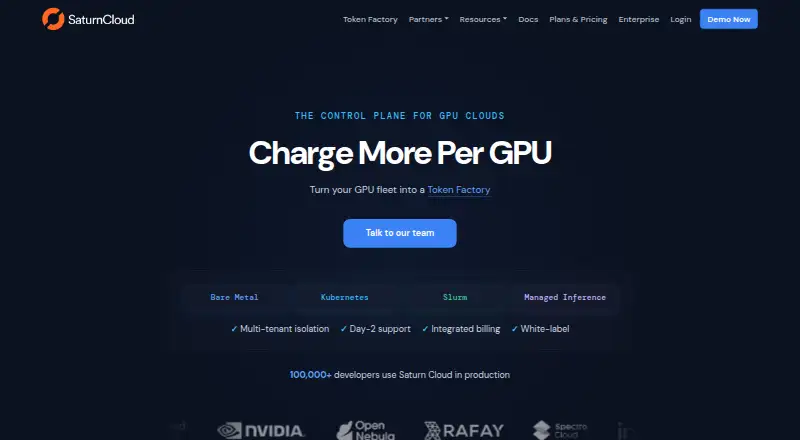
Saturn Cloud is a control plane for GPU clouds that turns GPU fleets into token-metered AI services. It brings bare metal, managed Kubernetes, and managed Slurm together for inference endpoints, training and fine-tuning, and GPU development workspaces. Workspaces include JupyterLab, VS Code, SSH, and persistent storage; GPU compute is supported, and listed languages include Python, R, Julia, and Java. Jupyter Notebook files are supported.
By default, each customer receives a separate Kubernetes or Slurm cluster, without shared scheduler, etcd, or admission webhooks between customers. GPU-hour and inference-token usage can be metered by user, project, and tenant. Invoicing data is available through the API and as a Snowflake view. Enterprise deployments can run in a customer’s cloud account, and Enterprise data can remain in the customer’s AWS environment. Listed infrastructure partners include Mirantis, Rafay, Spectro Cloud, OpenNebula, and SUSE; hyperscalers include AWS, Azure, Google Cloud, and Oracle, while neocloud partners include Nebius and Crusoe. Saturn Cloud says it completed a SOC 2 Type 1 audit and regularly scans application code and containers, including with Snyk. The application is backed up nightly by default, and that setting cannot be changed. The company is headquartered in New York, NY.
Who it suits
Saturn Cloud suits teams building or operating GPU workloads such as inference, training, fine-tuning, and development workspaces. Its Enterprise deployments and usage metering also fit organizations that need deployment in their own cloud account and billing data by user, project, or tenant.
What it does well
- Supports inference, training, fine-tuning, and GPU workspaces.
- Offers JupyterLab, VS Code, SSH, and persistent storage.
- Orchestrates bare metal, Kubernetes, and Slurm.
- Separates each customer into its own cluster by default.
- Metering data is available through the API and Snowflake view.
- Supports Python, R, Julia, and Java.
What to know first
- Free platform access does not include resource usage; that requires Pro.
- Pro compute and storage rates vary by instance.
- Version history is not supported.
- Nightly backups are enabled by default and cannot be changed.
Limits
The Hosted Free Plan provides platform access, while resource usage requires Pro. Hosted Pro charges by resource hours used, with compute and storage rates varying by instance; storage is listed at $0.10/GB-month.
Plans
| Plan | Billed and limits | Price |
|---|---|---|
| Hosted | Pay-as-you-go, hourly · 16 GB memory · 4 vCPUs · 0 vGPUs | $0.09 a month |
| Hosted Free Plan | Free access to the platform; resource usage requires Pro | Free |
| Enterprise | By contract; resources billed through your existing cloud agreement · Runs in your own AWS, Azure, Google Cloud, Oracle, or Nebius account; includes SSO, private VPC installation, and dedicated support | On request |
| Hosted Pro | Pay-as-you-go, hourly; charged only for hours resources are used · Hourly compute and storage rates vary by instance; storage listed at $0.10/GB-month | On request |
| GPU cloud operators | By contract under partner programs · Managed platform for notebooks, training jobs, and deployments on GPU cloud infrastructure | On request |
As saturncloud.io lists them, read 20 Sept 2026. The maker's own page has the final word.
Getting started
- Visit the Saturn Cloud website.
- Choose Hosted Free Plan for free platform access, or review Hosted Pro for resource usage.
- For pay-as-you-go resources, note that compute and storage rates vary by instance.
- For Enterprise deployment, use a supported customer cloud account.
- Use the API or Snowflake view for invoicing data.
Verdict
Choose Saturn Cloud for a platform that coordinates GPU infrastructure and workloads, with separate customer clusters and usage metering. Look elsewhere if you need included resource usage on a free plan, version history, or control over the backup setting.
Questions
Is there a free plan?
Yes. Hosted Free Plan access is free, but resource usage requires Pro.
How is Hosted Pro billed?
It is pay-as-you-go and hourly, charging only for hours resources are used. Compute and storage rates vary by instance; storage is listed at $0.10/GB-month.
What platforms are supported?
Saturn Cloud is listed for API, self-hosted, and web use.
Can Enterprise run in a customer's cloud account?
Yes. Enterprise deployments can run in a customer's AWS, Azure, Google Cloud, Oracle, or Nebius account.
Which languages and notebook formats are supported?
Listed languages are Python, R, Julia, and Java. Jupyter Notebook (.ipynb) is supported.
Does it support version history?
No. Version history is listed as unsupported.
Facts from Saturn Cloud's own pages
- Backups
- The application is backed up nightly by default, and the security page says this setting cannot be altered. · saturncloud.io, 7 Oct 2026
- Billing
- GPU-hour and inference-token usage can be metered by user, project, and tenant, with invoicing data available through the API and as a Snowflake view. · saturncloud.io, 7 Oct 2026
- Deployment and data
- Enterprise deployments can run in a customer's cloud account, and the security page says Enterprise data can remain in the user's AWS environment. · saturncloud.io, 7 Oct 2026
- Free access
- Hosted offers a Free Plan for platform access, while resource usage requires upgrading to Pro. · saturncloud.io, 7 Oct 2026
- Headquarters
- New York, NY, United States · saturncloud.io, 28 Sept 2026
- Hosted pricing
- Hosted Pro charges by resource hours used, and the page lists separate hourly compute and storage rates. · saturncloud.io, 7 Oct 2026
- Infrastructure
- Saturn Cloud orchestrates bare metal, managed Kubernetes, and managed Slurm through one control plane. · saturncloud.io, 7 Oct 2026
- Isolation
- The site says each customer gets a separate Kubernetes or Slurm cluster by default, with no shared scheduler, etcd, or admission webhooks between customers. · saturncloud.io, 7 Oct 2026
- Partners
- Listed infrastructure partners include Mirantis, Rafay, Spectro Cloud, OpenNebula, and SUSE; hyperscalers include AWS, Azure, Google Cloud, and Oracle; neoclouds include Nebius and Crusoe. · saturncloud.io, 7 Oct 2026
- Purpose
- Saturn Cloud describes itself as a control plane for GPU clouds that turns GPU fleets into token-metered AI services. · saturncloud.io, 7 Oct 2026
- Security
- Saturn Cloud says it completed a SOC 2 Type 1 audit and regularly scans application code and containers, including with Snyk. · saturncloud.io, 7 Oct 2026
- Support
- Enterprise pricing includes dedicated support; the homepage describes 24/7 GPU and Kubernetes specialist on-call support for day-two operations. · saturncloud.io, 7 Oct 2026
- Workloads
- The platform supports inference endpoints, training and fine-tuning, and GPU development workspaces with JupyterLab, VS Code, SSH, and persistent storage. · saturncloud.io, 7 Oct 2026
Where Saturn Cloud stands on Freedom251
- Data Science and Machine Learning Platforms#9 of 26
- Data Science Platforms#13 of 32
- Coding Playgrounds#80 of 138
- Notebook Software#20 of 25