Freedom251 › Data Visualization Software
KALMUS
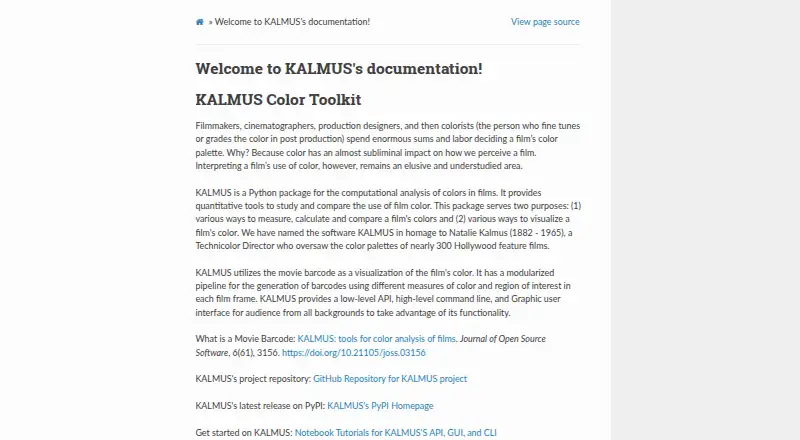
What KALMUS is
KALMUS is a free, open-source Python package for measuring, comparing, analyzing, and visualizing colors in films. It samples frames from video files and turns color measurements from chosen frame regions into movie barcodes. Utilities calculate mean, median, mode, and dominant colors and examine colors and relative sizes within image regions. Users can work through a low-level API, command-line interface, or graphical user interface. Documented barcode classes include barcode, color barcode, brightness barcode, and barcode generator options. Visual tools include Hue versus Light scatter plots and three-dimensional bar plots. Barcode images can be saved, along with barcode data in JSON or CSV format. Jupyter notebook tutorials cover the API, GUI, CLI, and advanced API use. KALMUS runs on Linux, macOS, and Windows, installs with pip, and requires Python 3.7 or 3.8. The CLI is available from version 1.3.7 onward. It uses the MIT License and lists education and science or research among intended audiences.
Who it suits
KALMUS is suited to filmmakers, cinematographers, production designers, colorists, educators, and researchers studying film color. It also fits Python users who want API, CLI, or GUI workflows.
What it does well
- Measures and compares colors from sampled film frames
- Offers API, CLI, and graphical interfaces
- Exports barcode images plus JSON and CSV data
- Includes Jupyter notebook tutorials
- Released under the MIT License
What to know first
- Requires Python 3.7 or 3.8
- Apple M1 systems cannot build it natively
- CLI support starts with version 1.3.7
- Installation uses pip
Plans
| Plan | Billed and limits | Price |
|---|---|---|
| KALMUS | Open-source MIT-licensed Python package | Free |
As kalmus-color-toolkit.github.io lists them, read 12 Oct 2026. The maker's own page has the final word.
Verdict
KALMUS provides several ways to study and visualize film color, from individual statistics to barcode graphics. Check the Python version and Apple M1 build limitation before installing.
Facts from KALMUS's own pages
- Apple M1 limitation
- The README says KALMUS cannot build natively on Apple M1 processors because of NumPy dependencies and suggests Rosetta emulation with Python 3.7 as a possible workaround. · github.com, 12 Oct 2026
- Audience
- The PyPI project metadata lists education and science/research as intended audiences. · pypi.org, 11 Oct 2026
- Barcode types
- The API documentation lists barcode, color barcode, brightness barcode, and barcode generator classes. · kalmus-color-toolkit.github.io, 11 Oct 2026
- CLI availability
- The project README says the command-line interface is available from KALMUS version 1.3.7 onward. · github.com, 12 Oct 2026
- CLI requirement
- The README says the command-line interface is available from KALMUS version 1.3.7 onward. · github.com, 11 Oct 2026
- Color analysis
- Its utilities can calculate mean, median, mode, and dominant colors, and analyze colors and relative sizes of image regions. · kalmus-color-toolkit.github.io, 12 Oct 2026
- Data sources
- video files (sampled film frames) · kalmus-color-toolkit.github.io, 24 Sept 2026
- Exports
- The update log describes saving barcodes as JSON and CSV files and saving barcode images. · kalmus-color-toolkit.github.io, 11 Oct 2026
- Free plan
- Yes · kalmus-color-toolkit.github.io, 24 Sept 2026
- Guides
- The project provides Jupyter notebook tutorials for its GUI, API, CLI, and advanced API usage. · github.com, 12 Oct 2026
- Installation
- The project README recommends installing KALMUS with pip or from a local repository clone. · github.com, 12 Oct 2026
- Integrations
- The documentation links to Jupyter notebook tutorials for using the API, GUI, and CLI. · kalmus-color-toolkit.github.io, 11 Oct 2026
- Intended users
- The documentation describes filmmakers, cinematographers, production designers, and colorists as people who make film color decisions, and presents KALMUS for audiences from different backgrounds. · kalmus-color-toolkit.github.io, 12 Oct 2026
- Interfaces
- KALMUS provides a low-level API, a command-line interface, and a graphical user interface. · kalmus-color-toolkit.github.io, 11 Oct 2026
- License
- The project is released under the open-source MIT License. · github.com, 12 Oct 2026
- Movie barcodes
- It visualizes film color as movie barcodes generated through a modular pipeline with different color measures and frame regions of interest. · kalmus-color-toolkit.github.io, 12 Oct 2026
- Platform
- desktop · kalmus-color-toolkit.github.io, 24 Sept 2026
- Platform requirement
- The README says the package cannot build natively on Apple M1 processors because of NumPy dependencies and suggests Rosetta with Python 3.7 as a possible workaround. · github.com, 11 Oct 2026
- Purpose
- KALMUS provides quantitative tools to analyze, compare, and visualize colors in films. · kalmus-color-toolkit.github.io, 12 Oct 2026
- Python requirement
- The project README says KALMUS requires Python 3.7 or 3.8. · github.com, 12 Oct 2026
- Research audience
- PyPI lists education and science/research as intended audiences for the package. · pypi.org, 12 Oct 2026
- Security
- The pages reviewed do not state security certifications or compliance measures. · kalmus-color-toolkit.github.io, 11 Oct 2026
- Support
- The maintainers invite users to report issues on GitHub or contact them by email at [email protected]. · github.com, 12 Oct 2026
- Visualization
- The update log documents a Hue vs. Light scatter plot and a Hue vs. Light 3D bar plot. · kalmus-color-toolkit.github.io, 11 Oct 2026
Where KALMUS stands on Freedom251
- Data Visualization Software#54 of 98