Freedom251 › Local Kubernetes Tools

k0s
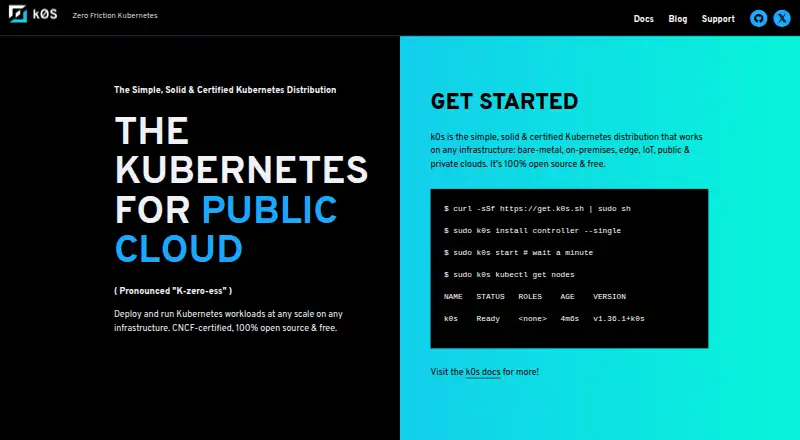
What k0s is
k0s is a free, self-hosted Kubernetes distribution for deploying workloads across public and private clouds, on-premises systems, bare metal, edge, and IoT environments. It is packaged as a single binary and requires no host operating system components beyond the kernel. The project describes it as CNCF-certified Kubernetes and lists support for x86-64, ARM64, ARMv7, and RISC-V. Installation methods include single-node, multi-node, air-gapped, and Docker setups. The k0sctl tool handles lifecycle tasks such as upgrades and backup and restore. Kube-Router is the default network option, with custom CNI plugins and a preconfigured Calico alternative. Datastores include etcd, SQLite, MySQL, and PostgreSQL. Listed security features include kube-bench, RBAC, network policies, control plane isolation, and OpenID provider support. Minimum requirements are 1 vCPU and 1 GB RAM. The project aims to keep the base versatile by minimizing bundled add-ons such as ingress, service meshes, and storage. Mirantis offers support services and subscriptions; FIPS 140-2 is available upon request and commercial agreement.
Who it suits
It suits teams deploying Kubernetes across cloud, on-premises, bare-metal, edge, or IoT environments that want a self-hosted distribution. The documented installation choices range from single-node to air-gapped setups.
What it does well
- Single-binary packaging requires only the kernel beyond it.
- Supports x86-64, ARM64, ARMv7, and RISC-V.
- Offers multiple installation and datastore options.
- k0sctl supports upgrades and backup and restore.
- Free for personal or commercial use.
What to know first
- Minimum requirements include 1 vCPU and 1 GB RAM.
- FIPS 140-2 requires request and commercial agreement.
- Bundled add-ons such as ingress and storage are minimized.
Plans
| Plan | Billed and limits | Price |
|---|---|---|
| k0s | 100% open source · free for personal or commercial use | Free |
As k0sproject.io lists them, read 5 Oct 2026. The maker's own page has the final word.
Getting started
- Visit the k0s project website.
- Choose a documented installation method: single-node, multi-node, air-gapped, or Docker.
- Prepare a system meeting the documented minimum of 1 vCPU and 1 GB RAM.
- Choose a supported datastore and networking option for the cluster.
- Use k0sctl for lifecycle management, including upgrades and backup and restore.
- Contact Mirantis about technical support, training, professional services, or support subscriptions if needed.
Verdict
k0s provides a self-hosted Kubernetes base with varied architectures, installation methods, networking, and datastore options. Its deliberately limited bundled add-ons and stated minimum requirements are worth considering when planning a deployment.
Questions
How much does k0s cost?
The listed k0s plan is free. It is described as 100% open source and free for personal or commercial use.
Is k0s self-hosted?
Yes. Its deployment model is self-hosted.
What systems and architectures does k0s support?
The listed platforms are Linux, self-hosted, and Windows. Documentation lists x86-64, ARM64, ARMv7, and RISC-V architectures, with minimum requirements of 1 vCPU and 1 GB RAM.
Which datastores and networking options can I use?
Documented datastore backends are etcd, SQLite, MySQL, and PostgreSQL. Kube-Router is the default network option; custom CNI plugins are supported, with Calico listed as a preconfigured alternative.
Who provides commercial support for k0s?
Mirantis offers technical support, professional services, training, and support subscriptions with prioritized phone, web, and email support.
Can I get FIPS 140-2?
FIPS 140-2 is available upon request and commercial agreement.
Facts from k0s's own pages
- Architecture
- The documentation lists support for x86-64, ARM64, ARMv7, and RISC-V. · docs.k0sproject.io, 5 Oct 2026
- Certification
- The project describes k0s as CNCF-certified Kubernetes. · k0sproject.io, 5 Oct 2026
- Datastores
- The documentation lists etcd, SQLite, MySQL, and PostgreSQL datastore backends. · docs.k0sproject.io, 5 Oct 2026
- FIPS
- FIPS 140-2 is available upon request and commercial agreement. · k0sproject.io, 5 Oct 2026
- Headquarters
- Campbell, California, United States · k0sproject.io, 28 Sept 2026
- Installation
- The documentation lists single-node, multi-node, air-gapped, and Docker installation methods. · docs.k0sproject.io, 5 Oct 2026
- Intended deployments
- The documentation says k0s is used from small far-edge deployments to large data centers. · docs.k0sproject.io, 5 Oct 2026
- Lifecycle
- k0sctl supports cluster lifecycle management, including upgrades and backup and restore. · docs.k0sproject.io, 5 Oct 2026
- Networking
- k0s uses Kube-Router by default and supports custom CNI plugins, with Calico listed as a preconfigured alternative. · docs.k0sproject.io, 5 Oct 2026
- Packaging
- k0s is distributed as a single binary with no host OS dependencies besides the kernel. · k0sproject.io, 5 Oct 2026
- Purpose
- k0s is a Kubernetes distribution for deploying workloads across public and private cloud, on-premises, bare metal, edge, and IoT environments. · k0sproject.io, 5 Oct 2026
- Scope
- The project aims to provide a versatile Kubernetes base and says it minimizes bundled add-ons such as ingress, service meshes, and storage. · docs.k0sproject.io, 5 Oct 2026
- Security
- The project site lists kube-bench, RBAC, network policies, control plane isolation, and OpenID provider support among its security features. · k0sproject.io, 5 Oct 2026
- Support
- The project identifies Mirantis as offering technical support, professional services, training, and support subscriptions with prioritized phone, web, and email support. · docs.k0sproject.io, 5 Oct 2026
- System requirements
- The documentation lists minimum requirements of 1 vCPU and 1 GB RAM. · docs.k0sproject.io, 5 Oct 2026
Where k0s stands on Freedom251
- Local Kubernetes Tools#7 of 23
- Container Orchestration Software#10 of 32
- Container Management Software#9 of 28