Freedom251 › Container Orchestration Software
K3s
What K3s is
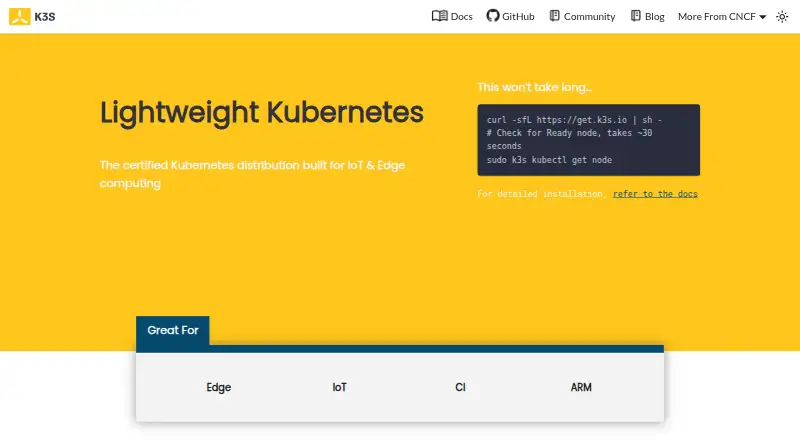
K3s is a Kubernetes distribution for IoT and edge computing, packaged to run in a small footprint. It is self-hosted, with Linux releases for x86_64, ARMv7, and ARM64. K3s can be distributed as a single binary or a minimal container image; the site describes the binary as under 70 MB, while its documentation gives a figure under 100 MB. The distribution includes components such as containerd or cri-dockerd, Flannel, CoreDNS, Traefik, ServiceLB, Kube-router, local-path-provisioner, and Spegel. SQLite is the default lightweight datastore, with etcd, MySQL, and Postgres also available. K3s supports high availability using an embedded datastore or an external MySQL, PostgreSQL, or etcd datastore. Installation guidance covers air-gapped environments, including private registries, manually deployed images, and an embedded registry mirror. Listed use cases range from homelabs, development, and continuous integration to ARM single-board computers and embedded Kubernetes. Security materials provide hardening guidance and CIS benchmark self-assessment guides that assume embedded etcd. Upgrade documentation describes Kubernetes-native automated upgrades using Rancher's system-upgrade-controller. The FAQ says K3s does not natively support Windows.
Who it suits
K3s suits teams and individuals running Kubernetes in edge, IoT, embedded, or air-gapped environments, as well as homelabs and development or continuous integration setups. Its listed ARM releases also suit deployments on ARM single-board computers.
What it does well
- Distributed as a single binary or minimal container image.
- SQLite is the default, with etcd, MySQL, and Postgres also available.
- Supports high availability with embedded or external datastores.
- Air-gapped installation options are documented.
- Releases are listed for x86_64, ARMv7, and ARM64.
What to know first
- K3s does not natively support Windows.
- Security benchmark guides assume embedded etcd.
Plans
| Plan | Billed and limits | Price |
|---|---|---|
| K3s | No price or usage limits stated on the opened official pages | Free |
As k3s.io lists them, read 7 Oct 2026. The maker's own page has the final word.
Getting started
- Visit the K3s website.
- Choose a Linux release for x86_64, ARMv7, or ARM64.
- Select a single-binary or minimal-container-image distribution route.
- Choose SQLite or another available datastore.
- For an air-gapped installation, use a private registry, manually deployed images, or the embedded registry mirror.
Verdict
Choose K3s when you need a self-hosted Kubernetes distribution for Linux, especially for edge, IoT, embedded, or air-gapped deployments. Look elsewhere if native Windows support is required.
Questions
What does K3s cost?
The K3s plan is listed as free.
Is K3s self-hosted?
Yes. Its deployment model is self-hosted.
Which platforms and architectures are supported?
K3s is listed for API, Linux, and self-hosted use. Releases are listed for x86_64, ARMv7, and ARM64.
Does K3s support Windows?
The FAQ says K3s does not natively support Windows.
Which datastores can K3s use?
SQLite is the default lightweight datastore. etcd, MySQL, and Postgres are also available.
What help channels are listed?
The FAQ directs users to known issues, GitHub issues and discussions, and the K3s channel in Rancher Slack.
Facts from K3s's own pages
- Air-gapped installs
- The installation guide documents air-gapped setups using a private registry, manually deployed images, or the embedded registry mirror. · docs.k3s.io, 7 Oct 2026
- Community support
- The FAQ directs users to known issues, GitHub issues and discussions, and the K3s channel in Rancher Slack for help. · docs.k3s.io, 7 Oct 2026
- Datastores
- SQLite is the default lightweight datastore, and etcd, MySQL, and Postgres are also available. · docs.k3s.io, 7 Oct 2026
- Footprint
- The site describes K3s as a single binary under 70 MB, while the documentation says under 100 MB. · k3s.io, 7 Oct 2026
- High availability
- K3s supports high-availability setups with an embedded datastore or external MySQL, PostgreSQL, or etcd datastore. · docs.k3s.io, 7 Oct 2026
- Included components
- K3s packages containerd or cri-dockerd, Flannel, CoreDNS, Traefik, ServiceLB, Kube-router, local-path-provisioner, and Spegel. · docs.k3s.io, 7 Oct 2026
- Integrations
- The upgrade documentation describes Kubernetes-native automated upgrades using Rancher's system-upgrade-controller. · docs.k3s.io, 7 Oct 2026
- Packaging
- K3s is distributed as a single binary or minimal container image. · docs.k3s.io, 7 Oct 2026
- Product
- K3s is a certified, lightweight Kubernetes distribution designed for IoT and edge computing. · k3s.io, 7 Oct 2026
- Security
- The security documentation provides hardening guidance and CIS benchmark self-assessment guides, which assume K3s runs with embedded etcd. · docs.k3s.io, 7 Oct 2026
- Supported architectures
- The site lists x86_64, ARMv7, and ARM64 releases. · k3s.io, 7 Oct 2026
- Use cases
- The documentation lists edge, homelab, IoT, continuous integration, development, ARM single-board computers, air-gapped environments, and embedded Kubernetes as use cases. · docs.k3s.io, 7 Oct 2026
- Windows support
- The FAQ states K3s does not natively support Windows. · docs.k3s.io, 7 Oct 2026
Where K3s stands on Freedom251
- Container Orchestration Software#11 of 32
- Local Kubernetes Tools#8 of 23
- Container Management Software#10 of 28