Freedom251 › Test Data Generation Tools
JSON Schema Faker
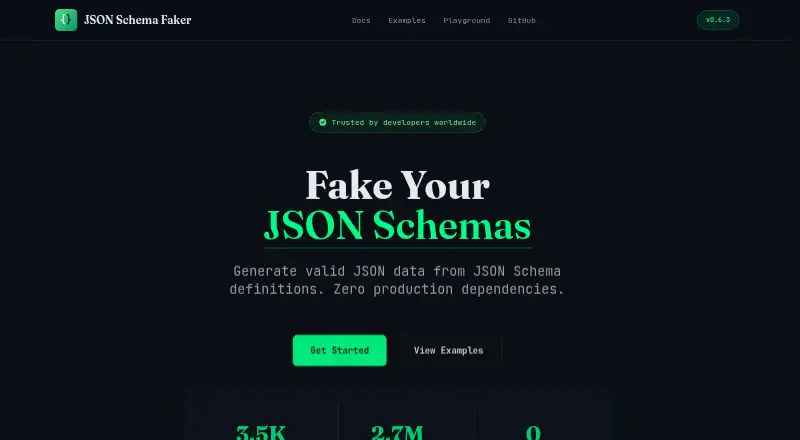
What JSON Schema Faker is
JSON Schema Faker generates synthetic JSON data from JSON Schema definitions. The project supports JSON Schema 2019-09 and 2020-12, and its numeric seed option makes output deterministic: the same seed produces the same results. Its `jsf` command can generate data from schema files, write output to a file and create multiple items as an array. Reference support includes `$ref` resolution with cycle detection, remote references and configurable recursion depth. Built-in generators cover formats such as email, date-time, URI, IP addresses and UUID; an AST-based string generator handles regex patterns. Developers can register custom formats and keyword generators, or add optional faker.js and chance.js extensions. YAML output requires an extension and the YAML package. The project works in Node.js and browsers and is built for Bun and Node.js; deployment is self-hosted. It is open source under the MIT License, with a listed price of $0 and zero production dependencies. Synchronous generation works only when schemas resolve without I/O; asynchronous resolvers or extensions make it throw.
Who it suits
It suits developers who need synthetic JSON generated from schema definitions, including repeatable data for a given numeric seed. Its CLI, reference resolution and custom generators serve workflows that use Node.js, Bun, browsers or self-hosted deployment.
What it does well
- Supports JSON Schema 2019-09 and 2020-12.
- Numeric seeds make generated output repeatable.
- CLI can write files and generate arrays.
- Resolves references with cycle detection and remote support.
- Allows custom formats and keyword generators.
- MIT licensed with zero production dependencies.
What to know first
- Synchronous generation cannot handle schemas requiring I/O.
- YAML output requires an extension and the YAML package.
Plans
| Plan | Billed and limits | Price |
|---|---|---|
| JSON Schema Faker | MIT License · npm and Bun installation | Free |
As json-schema-faker.js.org lists them, read 7 Oct 2026. The maker's own page has the final word.
Getting started
- Install JSON Schema Faker through npm or Bun.
- Prepare a JSON Schema definition.
- Use the `jsf` command to generate JSON from a schema file.
- Write generated output to a file or request multiple items as an array.
- For repeatable output, provide a numeric seed.
JSON Schema Faker turns JSON Schema definitions into valid synthetic data for developers building schema-led test fixtures or API data. It is best suited to Node.js, Bun, and browser workflows that benefit from repeatable output and configurable generators. Its focused scope is a strength, but synchronous generation cannot handle schema resolution that requires I/O.
Overview
This open-source, MIT-licensed project generates data from JSON Schema rather than providing a hosted service or relational data model. It supports JSON Schema 2019-09 and 2020-12, and the project describes itself as having zero production dependencies. That makes it a lean option for teams whose data needs are defined by schemas; teams modeling connected records should look for a relational generator instead.
Generation is available in Node.js and browsers, and the project is built for Bun and Node.js. It supports synthetic generation and API data generation, with JSON and YAML output. YAML output requires a package through an extension, and optional faker.js and chance.js integrations also depend on extensions.
Key features
Repeatable command-line generation
A numeric seed produces deterministic output, so using the same seed again returns the same results. That is useful for stable fixtures and reproducing a data-dependent issue. The jsf command can generate JSON from schema files, write it to a file, and create multiple items in an array, which suits scripted and batch workflows.
References, formats, and custom generators
Reference resolution includes cycle detection, configurable recursion depth, and remote references. These controls help when schemas reuse definitions or contain recursive structures. Built-in generators cover common formats such as email, date-time, URI, IP addresses, and UUID; regex patterns are handled with an AST-based string generator. Users can also register formats and define keyword generators to tailor output to their schemas.
The key runtime boundary is synchronous generation: it supports only schemas that resolve without I/O and throws when asynchronous resolvers or extensions are used. Workflows that need remote or otherwise asynchronous resolution must account for that limitation.
Pricing
JSON Schema Faker costs nothing under the MIT License, with npm and Bun installation. The free plan gives users the open-source generator without a paid tier or seat and quota terms stated for this plan. It suits developers who can run generation in their own environment and need schema-based synthetic JSON; there is no hosted deployment plan described.
Platforms
JSON Schema Faker supports Linux, macOS, Windows, web, and self-hosted use. Its Node.js and browser runtime support, plus its Bun and Node.js build target, gives developers options across local scripts and browser-based workflows.
Who it's for
Choose it for repeatable synthetic JSON when schemas already define the shape and constraints of the data, especially for test fixtures, scripts, and API data generation. It is less suitable when the main need is relational test data or when synchronous schema resolution must perform I/O.
Pros and cons
- Pro: Seeded deterministic output makes fixture generation reproducible.
- Pro: The CLI can read schema files, write output to a file, and generate arrays of items.
- Pro: Reference handling, format generators, regex support, and custom formats and keywords provide control over schema-shaped data.
- Pro: MIT licensing and zero production dependencies keep the core open and lightweight.
- Con: Synchronous generation throws for asynchronous resolvers or extensions, limiting schemas that require I/O.
- Con: YAML output and faker.js or chance.js integrations require extensions and additional packages.
- Con: It does not generate relational data, so it is a narrow fit for connected-table test scenarios.
Alternatives
Compare test data generation tools if you want to weigh schema-focused generation against other approaches. Pick Benerator if you need anonymization as well as generation and can work within its Community Edition's single-threaded generation and anonymization, dual-license open-source core, and lack of a full graph.
dbForge Studio for PostgreSQL is an alternative with a free Express plan and free trial, including a visual data editor, data export and import, and SQL tools. Choose YData SDK if its 20+ connectors and free monthly credit suit your workflow; its Free plan includes all features.
Bogus is a free open-source .NET package for developers whose projects use .NET Standard or .NET Framework. MOSTLY AI has a free plan for readers considering a different synthetic data tool. Chance.js is another free, MIT-licensed option. DummyJSON suits readers looking for a free fake REST API. Mimesis is a free, MIT-licensed option for Linux.
Verdict
JSON Schema Faker is a strong choice for developers who want open-source, repeatable synthetic JSON generated directly from schemas, with CLI support and room to customize formats and keywords. Its main appeal is that focused control without production dependencies. Look elsewhere if your workflow depends on synchronous schema resolution involving I/O, needs relational data, or requires YAML and optional integrations without extension setup.
Verdict
Choose JSON Schema Faker if you need an open source generator for schema-based synthetic JSON, with repeatable output, CLI support and configurable generators. Look elsewhere if your synchronous workflow relies on I/O during schema resolution, since that mode throws for asynchronous resolvers or extensions.
Questions
How much does JSON Schema Faker cost?
The listed plan is free.
Is JSON Schema Faker open source?
Yes. The project is identified as MIT licensed.
Which JSON Schema versions does it support?
It states support for JSON Schema 2019-09 and 2020-12.
Where can it run?
It works in Node.js and browsers and is built for Bun and Node.js. Deployment is self-hosted.
Can it generate YAML?
Yes, through an extension that requires the YAML package.
What is the synchronous generation limit?
Synchronous generation only supports schemas that resolve without I/O. Asynchronous resolvers or extensions cause it to throw.
Facts from JSON Schema Faker's own pages
- CLI
- The `jsf` command can generate JSON from schema files, write to a file, and generate multiple items as an array. · json-schema-faker.js.org, 7 Oct 2026
- Customization
- Users can register custom formats and define custom keyword generators. · json-schema-faker.js.org, 7 Oct 2026
- Dependencies
- The project describes itself as having zero production dependencies. · json-schema-faker.js.org, 7 Oct 2026
- Formats and patterns
- It includes generators for common formats such as email, date-time, URI, IP addresses, and UUID, and supports regex patterns with an AST-based string generator. · json-schema-faker.js.org, 7 Oct 2026
- Integrations
- Optional extensions support faker.js and chance.js, and YAML output requires the YAML package through an extension. · json-schema-faker.js.org, 7 Oct 2026
- License
- The site identifies the project as MIT licensed. · json-schema-faker.js.org, 7 Oct 2026
- Limit
- Synchronous generation only supports schemas that resolve without I/O; asynchronous resolvers or extensions cause it to throw. · json-schema-faker.js.org, 7 Oct 2026
- Maker details
- The official site and repository page opened do not identify a company headquarters or founding year. · github.com, 7 Oct 2026
- Purpose
- JSON Schema Faker generates valid JSON data from JSON Schema definitions. · json-schema-faker.js.org, 7 Oct 2026
- References
- It supports `$ref` resolution with cycle detection, configurable recursion depth, and remote reference resolution. · json-schema-faker.js.org, 7 Oct 2026
- Reproducible output
- A numeric seed produces deterministic output, with the same seed producing the same results. · json-schema-faker.js.org, 7 Oct 2026
- Runtime
- The project says it works in Node.js and browsers and is built for Bun and Node.js. · json-schema-faker.js.org, 7 Oct 2026
- Schema support
- The project states that it supports JSON Schema 2019-09 and 2020-12. · json-schema-faker.js.org, 7 Oct 2026
- Security and compliance
- The official site and repository pages opened do not state security certifications or compliance claims. · github.com, 7 Oct 2026
Where JSON Schema Faker stands on Freedom251
- Test Data Generation Tools#5 of 28