Freedom251 › Test Data Generation Tools
Chance.js
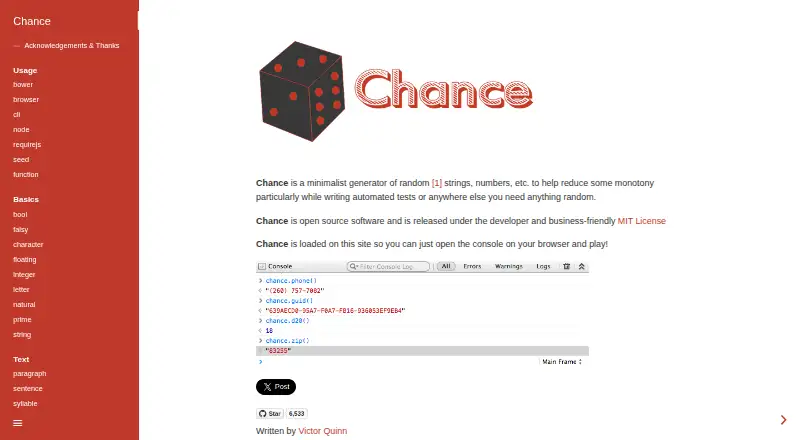
What Chance.js is
Chance.js is a free, open-source JavaScript library for generating random values for automated tests and other tasks that need sample data. Its generators cover text, people, mobile identifiers, web data, locations, time, finance and other categories. Developers can install it through npm for Node.js or load it in a browser, using a global instance or creating multiple instances. A separate chance-cli package offers command-line access to generators and options. Developers can seed an instance so that the same seed produces the same sequence, and the integer generator accepts optional inclusive minimum and maximum bounds. The `unique()` helper can assemble an array of non-repeating generated items. The site also documents loading through Bower, RequireJS and script tags. Chance is distributed under the MIT License. Its output is pseudorandom, so it is not intended for cryptographic applications that require true randomness. The documented name generator offers nationality options for English and Italian. The site credits Victor Quinn as the writer of Chance.
Who it suits
Chance.js suits developers who need generated sample values for automated tests or other programming tasks. Its browser, Node.js and command-line options serve different JavaScript workflows.
What it does well
- Generators span people, places, finance and web data
- Seeded instances can repeat output sequences
- Unique helper builds non-repeating arrays
- Integer generator accepts inclusive bounds
What to know first
- Pseudorandom output is unsuitable for cryptographic needs
- Name nationality options cover English and Italian
Plans
| Plan | Billed and limits | Price |
|---|---|---|
| Chance.js | Open source · MIT License | Free |
As chancejs.com lists them, read 10 Oct 2026. The maker's own page has the final word.
Getting started
- Open https://chancejs.com/.
- Install Chance in Node.js with `npm install chance`.
- For browser use, load it through a script tag or the documented Bower or RequireJS options.
- Alternatively, install the separate chance-cli package globally with npm and invoke a generator with options.
Chance.js is a free, open-source JavaScript library for producing synthetic values used in automated tests and similar development work. It is best for developers working in Node.js or browsers who need many fixture types and reproducible sequences. Its lightweight, seedable approach is practical for test data, while its pseudorandom output and narrow documented name-localization support limit where it belongs.
Overview
Chance focuses on generating random strings, numbers, and structured values rather than managing a database or test environment. The documented scope runs from names and addresses to dates, financial values, mobile identifiers, and web-related data, giving teams one library for varied fixtures. It has been developed since 2013, is credited to Victor Quinn, and is released under the MIT License, making it suitable for both personal and commercial projects without a license fee.
The central trade-off is randomness quality. Chance produces pseudorandom values and should not be used for cryptographic applications or any workflow that requires true randomness. For ordinary test records, mocks, and sample content, that restriction is usually acceptable; for tokens, secrets, or security-sensitive simulations, choose a cryptographic generator instead.
Key features
Broad fixture generation
Generators are organized across basics, text, people, mobile identifiers, web data, locations, time, finance, helpers, and miscellaneous values. This breadth reduces the need to combine several small data libraries when a test needs, for example, a person, address, date, account value, and URL in the same fixture. The documented name generator supports only English (en) and Italian (it) nationality settings, so globally varied name datasets require another approach or additional data.
Repeatable and constrained output
Instances can be initialized with a seed; instances created with the same seed produce the same sequence. That makes a failing automated test easier to reproduce and lets a fixture suite remain stable while it is being debugged. Integer generation accepts inclusive minimum and maximum bounds, which is useful for modeling defined ranges. The unique() helper builds an array of non-repeating generated items of a requested length, helping when test inputs must not collide. These controls improve test determinism, but they do not change the underlying pseudorandom security limitation.
JavaScript delivery options
In a browser, developers can use a global Chance instance or create multiple instances when separate streams are useful. Browser loading is documented through Bower, RequireJS, and script tags. Node.js installation uses npm with npm install chance and works in a Node application. A separate chance-cli package can be installed globally and invoked by generator name with options, which suits quick fixture generation from a shell rather than embedding a library in application code. The site lists the uncompressed browser file at 95KB, the minified file at 55KB, and the gzipped size at 17KB; those figures make it a relatively modest browser dependency, though teams should still account for their own bundling choices.
Pricing
| Plan | Price | What it includes |
|---|---|---|
| Chance.js | free | Open-source software under the MIT License |
There is one free plan, no free trial, and no paid tier or seat charge stated. That makes Chance a straightforward fit for individual developers and teams that want an unrestricted library license rather than a hosted quota or support package. The trade-off is that the plan is the software itself: organizations needing managed data services, commercial support, or security-grade randomness must add those capabilities elsewhere.
Platforms
Chance runs through an API in Node.js and in web browsers. The npm package targets Node.js applications, while browser users can load the library through the documented package and script mechanisms. The command-line package extends it to terminal workflows, but it is separate from the core library. Its generation mode is synthetic, and it supports API data generation.
Who it's for
Choose Chance for JavaScript developers creating automated-test fixtures, mock responses, or sample names and addresses in Node.js or a browser. Seeded instances are especially valuable when a team needs deterministic failures and repeatable builds. It also suits projects that prefer an MIT-licensed dependency and want categories spanning people, places, time, finance, and web data without paying for a service.
Look elsewhere when tests require name datasets beyond English and Italian, when a project needs cryptographically secure values, or when non-JavaScript platforms are the primary environment. Chance is a fixture generator, not a complete data-management platform.
Pros and cons
- Pro: A wide set of generators covers common test domains in one JavaScript package.
- Pro: Seeded instances reproduce sequences, making failures easier to recreate.
- Pro: Inclusive integer bounds and unique() support controlled, non-colliding fixtures.
- Pro: MIT licensing and a free plan remove purchase and redistribution barriers.
- Con: Pseudorandom output is unsuitable for cryptographic or true-randomness requirements.
- Con: Documented name nationality support is limited to English and Italian.
- Con: Browser and Node.js integrations are JavaScript-focused, with the CLI provided as a separate package.
Alternatives
Test Data Generation Tools is the broader list to consult when you want to compare several fixture and synthetic-data products.
- Benerator is a freemium option across API, desktop, self-hosted, and Windows environments; its free Community Edition is single-threaded and does not include a full graph.
- dbForge Studio for PostgreSQL is better when PostgreSQL work is central and you want a freemium desktop tool with visual data editing, import/export, and query history.
- JSON Schema Faker is a free MIT-licensed choice when fixtures should be driven by JSON Schema, with npm and Bun installation.
- YData SDK is a freemium alternative offering a free monthly-credit plan, all features, and more than 20 connectors.
- Bogus is a free open-source .NET package, so it fits .NET projects rather than JavaScript-first stacks.
- MOSTLY AI is a freemium API, web, and self-hosted option with a free tier and no further limits stated.
- DummyJSON provides a free fake REST API when consuming hosted sample endpoints is preferable to generating data inside your test process.
- Mimesis is free MIT-licensed software for Linux, offering a non-JavaScript route to synthetic data.
Verdict
Chance.js is a strong choice for JavaScript teams that need broad, repeatable synthetic fixtures at no cost, particularly in Node.js and browser tests. Its seed support, range controls, unique arrays, and MIT license make it easy to justify for ordinary test data. Choose another tool when you need cryptographic randomness, broader documented nationality coverage, or a platform outside the JavaScript ecosystem.
Verdict
Chance.js provides configurable generators for test data, including repeatable sequences and unique arrays. Its pseudorandom values should not be used where cryptographic randomness is required.
Questions
Is Chance.js free?
Yes. The listed plan is free, and Chance is open source under the MIT License.
Can I use Chance.js in a browser and Node.js?
Yes. It supports browser use and can be installed from npm for Node.js.
Can Chance.js produce repeatable values?
Yes. A seed can make an instance repeatable, and instances initialized with the same seed can produce the same sequence.
Can Chance.js be used for cryptographic randomness?
No. Its output is pseudorandom and should not be used for cryptographic applications requiring true randomness.
What nationality options does its name generator document?
The documented options are English (`en`) and Italian (`it`).
Who is credited as the writer of Chance?
The site credits Victor Quinn.
Facts from Chance.js's own pages
- Browser use
- In a browser, Chance can expose a global `chance` instance, and users can also create multiple instances. · chancejs.com, 10 Oct 2026
- Command line
- The site documents a CLI package, installed globally with `npm install -g chance-cli`, for invoking generators by name. · chancejs.com, 10 Oct 2026
- Data types
- Its generators cover items including text, people, locations, dates, finance, and web-related values. · chancejs.com, 9 Oct 2026
- File sizes
- The site lists chance.js as 95KB uncompressed and chance.min.js as 55KB, or 17KB gzipped. · chancejs.com, 9 Oct 2026
- Founded
- 2013 · chancejs.com, 28 Sept 2026
- Generator categories
- The documented generators cover basics, text, people, mobile identifiers, web data, locations, time, finance, helpers, and miscellaneous values. · chancejs.com, 10 Oct 2026
- Integrations
- The documentation includes installation and usage instructions for Bower and RequireJS, as well as npm for Node.js. · chancejs.com, 10 Oct 2026
- Intended users
- The site gives generating random names and addresses for automated tests as an intended practical use. · chancejs.com, 9 Oct 2026
- License
- Chance is open source and released under the MIT License. · chancejs.com, 10 Oct 2026
- Maker
- The site credits Victor Quinn as the writer of Chance. · chancejs.com, 10 Oct 2026
- Name generation limit
- The name generator's documented nationality support is limited to English (`en`) and Italian (`it`). · chancejs.com, 10 Oct 2026
- Node.js
- Chance can be installed with npm and used in a Node.js application. · chancejs.com, 9 Oct 2026
- Node.js use
- Chance can be installed from npm with `npm install chance` and used in Node.js. · chancejs.com, 10 Oct 2026
- Purpose
- Chance generates pseudo-random strings, numbers, and other values for automated tests and other uses that need random data. · chancejs.com, 10 Oct 2026
- Random integer ranges
- The integer generator accepts optional inclusive minimum and maximum bounds. · chancejs.com, 10 Oct 2026
- Repeatable output
- A developer can provide a seed when creating an instance to make its output repeatable. · chancejs.com, 9 Oct 2026
- Security limitation
- The site cautions that Chance should not be used for cryptographic applications requiring true randomness because it generates pseudo-random values. · chancejs.com, 10 Oct 2026
- Seeded repeatability
- Instances initialized with the same seed can produce the same sequence of random values. · chancejs.com, 10 Oct 2026
- Unique values
- The `unique()` helper builds an array of non-repeating generated items of a requested length. · chancejs.com, 10 Oct 2026
Where Chance.js stands on Freedom251
- Test Data Generation Tools#4 of 28