Freedom251 › Test Data Generation Tools
Bogus
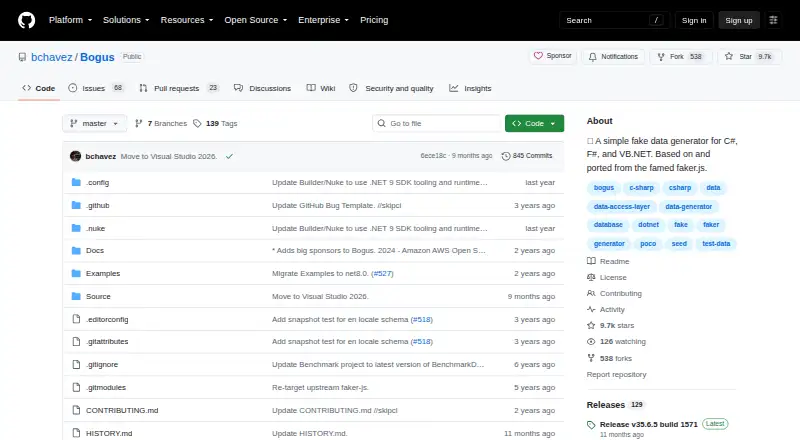
What Bogus is
Bogus is a fake data generator for C#, F#, and VB.NET. It creates synthetic data that developers can use to load databases, user interfaces, and apps for testing. The documented generators cover areas including addresses, commerce, companies, databases, dates, finance, names, and internet data. Bogus supports multiple locales and uses English when a locale-specific data set is unavailable. A randomizer seed can be set to produce repeatable data sets.
Developers can define object-generation rules with `Faker<T>`, including strict mode, custom instantiation, and completion callbacks. The project also describes using a Faker facade, working with DataSets directly, or inheriting from `Faker<T>`. Bogus is distributed as a NuGet package, installed with `Install-Package Bogus`; its minimum requirements are .NET Standard 1.3, .NET Standard 2.0, or .NET Framework 4.0. The project lists Linux, macOS, Windows, and self-hosted use, and JSON as a supported data format. The Bogus plan is free and open source at no cost. The README also offers a Bogus Premium license as a way to support the project. Projects listed as users include Bitwarden Passwordless Server, Elasticsearch .NET Client, FluentValidation, and Microsoft sample projects.
Who it suits
Bogus is for developers working in C#, F#, or VB.NET who need synthetic data to populate databases, interfaces, or apps during testing. Its locale support, repeatable data sets, and configurable object-generation rules suit projects that need controlled test data.
What it does well
- Generates data across addresses, commerce, companies, dates, finance, and more.
- Multiple locales are supported, with English as the fallback.
- A randomizer seed can make generated data repeatable.
- Offers facade, DataSets, and `Faker<T>` usage styles.
- Free open-source NuGet package.
What to know first
- Requires .NET Standard 1.3, .NET Standard 2.0, or .NET Framework 4.0.
- Installation is through a NuGet package using a package command.
Limits
The package lists .NET Standard 1.3, .NET Standard 2.0, or .NET Framework 4.0 as minimum requirements.
Plans
| Plan | Billed and limits | Price |
|---|---|---|
| Bogus | Free open-source .NET package; minimum requirements: .NET Standard 1.3 or .NET Standard 2.0 or .NET Framework 4.0 | Free |
As github.com lists them, read 7 Oct 2026. The maker's own page has the final word.
Getting started
- Open https://github.com/bchavez/Bogus.
- Check that the project meets a minimum requirement of .NET Standard 1.3, .NET Standard 2.0, or .NET Framework 4.0.
- Install the NuGet package with `Install-Package Bogus`.
- Choose a Faker facade, DataSets directly, or `Faker<T>` inheritance.
- Set a randomizer seed if you need repeatable data sets.
Bogus is a synthetic-data generator for C#, F#, and VB.NET projects. It is best suited to developers who need realistic-looking records for test databases, interfaces, or applications. Its configurable generators and repeatable randomizer seed make it a practical open-source option, provided your project can use its supported .NET targets.
Overview
Ported from faker.js, Bogus generates fake data for loading databases, user interfaces, and apps during testing. Its generators span addresses, commerce, companies, databases, dates, finance, names, and internet data, giving .NET developers a broad toolkit for populating test scenarios rather than a single-purpose fixture generator.
The project has been around since 2015 and is used by projects including Bitwarden Passwordless Server, Elasticsearch .NET Client, FluentValidation, and Microsoft samples. That ecosystem is a useful sign of relevance in .NET development, though Bogus remains a library developers configure and integrate themselves rather than a standalone hosted test-data service.
Key features
Configurable generation
Bogus supports several usage styles: a Faker facade, direct DataSets, or inheritance from Faker<T>. Its examples show defining object-generation rules, enabling strict mode, supplying custom instantiation, and attaching completion callbacks. This flexibility suits teams that want generated records shaped around their own models; it also means the package is most valuable to developers comfortable writing and maintaining code-based setup.
Locales and repeatability
Multiple locales help vary generated data, and Bogus defaults to English when a locale-specific data set is missing. A configurable randomizer seed can reproduce a data set, which is useful when a test failure needs to be recreated or when stable fixtures matter. The tradeoff is that seeded generation favors repeatability over fresh variation unless the seed is changed.
Installation and compatibility
The NuGet package can be installed with Install-Package Bogus. Its minimum targets are .NET Standard 1.3, .NET Standard 2.0, or .NET Framework 4.0, making it relevant across projects that can target one of those frameworks. Projects outside those requirements should look elsewhere.
Pricing
Bogus: free. The free offering is an open-source .NET package, so it fits individual developers and teams that want to generate test data without a paid package plan. The project also offers a Bogus Premium license to support the project, with custom pricing.
Platforms
Bogus is available for Linux, macOS, and Windows, and supports self-hosted deployment. It is a .NET package rather than a hosted web application; the listed JSON format and synthetic generation mode suit code-driven data creation, not a managed service workflow.
Who it's for
Choose Bogus if you build in C#, F#, or VB.NET and need configurable synthetic records for tests. It is particularly apt when you need multiple data categories, locale variation, or repeatable fixtures. It is less suitable for teams seeking a point-and-click generator or a hosted service, or for projects that cannot use the stated .NET targets.
Pros and cons
- Pros: Broad generators cover common test-data domains, from people and addresses to finance and internet data.
- Pros: Locale support and randomizer seeds help create varied data while preserving reproducibility when needed.
- Pros: Multiple configuration styles and custom object-generation rules can fit different .NET model setups.
- Cons: Using it requires a .NET project and code-based integration, so it is not a ready-to-use hosted generator.
- Cons: Compatibility depends on meeting one of the stated .NET Standard or .NET Framework minimums.
Alternatives
For a broader set of Test Data Generation Tools, compare approaches across the category. Benerator is another free option for Linux, macOS, Windows, API, and self-hosted use; its Community Edition is open-source under a dual license with exceptions, but generation and anonymization are single-threaded and it does not support full graph generation.
dbForge Studio for PostgreSQL is the more relevant alternative when PostgreSQL work is central: its free Express plan includes context-aware code completion, basic formatting, query history, a visual data editor, and data import and export, with a free trial also offered. JSON Schema Faker is a free alternative for developers who want an MIT-licensed tool installable with npm or Bun.
YData SDK may suit teams seeking connectors and a broader data workflow: its free monthly-credit plan includes all features and 20+ connectors, while pay-as-you-go pricing is also offered. MOSTLY AI is another free-start option across API, Linux, self-hosted, and web platforms. Chance.js is a free, MIT-licensed JavaScript option; DummyJSON provides a free fake REST API; and Mimesis is free MIT-licensed software for Linux.
Verdict
Bogus is a strong fit for .NET developers who want flexible synthetic data without a package fee. Its breadth, locale support, and seeded repeatability make it useful for realistic and reproducible test fixtures. Look elsewhere if you need a hosted or visual workflow, or cannot target its supported .NET frameworks.
Verdict
Choose Bogus if you develop in C#, F#, or VB.NET and need configurable synthetic data for testing. Its locale support and randomizer seed help with varied or repeatable data sets. The listed minimum .NET requirements make it a fit for projects that can use those frameworks.
Questions
Is Bogus free?
Yes. The Bogus plan is listed as free and open source at no cost.
Which languages does Bogus support?
Bogus is a fake data generator for C#, F#, and VB.NET.
How do I install Bogus?
The project provides a NuGet package that can be installed with `Install-Package Bogus`.
What platforms are listed for Bogus?
The listed platforms are Linux, macOS, Windows, and self-hosted.
Can Bogus generate repeatable data?
Yes. The README shows setting a randomizer seed to generate repeatable data sets.
Does the project offer paid support?
The README says users can support the project by purchasing a Bogus Premium license.
Facts from Bogus's own pages
- Configuration
- The README demonstrates defining object-generation rules with `Faker<T>`, strict mode, custom instantiation, and completion callbacks. · github.com, 7 Oct 2026
- Data categories
- Its documented generators cover areas including addresses, commerce, companies, databases, dates, finance, names, and internet data. · github.com, 7 Oct 2026
- Ecosystem
- The project lists Bitwarden Passwordless Server, Elasticsearch .NET Client, FluentValidation, and Microsoft sample projects among projects using Bogus. · github.com, 7 Oct 2026
- Founded
- 2015 · github.com, 28 Sept 2026
- Installation
- The project provides a NuGet package installable with `Install-Package Bogus`. · github.com, 7 Oct 2026
- License
- The repository includes a license file for the project. · github.com, 7 Oct 2026
- Locales
- Bogus supports multiple locales and defaults to English when a locale-specific data set is missing. · github.com, 7 Oct 2026
- Minimum requirements
- The package lists .NET Standard 1.3, .NET Standard 2.0, or .NET Framework 4.0 as minimum requirements. · github.com, 7 Oct 2026
- Premium support
- The README says users can support the project by purchasing a Bogus Premium license, but it does not state a price on the page. · github.com, 7 Oct 2026
- Purpose
- Bogus is a fake data generator for C#, F#, and VB.NET, ported from faker.js. · github.com, 7 Oct 2026
- Repeatable data
- The README shows setting a randomizer seed to generate repeatable data sets. · github.com, 7 Oct 2026
- Usage styles
- The README describes using Bogus through a Faker facade, DataSets directly, or `Faker<T>` inheritance. · github.com, 7 Oct 2026
- Use cases
- It generates fake data to load databases, user interfaces, and apps for testing. · github.com, 7 Oct 2026
Where Bogus stands on Freedom251
- Test Data Generation Tools#3 of 28