ISS Detector
What ISS Detector is
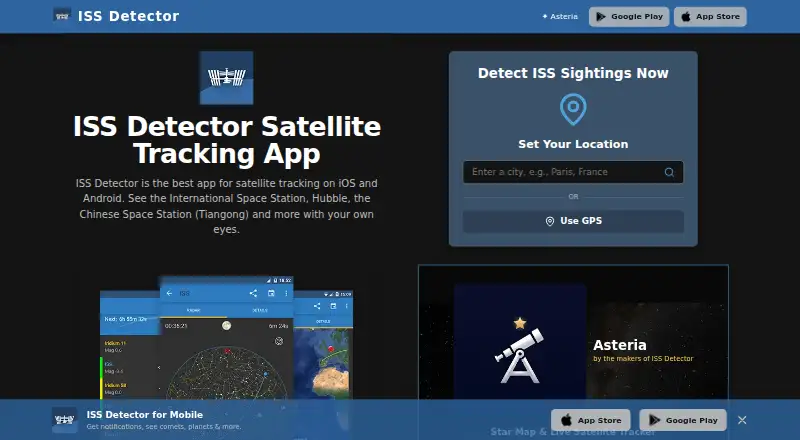
ISS Detector helps users locate visible International Space Station passes and predict satellite passes for their location. For each upcoming ISS pass, it gives the local start time, direction, highest altitude, and duration, and can notify users shortly before the pass begins. It also checks local weather and indicates when cloud cover may make a sighting difficult.
Premium extensions add tracking for Starlink, Hubble, rocket bodies, planets, comets, and amateur radio satellites. The radio features include transmitter details and Doppler shift calculations. Users can share sightings on social media. The app says it combines information from NASA, Heavens-Above, the Minor Planet Center, and yr.no weather. Its privacy policy says location calculations happen on-device and precise location is not stored on the maker’s servers. ISS Detector is listed for Android, iOS, macOS, and web. The free edition contains ads and in-app purchases; ISS Detector Pro costs $17.99, paid once, includes all extensions, and removes ads. Google Play says data can’t be deleted.
Who it suits
ISS Detector suits people who want local pass details and advance alerts for ISS sightings. Its premium extensions are relevant to users tracking other satellites, celestial objects, or amateur radio satellites.
What it does well
- Shows pass time, direction, altitude, and duration
- Sends a notification before an ISS pass
- Checks local weather for cloudy conditions
- Location calculations happen on-device
What to know first
- Free edition contains ads and in-app purchases
- Pro costs $17.99, paid once
- Google Play says data can’t be deleted
Limits
The free ISS Detector Satellite Tracker plan contains ads and in-app purchases. ISS Detector Pro costs 17.99 USD once and includes all extensions with no ads.
Plans
| Plan | Billed and limits | Price |
|---|---|---|
| ISS Detector Satellite Tracker | Contains ads · In-app purchases | Free |
| ISS Detector Pro | All extensions · No ads | $17.99, paid once |
As issdetector.com lists them, read 11 Oct 2026. The maker's own page has the final word.
Getting started
- Visit https://issdetector.com/.
- Choose the Android, iOS, macOS or web version.
- Start with the free ISS Detector Satellite Tracker plan, or choose ISS Detector Pro for all extensions and no ads.
- Allow location access so the app can calculate passes for your location.
- Set up notifications to receive an alert minutes before a pass.
ISS Detector is built for watching the International Space Station and predicting satellite passes from a specific location. It suits observers who want practical timing, direction and weather context rather than a broad planetarium, with extra tracked objects reserved for Pro.
Overview
Each upcoming ISS pass is presented with a local start time, direction, highest altitude and duration. A notification arrives minutes before the pass starts, turning the prediction into a prompt to go outside instead of something you must remember. The local forecast can warn when clouds are likely to prevent a sighting, although it cannot make uncertain weather predictable. Sightings can be shared on social media.
The app says it combines information from NASA, Heavens-Above, the Minor Planet Center and yr.no. Its privacy policy says location calculations happen on the device and that precise location is not stored on the maker’s servers. It also says users can request access to or deletion of data associated with an anonymous user ID under GDPR. Google Play nevertheless says data cannot be deleted, an important discrepancy for Android users who want a straightforward removal path.
Key features
- ISS pass predictions: Start time, viewing direction, peak altitude and duration give enough context to decide whether a pass is worth arranging your evening around. This is more actionable than a bare calendar entry.
- Advance alerts: Notifications minutes before a pass reduce the risk of missing a short viewing window, particularly for casual observers who do not monitor the app continuously.
- Cloud checks: Forecast information helps explain why a predicted pass may not be visible. Treat it as planning context, not a promise of clear conditions.
- Premium object tracking: Pro adds Starlink, Hubble, rocket bodies, planets, comets and amateur radio satellites. Radio-satellite tracking includes transmitter information and Doppler-shift calculations, making the upgrade more relevant to radio enthusiasts than to someone interested only in ISS flyovers.
- Sharing: Social-media sharing makes it simple to report or invite others to a sighting, though the app’s core value remains prediction rather than community features.
Pricing
The freemium structure is clear. ISS Detector Satellite Tracker costs free, includes ads and supports in-app purchases. It covers the basic ISS-tracking use case, so it is the sensible starting point for occasional observers who can accept advertising and do not need the extended catalog.
ISS Detector Pro costs $17.99, paid once. The one-time purchase includes all extensions and removes ads. That is a straightforward fit for regular observers, users tracking several object types, and amateur-radio users who need transmitter and Doppler information. The free plan gives up those extensions and retains ads; no separate subscription or trial terms are stated.
Platforms
ISS Detector has cross-platform coverage across Android, iOS, macOS and the web. Support is provided by email at [email protected]. The privacy policy names Space-Track for orbital data, RevenueCat for subscriptions, Google Analytics and Firebase for app statistics, met.no for weather, and the Minor Planet Center for comet and celestial data. The maker says anonymous user IDs and subscription statuses are stored securely using industry-standard security measures.
Who it's for
Choose ISS Detector if your priority is knowing when to look up, where to face and whether clouds may make the attempt pointless. It is particularly well matched to beginners, families and casual stargazers who want alerts instead of a full sky-simulation tool. Pro is aimed at enthusiasts following multiple satellites or using amateur-radio data. Look elsewhere if you require a planetarium-style exploration experience, or if Google Play’s stated inability to delete data is unacceptable.
Pros and cons
- Pro: Pass entries combine timing, direction, altitude and duration, so they support an actual viewing decision.
- Pro: Alerts and local weather checks address the two easiest ways to miss a pass.
- Pro: Pro’s one-time price removes ads and unlocks a broad set of additional objects, including radio-satellite details.
- Con: The free version contains ads and does not include the premium object extensions.
- Con: Google Play says data cannot be deleted, despite the privacy policy’s GDPR deletion process for data tied to an anonymous user ID.
Alternatives
For a free browser-based experience that requires an internet connection, choose NASA Eyes; it runs on Android, iOS, Linux, macOS, the web and Windows.
Choose Celestia if you want an open-source astronomy project with mobile frontends and broad desktop platform coverage.
SkyORB is another freemium option, with a free Classic update and a 4.99 USD one-time SkyORB ∞ plan for Apple platforms.
Solar System Scope fits readers who want a free WebGL browser version alongside mobile and desktop editions.
Cosmic Watch offers free sky, Earth and solar-system views with notifications, plus paid plans.
Star Chart is free with every feature and upgrade included and no subscriptions or paywalls.
Star Chart is a separate free edition with in-app upgrades.
Stellarium is a free choice for Linux, macOS, web and Windows users.
Browse more options in Astronomy Apps.
Verdict
ISS Detector is a strong choice for anyone who wants dependable pass timing, a last-minute alert and a local cloud check in one focused app. Buy Pro if you will track more than the ISS or want an ad-free experience; choose another astronomy tool if you need deeper sky exploration or cannot accept Google Play’s data-deletion limitation.
Verdict
ISS Detector combines pass predictions, alerts, and local weather checks, with additional tracked objects available through Pro. Consider the Google Play data-deletion limitation and the paid Pro option if you need all extensions without ads.
Questions
Is ISS Detector free?
Yes. The ISS Detector Satellite Tracker plan is free and contains ads and in-app purchases.
How much does ISS Detector Pro cost?
ISS Detector Pro costs $17.99, paid once. It includes all extensions and has no ads.
Which platforms does it support?
It is listed for Android, iOS, macOS and web.
What does it track beyond the ISS?
Premium features include Starlink, Hubble, rocket bodies, planets, comets and amateur radio satellites.
Can users request access to or deletion of their data?
The privacy policy says users may request access to or deletion of data associated with their anonymous user ID under GDPR. Google Play says data can’t be deleted.
What integrations does its privacy policy list?
It lists Space-Track for orbital data, RevenueCat for subscriptions, Google Analytics and Firebase for app statistics, met.no for weather, and Minor Planet Center for comet and celestial data.
Facts from ISS Detector's own pages
- Alerts
- The app sends a notification minutes before a pass starts. · play.google.com, 11 Oct 2026
- Data rights
- The privacy policy says users may request access to or deletion of data associated with their anonymous user ID under GDPR. · issdetector.com, 11 Oct 2026
- Data sources
- The app says it combines data from NASA, Heavens-Above, Minor Planet Center, and yr.no weather. · play.google.com, 11 Oct 2026
- Headquarters
- Gouda, Netherlands · issdetector.com, 28 Sept 2026
- Integrations
- The privacy policy lists Space-Track for orbital data, RevenueCat for subscriptions, Google Analytics and Firebase for app statistics, met.no for weather, and Minor Planet Center for comet and celestial data. · issdetector.com, 11 Oct 2026
- Location privacy
- The privacy policy says location calculations happen on-device and precise location is not stored on the maker’s servers. · issdetector.com, 11 Oct 2026
- Notable limitation
- Google Play says data can’t be deleted. · play.google.com, 11 Oct 2026
- Pass details
- Upcoming ISS passes include local start time, direction, highest altitude, and duration. · issdetector.com, 11 Oct 2026
- Purpose
- ISS Detector helps users find visible International Space Station passes and satellite pass predictions for their location. · issdetector.com, 11 Oct 2026
- Radio features
- Amateur radio satellite tracking includes transmitter information and Doppler shift calculations. · play.google.com, 11 Oct 2026
- Security
- The maker says anonymous user IDs and subscription statuses are stored securely and that it uses industry-standard security measures. · issdetector.com, 11 Oct 2026
- Sharing
- Users can share sightings on social media. · play.google.com, 11 Oct 2026
- Support
- The app listing provides support by email at [email protected]. · play.google.com, 11 Oct 2026
- Tracked objects
- Premium features include Starlink, Hubble, rocket bodies, planets, comets, and amateur radio satellites. · play.google.com, 11 Oct 2026
- Weather
- The app checks the local forecast and indicates when cloudy conditions may prevent a sighting. · play.google.com, 11 Oct 2026
Where ISS Detector stands on Freedom251
- Astronomy Apps#6 of 35