Freedom251 › Document Management Software
Invenio
What Invenio is
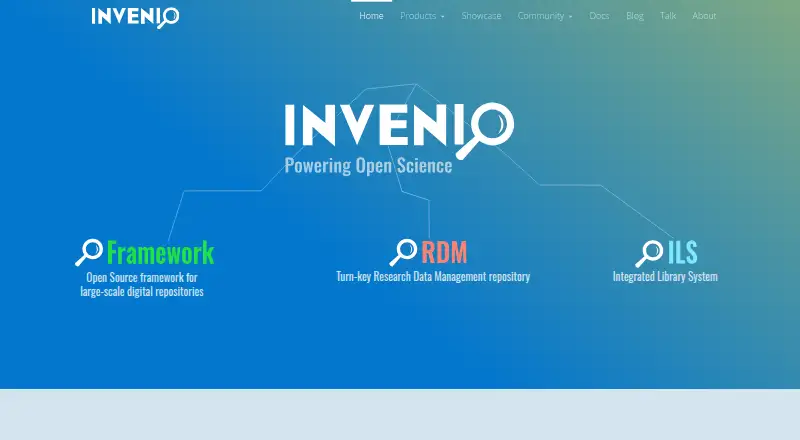
Invenio is a free, open-source suite covering research repositories, library systems, and tools for building information systems. Its products are InvenioRDM, a research data management repository; InvenioILS, an integrated library system; and Invenio Framework, a code library for developing large-scale applications. InvenioRDM serves research institutions, companies, and individuals, and supports 1 to 100 million records and files from 1 byte to several petabytes. It can run on bare metal, virtual machines, or container platforms such as Kubernetes and OpenShift. Institutional features include single sign-on, storage systems, public and private clouds, permissions models, and custom fields, with integrations for ORCID, DataCite, and OpenAIRE. Invenio Framework offers REST APIs, configurable search, DOI minting, fixity checks, and BagIt archival exports. InvenioILS includes cataloguing, circulation workflows, acquisitions, and interlibrary loans. The products are free open-source software, and self-hosted deployment is available. A key distinction for adopters is that Framework is a code library for building applications, while InvenioRDM is the repository application intended to be used as one.
Who it suits
InvenioRDM suits institutions, companies, or individuals needing a research data repository. InvenioILS is for library-system needs, while the Framework is for teams building information-system applications.
What it does well
- Invenio products are free open-source software.
- InvenioRDM supports up to 100 million records.
- RDM integrates with ORCID, DataCite, and OpenAIRE.
- Framework provides REST APIs and configurable search.
What to know first
- Invenio Framework is a code library, not a repository application.
- Only supported Invenio versions are guaranteed security fixes.
- Self-hosted deployment requires deployment and operations resources.
Limits
The free plan is free open-source software with self-hosted deployment available. Only supported Invenio versions are guaranteed to receive security fixes.
Plans
| Plan | Billed and limits | Price |
|---|---|---|
| Invenio products (free open source) | Free open source software · self-hosted deployment is available | Free |
As inveniosoftware.org lists them, read 11 Oct 2026. The maker's own page has the final word.
Getting started
- Visit https://inveniosoftware.org/
- Choose InvenioRDM, InvenioILS, or Invenio Framework for your intended use
- Use the free open-source plan
- Deploy the selected software on bare metal, a virtual machine, or a supported container platform
Invenio is a free, open-source suite for research repositories, library systems, and building information applications. It best suits institutions and technical teams able to deploy and maintain software themselves. The key choice is between InvenioRDM, a repository application, and Invenio Framework, a code library for building one.
Overview
Invenio has developed from its first release as CDSWare in 2002 into three distinct products: InvenioRDM for research data management, InvenioILS for library operations, and Invenio Framework for application development. That range is useful when an organization has related repository or library needs, but it does not make the products interchangeable. In particular, Framework requires a development project; it is not a finished repository users can simply adopt.
All Invenio products are free open-source software, with self-hosted deployment available. That avoids a software license charge, but means the organization must be prepared to operate its chosen system or arrange commercial hosting or services.
Key features
Research repository
InvenioRDM is the suite's turn-key repository for research data, based on Invenio Framework and Zenodo. Its stated range—from 1 to 100 million records and files from 1 byte to several petabytes—makes it relevant to projects with substantial preservation and growth requirements. It can run on bare metal, virtual machines, Kubernetes, or OpenShift, offering deployment choices for institutions with different infrastructure.
Institutional single sign-on, storage integrations, cloud support, permissions models, and custom fields help fit RDM into existing environments. ORCID, DataCite, and OpenAIRE integrations connect it to research workflows. Granular access control and audit logs are useful for repositories that must manage varied permissions and track activity.
Framework and library tools
Framework is for teams building digital repositories, enterprise search engines, or integrated library systems. It offers JSON Schema metadata, REST APIs, and configurable search with facets and citation networks. Serialization options include BibTeX, CSL, DataCite, Dublin Core, JSON-LD, and MARCXML, which helps teams exchange records across different scholarly and library formats.
For preservation workflows, Framework supports persistent identifiers such as DOIs, links between versions, fixity checks, and BagIt archival exports. It is built with Python 3 and Flask and uses OpenSearch with PostgreSQL or MySQL. Those are meaningful capabilities for development teams, but they do not remove the work of designing, building, and maintaining an application.
Library operations
InvenioILS covers bibliographic cataloguing, configurable circulation workflows, acquisitions, interlibrary loans, back-office tools, and REST APIs. It is the relevant component for library operations; organizations seeking those capabilities should assess ILS rather than treating RDM or Framework as a substitute.
Pricing
Invenio products (free open source): free. The plan is free open-source software, and self-hosted deployment is available. There are no paid software tiers described; organizations should weigh the no-license-cost model against the operational and development capacity needed to run the software. Commercial hosting and support providers are also listed by the project.
Platforms
Invenio supports API, Linux, macOS, self-hosted, and web environments. InvenioRDM can be deployed on bare metal, virtual machines, and container platforms such as Kubernetes and OpenShift, so it can fit organizations that manage their own infrastructure. The project also supports OAuth or SSO authentication and fine-grained access rights.
Who it's for
InvenioRDM is a strong fit for research institutions, private companies, and individuals seeking a research data repository, especially where large-scale records, preservation workflows, and institutional integrations matter. InvenioILS fits libraries that need cataloguing and circulation alongside acquisitions and interlibrary loan workflows. Framework is best for technical teams building tailored information systems; it is a poor fit for anyone expecting a ready-made repository without application development.
Support is available through community chat, a forum, GitHub issues, events, and training, with commercial hosting and services from listed providers. The security policy asks users to report issues privately by email and says an Invenio architect normally acknowledges receipt within 1–2 working days. Only supported Invenio versions are guaranteed to receive security fixes, so maintaining a supported version is important.
Pros and cons
Pros
- Broad research-data scale: RDM is designed for 1 to 100 million records and files up to several petabytes, making it suitable for repositories with substantial growth expectations.
- Research and institutional integration: ORCID, DataCite, OpenAIRE, SSO, storage, cloud, and custom-field support can help align the repository with established workflows.
- Preservation and format support: DOI support, fixity checks, BagIt exports, version links, and multiple serialization formats serve long-term access and exchange needs.
- Free and open source: The software has no stated license price, and self-hosting gives organizations deployment control.
Cons
- Operational responsibility: Self-hosted use requires infrastructure and maintenance capacity; the free license does not make deployment and support work disappear.
- Framework is not a finished product: Teams wanting a repository should choose RDM, while Framework entails building an application.
- Version support matters for security: Security fixes are guaranteed only for supported versions, requiring ongoing upgrade discipline.
Alternatives
Document Management Software is a broader category to browse when a research repository or library system is not the specific requirement.
For a different document-management option, Group-Office has a free Community plan with unlimited users and a Professional plan at €439 a month; choose it when that alternative's freemium offering better fits your needs. LogicalDOC has a free open-source Community plan with basic access control, advanced search, web UI, and SOAP and REST APIs, making it another option to compare for document management. OpenKM is a freemium alternative with a free plan and free trial.
OpenDocMan offers a free on-premises Community plan with unlimited users, file locking, and custom metadata; consider it when those document-management features are a closer match. SeedDMS is a free option with no stated limits on users or documents. Transkribus is a freemium alternative with a free plan. FlinkISO offers a free on-premise plan with unlimited concurrent users and all QMS modules, so it is worth considering when that offering fits the task. EPrints is free open-source software that requires a suitable Linux-based server for self-installation, an alternative for teams seeking a Linux-hosted repository.
Verdict
Choose InvenioRDM if you need a free, open-source research data repository with broad scale, preservation tools, and research-infrastructure integrations—and have the capacity to operate it. Choose InvenioILS for the suite's library workflows, or Framework when you have developers building a tailored information system. Look elsewhere if you need a finished general document-management product or cannot take on the deployment and maintenance burden.
Verdict
Invenio offers distinct products for research repositories, library operations, and application development. Choose InvenioRDM for a repository solution; Framework is building software rather than a ready-made repository.
Questions
How much does Invenio cost?
The listed Invenio products plan is free.
Is Invenio open source?
Yes. Invenio products are free open-source software, and Invenio Framework is licensed under MIT.
What is the difference between InvenioRDM and Invenio Framework?
InvenioRDM is a repository application for research data. Invenio Framework is a code library for building applications.
Which platforms and deployment options are supported?
The listed platforms are API, Linux, macOS, self-hosted, and web. InvenioRDM can run on bare metal, virtual machines, Kubernetes, and OpenShift.
What integrations does InvenioRDM support?
It integrates with Open Science infrastructure including ORCID, DataCite, and OpenAIRE.
How can users get support?
Community help is available through chat, a forum, GitHub issues, events, and training. The project also lists commercial hosting and service providers.
Facts from Invenio's own pages
- APIs and formats
- Invenio is JSON-native and provides REST APIs; its framework can serialize data as BibTeX, CSL, DataCite, Dublin Core, JSON-LD, or MARCXML. · inveniosoftware.org, 11 Oct 2026
- Community support
- Users can seek community help through the Invenio chatroom and forum, and the project also lists commercial hosting and support providers. · inveniosoftware.org, 11 Oct 2026
- Deployment
- InvenioRDM runs on bare metal, virtual machines, and container platforms such as Kubernetes and OpenShift. · inveniosoftware.org, 11 Oct 2026
- Founded
- 2002 · inveniosoftware.org, 28 Sept 2026
- Framework data and preservation
- Invenio Framework supports JSON Schema metadata, serializers for formats including BibTeX and DataCite, DOI minting, fixity checks, and BagIt archival exports. · inveniosoftware.org, 11 Oct 2026
- Framework use
- Invenio Framework can be used to build digital repositories, enterprise search engines, and integrated library systems. · inveniosoftware.org, 11 Oct 2026
- ILS features
- InvenioILS includes bibliographic cataloguing, configurable circulation workflows, acquisitions, interlibrary loans, backoffice tools, and REST APIs. · inveniosoftware.org, 11 Oct 2026
- Institutional integration
- InvenioRDM supports institutional single sign-on, storage systems, public and private clouds, permissions models, and custom fields. · inveniosoftware.org, 11 Oct 2026
- Library features
- InvenioILS supports cataloguing, configurable circulation workflows, acquisitions, interlibrary loans, back-office tools, and REST APIs. · inveniosoftware.org, 11 Oct 2026
- Notable limit
- Invenio Framework is a code library for building applications, while InvenioRDM is the repository application intended for use as a repository solution. · inveniosoftware.org, 11 Oct 2026
- Open Science integrations
- InvenioRDM integrates with ORCID, DataCite, and OpenAIRE. · inveniosoftware.org, 11 Oct 2026
- Open source
- Invenio products are free open source software, and Invenio Framework is licensed under MIT. · inveniosoftware.org, 11 Oct 2026
- Preservation
- Invenio Framework supports persistent identifiers such as DOIs, links between versions, fixity checks, and BagIt archival package exports. · inveniosoftware.org, 11 Oct 2026
- Product suite
- Invenio includes InvenioRDM, a repository/document management platform; InvenioILS, an integrated library system; and Invenio Framework, a code library for building large-scale information systems. · inveniosoftware.org, 11 Oct 2026
- Project history
- The first Invenio release, then named CDSWare, was on August 1, 2002. · inveniosoftware.org, 11 Oct 2026
- RDM deployment
- InvenioRDM runs on bare-metal, virtual machines, and container platforms such as Kubernetes and OpenShift. · inveniosoftware.org, 11 Oct 2026
- RDM purpose
- InvenioRDM is a turn-key research data management repository platform based on Invenio Framework and Zenodo. · inveniosoftware.org, 11 Oct 2026
- Record and file scale
- InvenioRDM is described as supporting 1 to 100 million records and files from 1 byte to several petabytes. · inveniosoftware.org, 11 Oct 2026
- Research integrations
- InvenioRDM integrates with Open Science infrastructure including ORCID, DataCite, and OpenAIRE. · inveniosoftware.org, 11 Oct 2026
- Scale
- Invenio Framework is designed to manage more than 100 million records and petabytes of files. · inveniosoftware.org, 11 Oct 2026
- Search and APIs
- Invenio Framework provides RESTful APIs and configurable search with facets and citation networks. · inveniosoftware.org, 11 Oct 2026
- Security
- The maker says Invenio was created with security and long-term preservation in mind, and the framework supports OAuth or SSO authentication and fine-grained access rights. · inveniosoftware.org, 11 Oct 2026
- Security fixes
- Only supported Invenio versions are guaranteed to receive security fixes. · invenio.readthedocs.io, 11 Oct 2026
- Security reporting
- The security policy asks users to report security issues privately by email and says an Invenio architect normally acknowledges receipt within 1–2 working days. · invenio.readthedocs.io, 11 Oct 2026
Where Invenio stands on Freedom251
- Document Management Software#6 of 63