Freedom251 › 3D Avatar Software

in3D
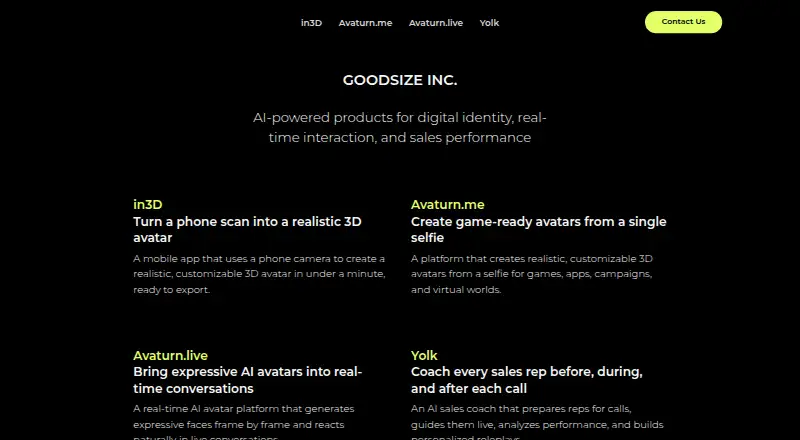
What in3D is
in3D is a mobile app and developer platform for creating human avatars through 3D body scanning. During a scan, the app records video and TrueDepth data through the phone camera; the site says an avatar can be created within a minute. Users can export models in FBX, GLB, or USDZ formats. The maker describes the avatars as having a Mixamo-compatible rig and 2048×2048 texture, and lists SDKs for Unreal Engine and Unity. Its Web SDK and API can add avatars to apps on any platform. The developer portal says API-created avatars can be used in commercial or non-commercial games, experiences, videos, and metaverses, but not to create competing 3D scanning technology or to sell as NFTs or paid model distributions. The privacy policy says the app uploads only video and photos recorded in the app, which are processed using Google Cloud Platform and Amazon Web Services. It says those files are encrypted with a key stored locally on the mobile device. The free API testing plan allows two scans per day; a 100-scan plan costs $100, paid once. A production or platform plan has pricing available by contacting the maker.
Who it suits
in3D suits people creating human avatars for games, experiences, videos, or other projects, as well as developers integrating avatars through an SDK or API. The free API option is for testing and is limited to two scans per day.
What it does well
- Exports models in FBX, GLB, or USDZ.
- Lists SDKs for Unreal Engine and Unity.
- Web SDK and API support app integration.
- Avatars have a Mixamo-compatible rig.
What to know first
- Free API testing is limited to two scans daily.
- API avatars cannot be sold as NFTs or paid model distributions.
- Children under 13 are not permitted to use the app.
Limits
The free API testing plan allows two scans per day. The one-time plan costs 100.00 USD for 100 scans; production or platform plan pricing is available by contacting [email protected].
Plans
| Plan | Billed and limits | Price |
|---|---|---|
| FREE | API testing · rate limited at 2 scans per day | Free |
| 100 scans for a larger test | 100 scans | $100, paid once |
| Production / platform plan | Contact [email protected] | On request |
As in3d.io lists them, read 5 Oct 2026. The maker's own page has the final word.
Getting started
- Open the in3D website.
- For non-developer use, get the iOS or Android app.
- Record a scan using the app camera.
- For API testing, use the free plan, limited to two scans per day.
- Export models in FBX, GLB, or USDZ, or use the Web SDK or an engine SDK.
in3D is a phone-based body-scanning app for people who need a human avatar in a game, app, or other digital experience. It suits creators who want a quick route from camera capture to rigged exports, and developers who can work within its API terms. Its strongest case is that capture-to-integration workflow; the daily free API cap makes it less suitable for sustained testing.
Overview
The app uses video and TrueDepth data recorded during a scan, and the maker says a phone-camera avatar can be created within a minute. That speed favors projects needing a captured human figure over teams seeking a general-purpose 3D modeling tool. The avatars have a Mixamo-compatible rig and a 2048×2048 texture, practical starting points for animation and game workflows.
Privacy-conscious users should note that the app uploads only video and photos recorded through the app, which are processed using Google Cloud Platform and Amazon Web Services. The policy says those files are encrypted with a key stored on the mobile device. Videos may be used to provide scanning or, in anonymized form, to improve the technology. The policy describes commercially reasonable security practices but does not guarantee that information cannot be accessed, disclosed, altered, or destroyed. The app is not for children under 13.
Key features
FBX, GLB, and USDZ exports give users several ways to move an avatar into other 3D workflows, while direct export to Sketchfab offers another destination if the user supplies a Sketchfab API token. Unreal Engine and Unity SDKs support game-engine integration. The Web SDK and API are intended to bring avatars into apps on any platform, extending in3D beyond its mobile capture apps.
API-created avatars can be used in commercial and non-commercial games, experiences, videos, and metaverses. The terms rule out using them to build competing 3D scanning technology, selling them as NFTs, or distributing them as paid 3D models. That is a meaningful constraint for businesses whose product depends on avatar resale or scanning services, but leaves a broad range of ordinary game and experience uses open.
Pricing
- FREE: free. This is for API testing and is limited to 2 scans per day. It is enough for light experimentation, not a high-volume evaluation.
- 100 scans for a larger test: $100, paid once for 100 scans. This one-time option gives teams a defined test allowance beyond the free daily cap, without a recurring charge.
- Production / platform plan: custom pricing; contact [email protected]. This is the route for production or platform use, but it does not provide a public price for budgeting.
The free plan is the lowest-commitment way to try API scanning, but its two-scan daily limit is restrictive. The 100-scan purchase is better suited to a bounded evaluation, while production users need to request custom pricing.
Platforms
The product spans Android and iOS capture apps, web access, and API integration. The developer portal directs non-developers to the mobile apps; the SDKs and API make the broader platform reach most relevant to teams building their own products.
Who it's for
in3D is a good fit for creators who want a phone-captured, rigged human model in familiar export formats, and for developers adding avatars to Unity, Unreal Engine, or a web-enabled app. It is less suited to users who need a general modeling environment, high-volume free API access, or the ability to sell API-created models.
Pros and cons
- Pro: FBX, GLB, and USDZ exports, plus a Mixamo-compatible rig, give animation and game teams several practical handoff options.
- Pro: Unity and Unreal Engine SDKs, alongside a Web SDK and API, support both engine-based and app integrations.
- Pro: A free API testing plan lets developers start without payment.
- Con: The free API plan allows only two scans per day, limiting repeated or team testing.
- Con: API-created avatars cannot be sold as NFTs or paid 3D models, and cannot be used to create competing scanning technology.
- Con: Production pricing is custom, so teams must contact the developer to establish cost.
Alternatives
Avaturn is worth considering when the number of avatars or exports matters more than in3D's phone-scan workflow: its free plan allows unlimited avatar creation and exports, while its PRO plan is $800 a month for up to 1,000 avatars per month.
MetaPerson Creator offers a free first avatar and export, with additional avatars using in-app credits; choose it if that free initial export better matches a one-off need. Genies Avatar SDK is another option for developers seeking a free SDK for commercial projects.
For broader 3D creation rather than phone-based avatar capture, Blender is a free, open-source suite for Linux, macOS, and Windows that can be downloaded without registration or an internet connection. MakeHuman is a free alternative for users seeking a standalone human-modeling tool without license fees or a download paywall.
IMVU is a free virtual world and chat experience rather than a direct avatar-scanning workflow. Meshy offers a free plan with 100 credits and 10 monthly downloads for Meshy 6 Lite models, an option for users whose needs fit that credit-based model. Roblox Creator Hub provides free access to Creator Hub and Roblox Studio tools for projects aimed at Roblox.
Explore more options in 3D Avatar Software and Game Character Creation Software.
Verdict
Choose in3D if you want a quick phone-based route to a rigged human avatar and need exports or SDK/API integration for games and digital experiences. Its capture and integration options are compelling, but the two-scan daily free cap, custom production pricing, and restrictions on avatar resale make alternatives a better fit for high-volume testing or businesses built around selling model files.
Verdict
in3D provides a phone-based avatar creation app alongside SDK and API integration options. API use has stated restrictions, and the free testing plan is limited to two scans per day.
Questions
Is there a free plan?
Yes. The FREE API testing plan costs nothing and is rate limited to two scans per day.
How much does the 100-scan plan cost?
The “100 scans for a larger test” plan costs $100, paid once and includes 100 scans.
Which platforms are supported?
The listed platforms are Android, API, iOS, and web.
Which file formats can I export?
3D models can be exported in FBX, GLB, or USDZ formats.
Can API-created avatars be used commercially?
Yes. The developer portal says they can be used in commercial or non-commercial games, experiences, videos, and metaverses. They cannot be used to create competing 3D scanning technology or sold as NFTs or paid model distributions.
How are scan photos and videos handled?
The policy says only video and photos recorded in the app are uploaded for processing through Google Cloud Platform and Amazon Web Services. It says those files are encrypted using a key stored on the mobile device.
Facts from in3D's own pages
- Age limit
- The privacy policy says the app is not directed at children under 13 and its terms do not allow their use. · in3d.io, 4 Oct 2026
- Avatar specifications
- The maker says in3D avatars have a Mixamo-compatible rig and 2048×2048 texture. · in3d.io, 5 Oct 2026
- Avatar specs
- The same post says in3D avatars have a Mixamo-compatible rig and 2048×2048 texture. · in3d.io, 4 Oct 2026
- Cloud processing
- The app uses Google Cloud Platform and Amazon Web Services to process and edit photographs and videos. · in3d.io, 4 Oct 2026
- Commercial use
- The developer portal says avatars created using the in3D API can be used in commercial or non-commercial games, experiences, videos, and metaverses. · developer.in3d.io, 5 Oct 2026
- Data use
- The policy says user videos are used to provide 3D body scanning or as anonymized data for internal technology improvement. · in3d.io, 4 Oct 2026
- Encryption
- The policy says videos and photos are encrypted using a key stored locally on the mobile device. · in3d.io, 4 Oct 2026
- Export formats
- The app lets users export 3D models in FBX, GLB, or USDZ formats. · in3d.io, 5 Oct 2026
- Integration
- An in3D blog post says the app can directly export a 3D model to Sketchfab using a Sketchfab API token. · in3d.io, 4 Oct 2026
- Mobile availability
- The developer portal directs non-developers to use the iOS or Android app. · developer.in3d.io, 5 Oct 2026
- Privacy and processing
- The privacy policy says the app uploads only video and photos recorded in the app, and uses Google Cloud Platform and Amazon Web Services to process them. · in3d.io, 5 Oct 2026
- Product
- in3D is an app and SDK for 3D body scanning and creating realistic avatars. · in3d.io, 5 Oct 2026
- Scan input
- The app uses video and TrueDepth data recorded through the user’s camera during scanning. · in3d.io, 4 Oct 2026
- Scan speed
- The site says avatars can be created from a phone camera within a minute. · in3d.io, 5 Oct 2026
- SDK integrations
- The site names SDKs for Unreal Engine and Unity. · in3d.io, 5 Oct 2026
- Security
- The privacy policy says videos and photos are encrypted using a key stored locally on the mobile device, while also stating that Goodsize cannot guarantee information security. · in3d.io, 5 Oct 2026
- Support
- The developer portal lists [email protected] for support and [email protected] for production inquiries. · developer.in3d.io, 5 Oct 2026
- Upload scope
- The policy says the app uploads only the video and photos specifically recorded using the app. · in3d.io, 4 Oct 2026
- Use restrictions
- The developer portal says API-created avatars cannot be used to create competing 3D scanning technology or sold as NFTs or paid 3D model distributions. · developer.in3d.io, 5 Oct 2026
- Web SDK and API
- The maker says its Web SDK and API can integrate avatars into an app on any platform. · in3d.io, 5 Oct 2026
Where in3D stands on Freedom251
- 3D Avatar Software#5 of 26
- Game Character Creation Software#6 of 22