Freedom251 › Desktop Wallpaper Software
Hydra
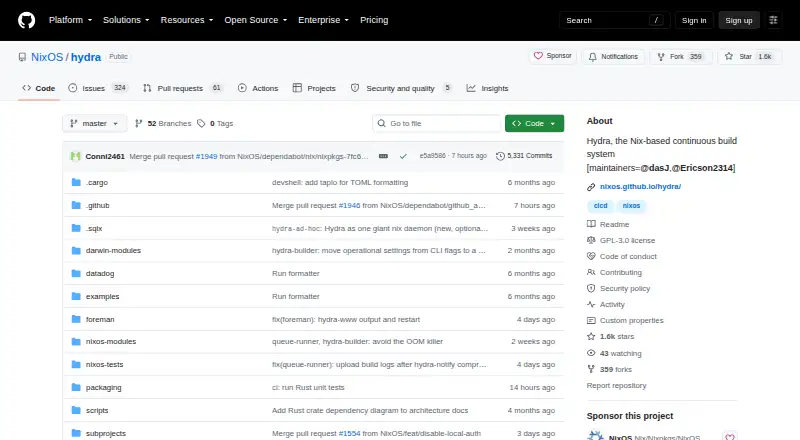
What Hydra is
Hydra is a continuous integration service for Nix-based projects. It checks out project source periodically or continuously, builds it, runs tests, and produces reports. Developers organize work into jobsets defined by inputs; changes to those inputs can trigger builds, and jobsets can depend on one another. Hydra supports Flake jobsets when their outputs expose a hydraJobs attribute set. Jobsets can build packages, ISO images, and tarballs, and can use Git checkout sources as inputs. Hydra also provides a JSON API. It is intended for Nix and NixOS package developers, not simply for people using NixOS. The software is free and licensed under GPL-3.0, and is self-hosted; no hosted option is listed. Running Hydra is currently supported only on NixOS, and the repository recommends its NixOS module for production. Flake evaluation is restricted from accessing files outside the Nix store. Some state is kept in the database, so backups are needed; the wiki also reports that hydra-queue-runner can sometimes leave builds queued without scheduling them.
Who it suits
Hydra suits Nix and NixOS package developers who need to build and test projects through jobsets. It is not needed just to use NixOS, and running it requires NixOS.
What it does well
- Free and licensed under GPL-3.0.
- Builds packages, ISO images, and tarballs.
- Jobsets can trigger on input changes.
- Provides a JSON API.
What to know first
- Running Hydra is currently supported only on NixOS.
- No hosted option is listed.
- Some state is stored in the database, requiring backups.
- The queue runner can sometimes leave builds unscheduled.
Limits
Hydra is currently supported for running only on NixOS. Its database stores some state, so a complete stateless configuration is not currently possible and backups are needed.
Plans
| Plan | Billed and limits | Price |
|---|---|---|
| Hydra | GPL-3.0 licensed; running Hydra is currently only supported on NixOS | Free |
As github.com lists them, read 4 Oct 2026. The maker's own page has the final word.
Getting started
- Open the Hydra repository on GitHub.
- Set up a NixOS host to run Hydra.
- Use the NixOS module recommended for production.
- Configure jobsets with project inputs, such as Git checkout sources.
- Arrange backups for state stored in Hydra’s database.
Hydra is a continuous integration system for projects built with Nix, particularly Nix and NixOS package development. It is best suited to teams comfortable running their own NixOS infrastructure. Its jobset-based builds and reports come without a software charge, but operating and maintaining Hydra is part of the deal.
Overview
Hydra checks out source periodically or continuously, builds it, runs tests, and produces reports. Jobsets organize that work around inputs: changes can trigger builds, and one jobset can depend on another. This makes Hydra a natural fit for projects already structured around Nix, not a general-purpose requirement for people who simply use NixOS.
Jobsets can build packages, ISO images, and tarballs. Git checkout inputs are supported, with documented examples using GitHub repositories. Flake jobsets work when their outputs expose a hydraJobs attribute set. Flake evaluation runs in restricted mode, preventing access to files outside the Nix store, including fetched flake inputs; projects must account for that boundary in how they structure builds.
Key features
Build workflows and API
Hydra combines source checkouts, builds, tests, and reports in one Nix-oriented workflow. The JSON API, defined by the repository's hydra-api.yaml specification, gives developers an interface for working with Hydra programmatically. The feature set is focused: its appeal lies in serving Nix jobs, rather than breadth across unrelated build environments.
Self-hosting and operations
Hydra is open source under GPL-3.0, and supports self-hosted runners and artifact or dependency caching. Running it is currently supported only on NixOS; the project recommends its NixOS module for production. That keeps deployment aligned with the system Hydra is designed for, but rules it out for organizations that require a supported non-NixOS host or a hosted CI service.
Some state lives in Hydra's database, so a fully stateless configuration is not possible and backups are necessary. The wiki also reports that hydra-queue-runner can sometimes leave builds queued without scheduling them. Those are meaningful operational costs for teams that need reliable build throughput and should be included in deployment planning.
Pricing
Hydra is free: the Hydra plan costs free and is GPL-3.0 licensed. There is no hosted option, so the absence of a software fee does not remove the work of providing NixOS infrastructure, storing artifacts, maintaining the database, and backing up state. The plan suits teams willing to run and support their own installation; teams seeking a managed service should look elsewhere.
Platforms
Hydra is categorized for API, Linux, self-hosted, and web use. In practice, its deployment constraint is more specific than the Linux label: running Hydra is currently supported only on NixOS, with the NixOS module recommended for production.
Who it's for
Hydra makes sense for Nix and NixOS package developers who want jobset-driven builds, tests, reports, and artifact or dependency caching, and who can take responsibility for NixOS deployment and database backups. It is not needed merely to use NixOS. Teams needing hosted CI, a supported deployment outside NixOS, or less operational responsibility should choose another approach.
Pros and cons
Pros
- No software charge: The GPL-3.0-licensed plan costs nothing, making the software accessible to teams that can supply their own infrastructure.
- Nix-focused jobsets: Input-triggered jobs, dependencies between jobsets, Flake support, and multiple build product types suit Nix project workflows.
- Self-hosted capabilities: Self-hosted runners, caching, and a JSON API support teams operating their own CI environment.
Cons
- NixOS deployment requirement: Running Hydra is currently supported only on NixOS, limiting infrastructure choices.
- Ongoing operations: Database state requires backups, and there is no hosted option to take over maintenance.
- Queue-runner concern: A reported issue can leave builds queued but unscheduled, a risk for teams that depend on predictable queue processing.
Alternatives
For a broader set of CI choices, browse Continuous Integration Software. Hydra remains the focused option for Nix jobsets and NixOS self-hosting; the alternatives below serve different needs.
DesktopHut is a free wallpaper app for Windows, macOS, Android, and web. John’s Background Switcher is a freemium wallpaper app for Windows and macOS. PUSH Video Wallpaper offers a free Windows version with a visible watermark, plus a home license with a one-time payment. Vivid Walls has a free Mac app with eight bundled wallpapers and a 9.99 USD one-time in-app purchase for its full library. Waypaper is a free, open-source wallpaper setter for Linux and macOS that requires a compatible backend. Lively Wallpaper is free, open-source wallpaper software for Windows 10 1903 or later. Plash is a free Mac app requiring macOS 26.4 or later. Day & Night offers time-based wallpaper changes for free on macOS, with a 0.99 USD one-time premium in-app purchase for additional capabilities.
Verdict
Choose Hydra if your team builds Nix projects, wants jobset-based CI without a software fee, and can run NixOS while managing backups and queue operations. Its strongest reason to choose it is the close fit between its build model and Nix workflows; its strongest reason to look elsewhere is the burden of self-hosting on NixOS, compounded by the reported queue-runner issue.
Verdict
Hydra provides build, test, and reporting workflows for Nix projects, including jobsets and Flake support. It is a self-hosted option with NixOS deployment requirements, database backup needs, and a reported queue-runner issue.
Questions
How much does Hydra cost?
Hydra is listed as free and is licensed under GPL-3.0.
Is Hydra hosted?
No hosted option is listed. Hydra is self-hosted, and running it is currently supported only on NixOS.
Who is Hydra for?
It is intended for Nix and NixOS package developers. It is not needed simply to use NixOS.
What can Hydra build?
A jobset can build packages, ISO images and tarballs, and Hydra can run tests and produce reports.
Does Hydra support Flakes and an API?
It supports Flake jobsets whose outputs expose a hydraJobs attribute set, and provides a JSON API defined by hydra-api.yaml.
What should operators know about its limits?
Some state is stored in the database, so backups are needed. The wiki also reports that hydra-queue-runner can sometimes leave queued builds unscheduled.
Facts from Hydra's own pages
- API
- The repository includes a JSON API specification in hydra-api.yaml and points users to Swagger Editor for exploration. · github.com, 14 Oct 2026
- API surface
- The hydra-api.yaml file contains 1,267 lines, including 1,220 lines of code. · github.com, 14 Oct 2026
- Binary cache
- Successful builds become substitutable store paths that can feed a binary cache. · zemdregon.github.io, 14 Oct 2026
- Build model
- Hydra evaluates Nix expressions into derivations and builds them on configured machines. · zemdregon.github.io, 14 Oct 2026
- Build outputs
- A Hydra build is an instantiated job such as a package, ISO image, or tarball. · wiki.nixos.org, 14 Oct 2026
- Build products
- Hydra can build jobs such as packages, ISO images, and tarballs as part of a jobset. · wiki.nixos.org, 4 Oct 2026
- Builds and tests
- Hydra periodically or continuously checks out project source, builds it, runs tests, and produces reports. · wiki.nixos.org, 4 Oct 2026
- Checks distinction
- Hydra does not use a flake's checks output as its job tree; checks are generally local or forge-CI gates. · zemdregon.github.io, 14 Oct 2026
- Database dependency
- A self-hosted deployment uses PostgreSQL for persistent Hydra state. · zemdregon.github.io, 14 Oct 2026
- Declarative configuration
- Hydra supports both imperative and declarative project and jobset configuration. · wiki.nixos.org, 14 Oct 2026
- Deployment
- The repository says running Hydra is currently only supported on NixOS and recommends the NixOS module for production. · github.com, 4 Oct 2026
- Documentation
- The project links to a Hydra User's Guide, NixOS Wiki material, hydra-cli, and a build-farm setup presentation. · github.com, 14 Oct 2026
- Evaluations
- An evaluation interprets Nix code into derivation files that define the build jobs. · wiki.nixos.org, 14 Oct 2026
- Flakes
- Hydra supports Flake jobsets whose outputs expose a hydraJobs attribute set. · wiki.nixos.org, 4 Oct 2026
- Flake support
- For flakes, Hydra consumes the hydraJobs output attribute as its job tree. · zemdregon.github.io, 14 Oct 2026
- Foundation operations
- The NixOS Foundation says its Hydra build farm has hundreds of macOS, x86-64 Linux, and aarch64 Linux build cores and executes more than 350,000 builds weekly. · nixos.org, 14 Oct 2026
- Independent review coverage
- G2's Hydra page says it does not have enough reviews to provide buying insight; the listing is for a project-management product rather than NixOS Hydra. · g2.com, 14 Oct 2026
- Independent technical assessment
- An independent Nix documentation site describes Hydra as heavyweight for self-hosting and suggests lightweight forge CI for most application repositories. · zemdregon.github.io, 14 Oct 2026
- Integrations
- Hydra jobset inputs can use Git checkout sources, and the documented examples use GitHub repositories. · github.com, 4 Oct 2026
- Intended users
- Hydra is intended for Nix and NixOS package developers and is not needed simply to use NixOS. · wiki.nixos.org, 4 Oct 2026
- Jobsets
- Jobsets combine inputs with a Nix expression and can re-evaluate when inputs change. · wiki.nixos.org, 14 Oct 2026
- Known issue
- The wiki reports that hydra-queue-runner can sometimes get stuck while builds remain queued and unscheduled. · wiki.nixos.org, 4 Oct 2026
- License
- Hydra is distributed under the GNU General Public License version 3. · github.com, 14 Oct 2026
- Limit: database contention
- A Hydra issue reports that evaluating very large jobsets can lock the builds table and delay queue-runner updates for around 30 minutes. · github.com, 14 Oct 2026
Where Hydra stands on Freedom251
- Desktop Wallpaper Software#1 of 34
- Continuous Integration Software#2 of 58
- Download Manager Software#4 of 58
- Nintendo Switch Emulators#2 of 20