
HSQLDB
by HSQLDB
What HSQLDB is
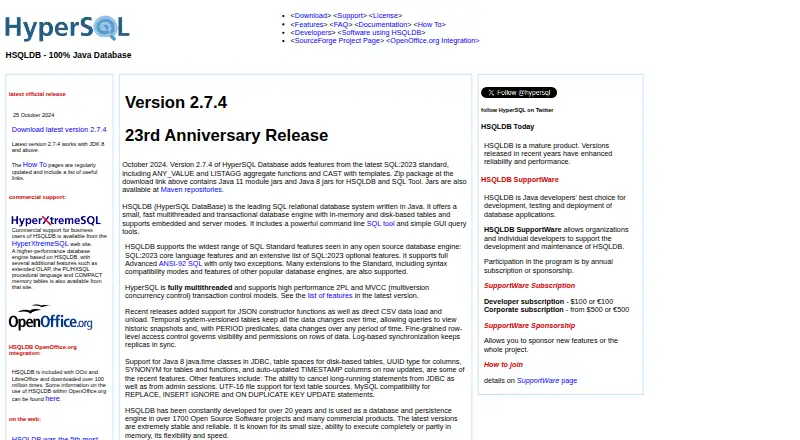
HSQLDB is a Java-based relational database engine with both in-memory and disk-based tables, available in embedded and server modes. It supports SQL:2023 core features and an extensive set of optional features, with lock-based and MVCC transaction models in a fully multithreaded engine. Listed capabilities include JSON constructor functions, CSV loading and unloading, temporal system-versioned tables, row-level access control, and log-based replica synchronization. The software includes a command-line SQL tool and simple GUI query tools. Its latest official release listed is version 2.7.4, compatible with JDK 8 and above; the release package includes Java 11 module jars and Java 8 jars for HSQLDB and SQL Tool. HSQLDB is self-hosted and lists high availability, read replicas, and JSON data support. It can be used in commercial products when license terms are met; its licenses are based on the new BSD License. The HSQLDB database software plan is free. Paid support subscriptions include Developer at $100 a year and Premier Corporate at $2,500 a year at the base level. The project also lists a help forum, user mailing list, issue trackers, and professional support options.
Who it suits
HSQLDB suits developers and organizations looking for a self-hosted Java relational database with embedded or server deployment. It may also fit teams that need SQL tools, transaction choices, or replica-related features.
What it does well
- Supports embedded and server modes.
- Includes in-memory and disk-based tables.
- Supports lock-based and MVCC transactions.
- Database software is free under its licenses.
- Offers command-line and GUI query tools.
What to know first
- Memory tables are limited by available memory.
- TEXT tables are limited to 256GB each.
- CACHED table size defaults to 8TB.
- Paid subscriptions are required for listed priority support.
Limits
The default combined size limit for CACHED tables is 8TB, extendable to 256TB with a connection property. TEXT tables are limited to 256GB each, and memory tables are limited by available memory.
Plans
| Plan | Billed and limits | Price |
|---|---|---|
| Developer subscription | Annual subscription · Priority support · Input into future development | $100 a year |
| Basic Corporate subscription | Less than 50 distributed units | On request |
| Premier Corporate subscription | Base level; annual subscription · For large corporations and large-scale use or distribution · Full deployment support · Enhancement requests | $2,500 a year |
| HSQLDB | Database software is free to use and distribute under its licenses | Free |
| HSQLDB software | Free to use and distribute under BSD-based licenses · Open-source database engine · embedded or server modes | Free |
| SupportWare Developer subscription | $100 annually · Individual developers; priority questions and a say in future development | $100 a year |
| Developer SupportWare | Annual subscription · Individual developer · priority support · input into future development | $100 a year |
| Premier Corporate SupportWare | Annual subscription; base level · Large-scale use or distribution · enhancement requests · full deployment support | $2,500 a year |
The first 8 of 11 plans, as hsqldb.org lists them, read 22 Sept 2026. The maker's own page has the final word. Every plan
Getting started
- Visit the HSQLDB website.
- Choose the free HSQLDB software plan or review the paid subscriptions.
- Use the Java release package that matches your environment; the latest official release listed works with JDK 8 and above.
- Run HSQLDB in embedded or server mode.
- Use the command-line SQL tool or a simple GUI query tool.
HSQLDB is a Java relational database engine that can run inside an application or as a server, using either memory-resident or disk-backed tables. It is best suited to Java teams that want a self-hosted SQL database with substantial standards coverage and deployment control. The principal appeal is a capable, freely usable engine; the cost is that your team owns operations unless it buys support.
Overview
HSQLDB combines embedded and server modes, making it useful for applications that need a local database as well as installations that centralize database access. Its new-BSD-based licensing permits commercial use and distribution when the license terms are met, so product teams can ship it without a per-database software charge. Self-hosting also means responsibility for deployment, maintenance, and capacity planning stays with you.
The engine dates to 2001 and remains particularly relevant where Java compatibility and an embeddable architecture matter. It is not a hosted service with managed infrastructure, so organizations seeking a provider-run database should look elsewhere.
Key features
SQL:2023 core support and an extensive set of optional features give HSQLDB considerably more SQL depth than a minimal embedded store. JSON data support, JSON constructor functions, CSV load and unload, temporal system-versioned tables, and row-level access control cover modern application and governance requirements. These capabilities reduce the need to bolt on separate handling for common data formats and history tracking.
Concurrency is configurable through lock-based or MVCC transaction models, and the engine is fully multithreaded. High availability, read replicas, and log-based replica synchronization provide a foundation for resilient deployments, although implementing and operating that architecture remains your responsibility. Memory tables are constrained by available RAM, while CACHED table data and indexes are written to disk, allowing larger working sets when persistence is more important than memory speed.
A command-line SQL tool and simple GUI query tools support development and administration. Named integrations include OpenOffice, LibreOffice, Spring, Hibernate, Flyway, Liquibase, DBeaver, and Eclipse, which should ease adoption in those ecosystems. Release 2.7.4 works with JDK 8 and newer; packages include Java 11 module jars and Java 8 jars for both HSQLDB and SQL Tool.
Pricing
The HSQLDB plan costs nothing and covers use and distribution under its licenses. There is no free trial because the core software is already free. This is the right tier for individuals, open-source projects, and commercial products that can handle their own support and comply with the license.
The Developer subscription costs $100 a year, billed as an annual subscription. It adds priority support and input into future development, making it suited to individual developers who need a faster route to answers or want a voice in the project. SupportWare Developer subscription is also $100 a year, billed at $100 annually, for individual developers seeking priority questions and development input.
Basic Corporate subscription uses custom pricing and is for fewer than 50 distributed units. Its SupportWare counterpart costs $500 a year, with billing stated as $500-$1000 annually, and targets corporations with limited internal use or fewer than 50 distributed units; it adds priority support and input on future development.
Premier Corporate subscription costs $2,500 a year on a base-level annual subscription. It is intended for large corporations and large-scale use or distribution, with full deployment support and enhancement requests. SupportWare Premier Corporate subscription has the same 2500.00 USD base-level annual price and adds deployment support and enhancement requests. These paid tiers buy assistance and influence, not a hosted database service.
Platforms
HSQLDB supports API, Linux, macOS, self-hosted, and Windows deployments. Its self-hosted model and Java runtime compatibility favor teams comfortable packaging and operating their own database. The FAQ states a default combined CACHED-table limit of 8TB, extendable to 256TB through a connection property; each TEXT table is limited to 256GB. Those ceilings are substantial, but teams should validate their schema and connection configuration before committing to very large datasets.
Who it's for
Choose HSQLDB for Java applications that need embedded operation, server mode, broad SQL functionality, replicas, or commercial redistribution under a permissive license. It also fits teams that value optional paid access to project support and development direction. It is a weaker fit for organizations that want a fully managed cloud database, automatic operations, or a non-Java-centered deployment approach.
Pros and cons
- Pros: Free commercial-capable licensing when terms are met; SQL:2023 core coverage with modern JSON, CSV, temporal, and access-control features; both embedded and server modes; lock-based and MVCC transactions; high availability, read replicas, and replica synchronization; broad Java and tooling integrations.
- Cons: Self-hosting leaves deployment and administration to your team; memory-table capacity depends on available RAM; paid support is needed for priority assistance, deployment help, or formal development input; very large deployments must account for CACHED and TEXT table limits.
Alternatives
SQLite is the simpler choice when you want a free embedded SQL engine with no separate server process and broad platform reach.
H2 Database Engine is another free embedded option, with source code included and no trial requirement.
Azure SQL Database suits readers who prefer a hosted, cross-platform service and a free offer with defined compute, storage, backup, and database quotas.
MySQL is worth considering for a familiar freemium database with a GPL-licensed Community Edition and replication and high-availability components.
InterSystems IRIS is a paid platform with a free Community Edition and trial for teams evaluating a broader commercial database product.
Microsoft SQL Server is an alternative for organizations aligned with Microsoft's editions and volume-licensing model.
Neon is a hosted option with a free tier defined by projects, compute hours, storage, branches, and egress.
C++Builder is a development tool alternative rather than a direct database-engine substitute.
Verdict
HSQLDB is a strong choice for Java developers and product teams that need a capable embedded or self-hosted relational engine without software licensing fees. Its standards coverage, transaction choices, replication features, and permissive commercial licensing are the main reasons to choose it. Look elsewhere if you want managed infrastructure or if your organization cannot take on database operations; paid subscriptions add support, but they do not change the self-hosted deployment model.
Verdict
HSQLDB offers a broad relational database feature set with free software and optional paid support. Check its storage limits and license terms against your deployment needs.
Questions
Is HSQLDB free?
The HSQLDB database software plan is free and is free to use and distribute under its licenses. Commercial use is permitted when the license terms are met.
What do paid subscriptions cost?
The Developer subscription is $100 a year. The Premier Corporate subscription is $2,500 a year at the base level; the Basic Corporate subscription price is not provided in the plan details.
Which operating systems or environments does it support?
The listed platforms are API, Linux, macOS, self-hosted, and Windows. The latest official release listed works with JDK 8 and above.
Is HSQLDB open source?
Its licenses are based on the new BSD License, and the software is free to use in commercial products when the license terms are met.
What support is available?
Options include a help forum, a user mailing list, bug and feature request trackers, paid SupportWare, and professional commercial support.
What are the database size limits?
The default combined size limit for CACHED tables is 8TB, extendable to 256TB with a connection property. Each TEXT table is limited to 256GB.
Facts from HSQLDB's own pages
- Backup
- The engine supports fast startup and shutdown with incremental backup plus online and offline backups and SQL-script dumps. · hsqldb.org, 15 Oct 2026
- Capacity
- Official limits include disk tables up to 8 TB, text tables up to 256 GB and individual CLOB/BLOB storage up to 64 TB. · hsqldb.org, 15 Oct 2026
- Concurrency
- The engine is multithreaded and offers lock-based, MVCC and hybrid transaction-control models. · hsqldb.org, 15 Oct 2026
- Data storage limit
- The FAQ states the default combined size limit for CACHED tables is 8TB, extendable to 256TB with a connection property; TEXT tables are limited to 256GB each. · hsqldb.org, 7 Oct 2026
- Deployment protocols
- Embedded and client-server operation are supported through HSQL, HTTP and HSQL-BER protocols, each with an SSL option. · hsqldb.org, 15 Oct 2026
- Developer tooling
- The distribution includes SQLTool command-line administration, two GUI database managers, a transfer utility and a test/script utility. · hsqldb.org, 15 Oct 2026
- Developer tools
- The product includes a command-line SQL tool and simple GUI query tools. · hsqldb.org, 7 Oct 2026
- Distribution
- The release package includes Java 11 module jars and Java 8 jars for HSQLDB and SQL Tool. · hsqldb.org, 7 Oct 2026
- Documentation depth
- The project publishes HTML, PDF and text guides, JavaDoc for public classes, utilities documentation, examples, tests and SQL scripts. · hsqldb.org, 15 Oct 2026
- Extensibility
- Applications can define Java stored procedures, Java or SQL triggers, aggregate functions and routines with INOUT parameters and multiple result sets. · hsqldb.org, 15 Oct 2026
- Founded
- 2001 · hsqldb.org, 28 Sept 2026
- Free plan
- Yes · hsqldb.org, 22 Sept 2026
- Installation requirement
- Installation consists of downloading and unpacking hsqldb.zip and requires a Java Runtime Environment or JDK. · hsqldb.org, 15 Oct 2026
- Integrations
- The project documents JDBC and ODBC connectivity and integration with OpenOffice.org and LibreOffice. · hsqldb.org, 15 Oct 2026
- Java compatibility
- The latest official release listed is version 2.7.4, which works with JDK 8 and above. · hsqldb.org, 7 Oct 2026
- Java support
- HSQLDB is written entirely in Java; the standard jar targets Java 11+ while an alternative jar supports Java 8+. · hsqldb.org, 15 Oct 2026
- JDBC API
- It provides extensive JDBC support including batch statements, scrollable and updatable ResultSets, metadata, CallableStatement and PreparedStatement. · hsqldb.org, 15 Oct 2026
- Latest release
- The official latest release is version 2.7.4, dated 25 October 2024. · hsqldb.org, 15 Oct 2026
- License
- HSQLDB source and binaries use permissive BSD-based licenses, with separate terms for legacy Hypersonic SQL code. · hsqldb.org, 15 Oct 2026
- Limit: Capterra scale
- One Capterra reviewer says the embedded database is not suitable for a large project, and another notes it is unsupported in newer SAP Commerce Cloud versions. · capterra.com, 15 Oct 2026
- Limit: SourceForge debugging
- A critical SourceForge review complained that older error messages did not identify the failing table or column, making debugging laborious. · sourceforge.net, 15 Oct 2026
- Limit: SourceForge DSV handling
- A reviewer reported that an older SqlTool DSV export failed to escape quotes and line breaks, preventing reliable re-import of multiline data. · sourceforge.net, 15 Oct 2026
- Maker
- HSQLDB is developed and published by The HSQL Development Group, formed in 2001. · hsqldb.org, 7 Oct 2026
- Maker and founding
- The HSQL Development Group is the publisher and says it was formed in 2001. · hsqldb.org, 15 Oct 2026
Where HSQLDB stands on Freedom251
- Sql Databases#1 of 23
- Relational Databases#2 of 38
- Embedded Databases#2 of 30
- Database Software#6 of 74