Freedom251 › Virtual Desktop Infrastructure Software
Hive Fabric
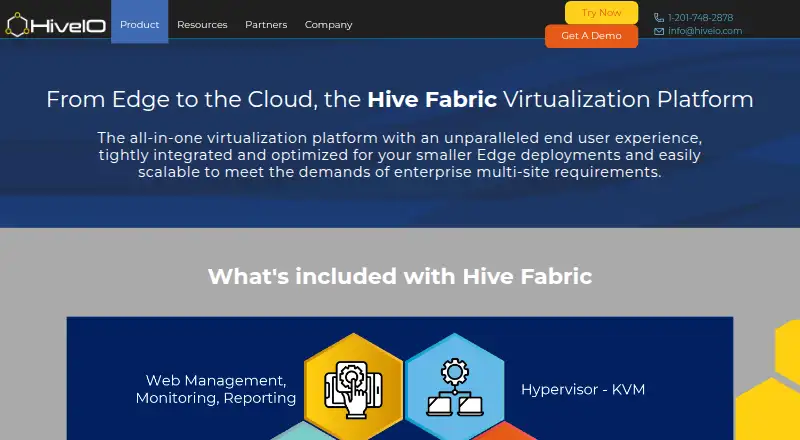
What Hive Fabric is
Hive Fabric is a virtualization platform for Windows and Linux desktop and server workloads, with deployment options suited to edge sites and multi-site environments. It runs on the open-source KVM hypervisor and combines hyperconverged and RAM-based storage with connections to network and cloud storage. A browser portal provides access to desktops, servers, and physical systems through RDP or an integrated HTML5 client. Administrators can manage multiple sites and clusters through one web interface, available from any host in a cluster. Desktop pools can span cluster hosts without shared storage, and workloads support live migration between hosts.
The access gateway supports MFA through RADIUS or token-based two-factor authentication based on Open Auth. Built-in Data Protection can replicate VMs, User Volumes, and Templates to selected cloud or on-premises storage on daily, weekly, or monthly schedules. Hive Sense reviews phone-home data hourly for potential issues and threats and can initiate HiveIO support engagement when it detects anomalies. Installation uses a single ISO. Community Edition costs nothing and has a perpetual license for one physical host and unlimited VMs; activation requires ClusterID registration. Core and Enterprise use annual licensing, with Enterprise also offering monthly consumption licensing.
Who it suits
Hive Fabric suits organizations managing Windows or Linux desktop and server workloads across clusters or multiple sites, including those addressing the cost and complexity of VDI management. Its maker also describes it as suitable for IT generalists.
What it does well
- Runs on the open-source KVM hypervisor.
- One web interface can manage multiple sites and clusters.
- Supports live migration between hosts without shared storage for desktop pools.
- Built-in protection replicates VMs, User Volumes, and Templates.
- Supports MFA through RADIUS or token-based two-factor authentication.
What to know first
- Community Edition is limited to one physical host.
- Community Edition activation requires ClusterID registration.
- Core and Enterprise pricing is through sales or approved distributors.
Limits
Community Edition covers one physical host, although its perpetual license permits unlimited VMs. Core and Enterprise are licensed by VM count or CPU core; full licenses unlock additional features. Enterprise monthly consumption is invoiced in agreed increments.
Plans
| Plan | Billed and limits | Price |
|---|---|---|
| Hive Fabric Community Edition | Perpetual license · single physical host · unlimited VMs | Free |
| Hive Fabric Core | Annual term; pricing through HiveIO sales or approved distributors · Licensed by VM count or CPU core · full license unlocks additional features | On request |
| Hive Fabric Enterprise | Annual term or monthly consumption licensing · Licensed by VM count or CPU core · monthly consumption invoiced in agreed increments | On request |
As hiveio.com lists them, read 4 Oct 2026. The maker's own page has the final word.
Getting started
- Visit the Hive Fabric product website.
- Choose a suitable plan, such as Community Edition, Core, or Enterprise.
- For Community Edition, register a ClusterID for activation.
- Install the software from its single ISO.
- Use the web interface to manage the cluster and workloads.
Hive Fabric combines desktop and server virtualization for teams managing workloads across cluster hosts, edge locations, or multiple sites. It is best suited to IT teams that want storage, browser access, and replication managed in the same platform. Community Edition offers a no-cost way to run unlimited VMs on one host; broader deployments require an annual or consumption-licensed paid plan.
Overview
Built on KVM, Hive Fabric brings Windows and Linux desktops and servers under one virtualization platform. Its built-in hyperconverged and RAM-based storage, plus integrations with network and cloud storage, give administrators several ways to support workloads. That range is useful for organizations with varied infrastructure, though teams seeking only a simple desktop virtualization tool may not need the server and multi-site capabilities.
Installation uses a single ISO, and HiveIO says a cluster can be operational in less than an hour. The platform is also aimed at IT generalists dealing with VDI cost and management complexity. The short installation path may help, but the cluster-level capabilities that distinguish the platform require a paid edition beyond one host.
Key features
- Browser-based access: A portal connects users to desktops, servers, and physical systems through RDP or an integrated HTML5 client. That mix suits environments where users need access to more than virtual desktops.
- Cluster and site administration: Administrators can use the web UI from any host in a cluster and manage multiple clusters and sites from one interface. This is a practical advantage for distributed deployments, while a single-host Community installation cannot exercise the multi-host management model.
- Storage and workload mobility: Hive Fabric combines built-in hyperconverged and RAM-based storage with network and cloud storage integrations. It supports desktop pools across a cluster without shared storage and live migration between hosts, which can suit teams building clusters without shared-storage infrastructure.
- Access security: The access gateway supports MFA through RADIUS or token-based two-factor authentication using Open Auth. This provides an additional access-control option for organizations whose gateway requirements align with those standards.
- Data protection and monitoring: Built-in Data Protection can replicate VMs, User Volumes, and Templates to selected cloud or on-premises storage on daily, weekly, or monthly schedules. Hive Sense checks phone-home data hourly for potential issues and threats and can initiate HiveIO support engagement when it detects anomalies.
- Virtual desktop capabilities: Hive Fabric supports profile management, application virtualization, identity integration, and GPU support, alongside Windows and Linux workloads. These capabilities make it relevant to more than basic desktop hosting, though the licensing basis means the cost of a larger deployment depends on VM count or CPU cores.
Pricing
Hive Fabric uses a freemium model with custom pricing for paid editions. The free Community Edition is priced at free and includes a perpetual license for one physical host with unlimited VMs. Activation requires ClusterID registration. The unlimited VM allowance is generous for a single-host setup, but the one-host cap rules it out for a free multi-host cluster.
Core has custom pricing on an annual term, licensed by VM count or CPU core. A full license unlocks additional features, making it the paid option for teams that need more than Community Edition; buyers should confirm which features their deployment requires with HiveIO or an approved distributor.
Enterprise offers custom pricing on an annual term or monthly consumption licensing. It is also licensed by VM count or CPU core, and monthly consumption is invoiced in agreed increments. That gives larger or changing deployments a consumption option, but the licensing basis and agreed increments mean the price depends on the deployment and purchasing terms.
A free trial is offered. HiveIO also provides technical support by email and can assist with technical evaluations or formal proofs of concept.
Platforms
Hive Fabric is a hybrid deployment platform with Linux, Windows, web, API, and self-hosted availability. Users can connect from Windows, Linux, web browsers, and mobile devices. It supports both desktop types, along with Windows and Linux workloads.
Who it's for
Hive Fabric fits organizations that need desktop and server virtualization across cluster hosts or multiple sites, especially those that value centralized administration, VM and template replication, and storage flexibility. It may also suit IT generalists seeking a consolidated way to manage VDI and server workloads. It is a weaker fit for small teams that need a free multi-host setup, or for buyers who want a published price before discussing deployment size and licensing with sales.
Pros and cons
- Pro: The perpetual Community Edition covers unlimited VMs, keeping a single-host deployment free of recurring license charges.
- Pro: Centralized multi-site management, live migration, and desktop pools without shared storage support cluster-oriented deployments.
- Pro: Scheduled replication and hourly anomaly monitoring add data protection and operational oversight within the platform.
- Con: Community Edition is restricted to one physical host, so it cannot provide a free cluster deployment.
- Con: Core and Enterprise prices depend on VM count or CPU cores and are handled through sales or approved distributors, making direct cost comparison difficult.
- Con: The platform's broad desktop, server, storage, and site-management scope may be more than organizations seeking only a narrow VDI tool need.
Alternatives
QVD is worth considering for developers and testers who want a free community edition and broader client platform coverage, including Android, iOS, and macOS.
ThinLinc may suit teams that want a published free allowance of 10 concurrent users or a paid per-user Standard plan at $122 a year.
Ravada VDI is a free, self-hosted option for teams administering Linux-based servers that want stated KVM support.
Hydra is an alternative for teams considering Windows 365 alongside a community edition with limited tenants and host pools.
Kasm Workspaces may fit teams seeking a free community edition capped at five concurrent sessions and restricted to noncommercial use.
Amazon WorkSpaces is an option for teams seeking a paid desktop service with a published Windows single-session user fee of $4.19 a month, plus provisioned instance-hour charges.
Citrix Workspace is another paid option for teams evaluating desktop and workspace software across multiple client platforms.
IsardVDI is worth considering for teams prioritizing an open-source VDI platform with collaborative development on GitLab.
For a broader category comparison, see Virtual Desktop Infrastructure Software.
Verdict
Choose Hive Fabric if you need to manage desktop and server virtualization across cluster hosts or sites and want storage, access, replication, and monitoring in one platform. Its perpetual single-host Community Edition is a useful entry point, but the one-host limit and custom paid pricing make it a less suitable choice for teams that need a free cluster or transparent multi-host costs.
Verdict
Choose Hive Fabric if you need to manage desktop and server virtualization across cluster hosts or multiple sites, with storage, access, and replication capabilities in one platform. Community Edition is free for a perpetual single-host license; Core and Enterprise are licensed by VM count or CPU core, with pricing handled through HiveIO sales or approved distributors.
Questions
Is Hive Fabric free?
Community Edition costs nothing and uses a perpetual license. Core and Enterprise pricing is available through HiveIO sales or approved distributors.
What does Community Edition include?
It is licensed for one physical host and unlimited VMs. Activation requires ClusterID registration.
Which platforms does Hive Fabric support?
Listed platforms are API, Linux, self-hosted, web, and Windows. Client platforms include Windows, Linux, web browsers, and mobile devices.
Is Hive Fabric open source?
Hive Fabric is built on the open-source KVM hypervisor.
What are the Core and Enterprise plans?
Core is billed annually and licensed by VM count or CPU core. Enterprise offers annual or monthly consumption licensing, also by VM count or CPU core.
What support does HiveIO offer?
HiveIO lists technical support by email and says it can assist with technical evaluations or formal proofs of concept.
Facts from Hive Fabric's own pages
- Administration
- The web UI is accessible from any host in a cluster and can manage multiple sites and clusters from one interface. · hiveio.com, 4 Oct 2026
- Community limits
- Community Edition is limited to one host; its perpetual license covers unlimited VMs and requires ClusterID registration for activation. · hiveio.com, 4 Oct 2026
- Data protection
- Built-in Data Protection can replicate VMs, User Volumes, and Templates to chosen cloud or on-premises storage daily, weekly, or monthly. · hiveio.com, 4 Oct 2026
- Deployment
- The software installs from a single ISO, and the maker says a cluster can be operational in less than an hour. · hiveio.com, 4 Oct 2026
- Desktop access
- A browser-based portal connects to desktops, servers, and physical systems through RDP or an integrated HTML5 client. · hiveio.com, 4 Oct 2026
- Headquarters
- Hoboken, New Jersey, United States · hiveio.com, 28 Sept 2026
- Hypervisor
- The platform is built on the open-source KVM hypervisor. · hiveio.com, 4 Oct 2026
- Integrations
- Hive Fabric supports cloud and network storage technologies, and the maker lists RADIUS as an access-gateway MFA standard. · hiveio.com, 4 Oct 2026
- Intended users
- HiveIO says it helps organizations facing the cost and complexity of VDI management and describes the platform as suitable for IT generalists. · hiveio.com, 4 Oct 2026
- Monitoring
- Hive Sense evaluates phone-home data hourly for potential issues and threats and can initiate HiveIO support engagement when it detects anomalies. · hiveio.com, 4 Oct 2026
- Purpose
- Hive Fabric is an all-in-one virtualization platform for desktop and server workloads, aimed at deployments from edge sites to enterprise multi-site environments. · hiveio.com, 4 Oct 2026
- Security
- Its access gateway supports MFA using RADIUS or token-based two-factor authentication based on Open Auth. · hiveio.com, 4 Oct 2026
- Storage
- It provides built-in hyperconverged and RAM-based storage and integrates with network and cloud storage technologies. · hiveio.com, 4 Oct 2026
- Support
- HiveIO lists technical support by email and says it can assist with technical evaluations or formal proofs of concept. · hiveio.com, 4 Oct 2026
- Workloads
- Hive Fabric supports Windows and Linux workloads and allows desktop pools across a cluster without shared storage, with live migration between hosts. · hiveio.com, 4 Oct 2026