Freedom251 › Quota Management Software

GTMKit Quota Planning
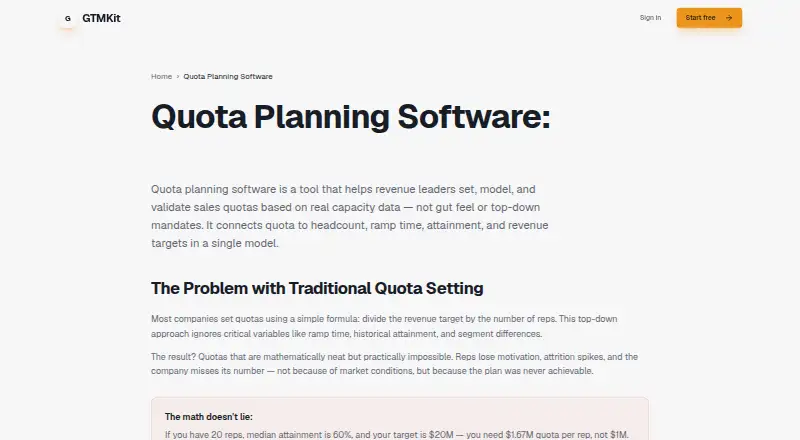
What GTMKit Quota Planning is
GTMKit Quota Planning is web software for sales capacity planning and quota modeling. It connects quotas, ramp time, attainment, and hiring plans in a single capacity plan, with rates and ramp assumptions editable in one place. When assumptions change, capacity calculations update in real time. Teams can add representatives with start dates, quotas, and OTE; GTMKit calculates ramped capacity over time. Users can define monthly or quarterly targets and review where capacity sits above or below them. Scenario planning allows hiring plans to be compared side by side, while a real-time dashboard tracks ramping representatives, quota coverage, and capacity gaps. AI-powered forecasting gives hiring recommendations based on targets and the current team. The product focuses on capacity and quota planning rather than pipeline forecasting, and the site says a quota model can be set up without implementation or consultants. The Starter Plan is free for up to 10 representatives and 2 scenarios, with basic forecasting and email support. Pro costs $199 a month.
Who it suits
GTMKit suits sales leaders, revenue operations, finance teams, and FP&A professionals planning quotas, hiring, and representative capacity. It is focused on capacity and quota planning, not pipeline forecasting.
What it does well
- Combines quota, ramp, attainment, and hiring plans.
- Editable assumptions update real-time capacity calculations.
- Compare hiring scenarios side by side.
- Tracks quota coverage and capacity gaps.
- Starter Plan supports up to 10 representatives.
What to know first
- Starter Plan allows only 2 scenarios.
- Starter Plan has basic forecasting.
- Pro costs $199 a month.
- Focuses on capacity planning rather than pipeline forecasting.
Limits
The Starter Plan costs nothing and covers up to 10 representatives, two scenarios, basic forecasting, and email support. Pro costs $199 a month and includes unlimited representatives and scenarios, an AI GTM Agent, priority support, and custom segments.
Plans
| Plan | Billed and limits | Price |
|---|---|---|
| Starter Plan | $0/month · Up to 10 reps · 2 scenarios · Basic forecasting · Email support | Free |
| Pro Plan | $199/month · Unlimited reps · Unlimited scenarios · AI GTM Agent · Priority support · Custom segments | $199 a month |
As gtmkit.io lists them, read 15 Oct 2026. The maker's own page has the final word.
Getting started
- Open the GTMKit Quota Planning website.
- Use the web product and choose the Starter Plan at no cost or the Pro Plan at $199 a month.
- Set up a quota model; the site says implementation and consultants are not needed.
- Add representatives with their start dates, quotas, and OTE.
- Define monthly or quarterly targets and model hiring scenarios.
GTMKit Quota Planning is sales capacity and quota modeling software for connecting team growth, ramp and targets. It suits sales, revenue operations and finance teams that need a shared view of capacity, rather than a pipeline forecast. Its strongest case is a live planning model with side-by-side scenarios; the trade-off is that the free plan caps both team size and scenario count.
Overview
Quota, ramp time, attainment and hiring plans feed into one capacity model. Rates, quotas and ramp assumptions are editable in one place, and changes update capacity calculations in real time. That gives sales and finance a common set of assumptions to work from instead of disconnected planning inputs.
GTMKit is deliberately focused on capacity and quota planning, not pipeline forecasting. It also presents itself as requiring no implementation or consultants to set up a quota model, a practical fit for teams that want to model plans without a separate implementation effort.
Key features
- Scenario planning: Model different hiring plans and compare them side by side. This makes it easier to weigh staffing choices against targets, although the Starter plan allows only two scenarios.
- Capacity and ramp tracking: Add representatives with start dates, quotas and OTE, then calculate ramped capacity over time. A real-time dashboard tracks ramping representatives, quota coverage and capacity gaps.
- Target setting: Set monthly or quarterly targets and see whether modeled capacity sits above or below them. This connects headcount assumptions to the planning period that matters.
- AI forecasting: Pro includes an AI GTM Agent for forecasting and hiring recommendations based on targets and the current team. Starter has basic forecasting, so teams that need the AI tier must pay for Pro.
Pricing
The pricing model is freemium, with a free plan and a free trial. The published monthly plan terms are:
- Starter Plan — free: Up to 10 reps, two scenarios, basic forecasting and email support. It is a sensible starting point for a small team testing capacity planning, but the representative and scenario caps limit its usefulness as the plan grows.
- Pro Plan — $199 a month: Unlimited representatives and scenarios, AI GTM Agent, priority support and custom segments. It fits teams that need broader scenario coverage or the AI hiring recommendations, at a fixed monthly price rather than the free plan's caps.
Platforms
GTMKit Quota Planning is available on the web.
Who it's for
Sales leaders, revenue operations, finance teams and FP&A professionals are the intended users. It is best suited to groups that need to connect hiring and ramp assumptions to quota capacity, with sales and finance working from a single current plan. Teams looking primarily for pipeline forecasting should choose a different focus.
Pros and cons
- Pro: Quota, ramp, attainment and hiring assumptions share one model, so changes can flow through to capacity calculations immediately.
- Pro: Side-by-side scenario comparisons and monthly or quarterly targets make the staffing-to-capacity trade-off explicit.
- Con: Starter's 10-representative and two-scenario limits may force growing teams to move to Pro for broader planning.
- Con: GTMKit focuses on capacity and quota, so it is not the fit for teams seeking pipeline forecasting.
Alternatives
For a broader starting point, browse Quota Management Software. Consider Salesforce Sales Cloud if a free CRM suite or per-user Starter plan better matches your needs; its Free Suite costs nothing and includes 10GB per org, while Starter Suite is $25 a month per user.
Optymyze is a paid alternative available on Android, API, iOS and web. Forma.ai is another paid option, with onboarding and implementation handled by Forma.ai and tailored platform proposals. For a paid platform whose listed option calls for a demo, consider OneStream. Workday Adaptive Planning is paid and offers a 30-day free trial. Jedox is a paid web option with Business and Professional plans. Pigment is a paid web alternative. Varicent Incentive Compensation Management is paid, has no free plan or free trial, and prices by package, payees and add-ons.
Verdict
GTMKit Quota Planning is a strong fit for sales and finance teams that want to connect hiring decisions to quota capacity in one current model. Scenario comparisons and live capacity updates are the reasons to choose it; the main reasons to look elsewhere are a need for pipeline forecasting or a team too large for Starter's caps to make the free plan sufficient.
Verdict
GTMKit brings quota, hiring, and ramp assumptions into one capacity model with scenario comparisons and tracking. The free Starter Plan is limited to 10 representatives and 2 scenarios; Pro adds unlimited representatives and scenarios for $199 a month.
Questions
How much does GTMKit Quota Planning cost?
The Starter Plan is free. The Pro Plan is $199 a month.
What does the free plan include?
Starter includes up to 10 representatives, two scenarios, basic forecasting, and email support.
Is there a free trial?
Yes, a free trial is listed.
Which platform does it support?
It is available on the web.
What is included in Pro?
Pro includes unlimited representatives and scenarios, an AI GTM Agent, priority support, and custom segments.
Who is GTMKit Quota Planning designed for?
It is designed for sales leaders, revenue operations, finance teams, and FP&A professionals.
Facts from GTMKit Quota Planning's own pages
- AI forecasting
- The product offers AI-powered forecasting with hiring recommendations based on targets and the current team. · gtmkit.io, 15 Oct 2026
- Assumptions
- Rates, quotas, and ramp assumptions are visible and editable in one place. · gtmkit.io, 1 Oct 2026
- Attainment validation
- Historical attainment data is used to test whether proposed quotas are achievable. · gtmkit.io, 15 Oct 2026
- Audience
- The stated audience includes sales leaders, revenue operations, finance teams and FP&A professionals. · gtmkit.io, 15 Oct 2026
- Capacity dashboard
- Its dashboard tracks ramping representatives, quota coverage and capacity gaps in real time. · gtmkit.io, 15 Oct 2026
- Capacity gap view
- The product shows the difference between assigned quota and expected capacity as assumptions change. · gtmkit.io, 15 Oct 2026
- Capacity math
- Changes propagate instantly through real-time capacity calculations. · gtmkit.io, 1 Oct 2026
- Dashboard
- The real-time dashboard tracks ramping representatives, quota coverage, and capacity gaps. · gtmkit.io, 1 Oct 2026
- Editable assumptions
- Rates, quotas and ramp assumptions are visible and editable in one place. · gtmkit.io, 15 Oct 2026
- Industry context
- Gartner describes capacity-based hunter-quota allocation as a way to produce more defensible targets and avoid inflated sales costs. · gartner.com, 15 Oct 2026
- Industry context: hiring timing
- An independent sales-planning guide states that hiring dates determine when productive capacity exists in a plan. · hushh.ai, 15 Oct 2026
- Industry context: planning variables
- Anaplan describes go-to-market capacity planning as linking sales coverage, headcount and revenue objectives. · anaplan.com, 15 Oct 2026
- Industry context: ramp
- An independent GTM playbook describes ramp schedules and expected first-year yield as core inputs to capacity models. · wesbecher.llc, 15 Oct 2026
- Limit: Forecasting depth
- Starter includes basic forecasting, while the Pro plan advertises the AI GTM Agent. · gtmkit.io, 15 Oct 2026
- Limit: pipeline forecasting
- Teams needing pipeline-based forecasting may find the stated product scope limited because GTMKit centers on structural capacity planning. · gtmkit.io, 15 Oct 2026
- Limit: Starter representatives
- The free Starter tier is limited to ten representatives. · gtmkit.io, 15 Oct 2026
- Limit: Starter scenarios
- The free Starter tier is limited to two scenarios. · gtmkit.io, 15 Oct 2026
- Name-match criticism (different product)
- One WordPress reviewer reported that GA4 tracking did not work and described four days of troubleshooting; this complaint concerns the separate plugin. · wordpress.org, 15 Oct 2026
- Name-match developer documentation (different product)
- The separate WordPress repository documents Composer and npm installation, PHP and JavaScript test harnesses, hooks and filters, and a private day-to-day development repository. · github.com, 15 Oct 2026
- Name-match licence (different product)
- The separate WordPress GTM Kit plugin is open source under GPLv3 or later. · github.com, 15 Oct 2026
- Name-match praise (different product)
- Other WordPress reviewers praised the separate plugin for straightforward setup, responsive support and reliable ecommerce event tracking. · wordpress.org, 15 Oct 2026
- Name-match warning
- WordPress.org lists a different product named “GTM Kit – Google Tag Manager & GA4 integration”; it is a WordPress plugin rather than quota-planning software. · wordpress.org, 15 Oct 2026
- Planning focus
- GTMKit distinguishes capacity and quota planning from pipeline forecasting and says it focuses on the former. · gtmkit.io, 15 Oct 2026
- Planning model
- The product combines headcount, quota, ramp time, attainment and hiring plans in one planning model. · gtmkit.io, 15 Oct 2026
Where GTMKit Quota Planning stands on Freedom251
- Quota Management Software#1 of 25
- Sales Capacity Planning Software#2 of 18