Freedom251 › Gradebook Software
Gradebook.ng
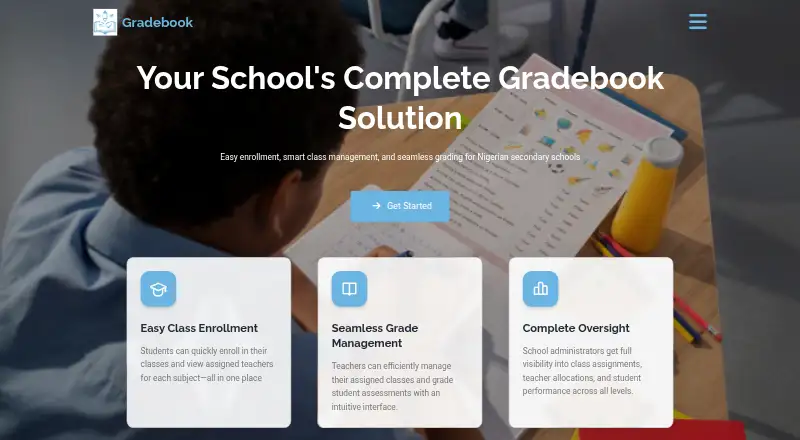
What Gradebook.ng is
Gradebook.ng is a web-based school management system built on the Scola platform for Nigerian secondary schools. Its admissions portal lets families submit applications and follow their review status. The grading system records assessments, applies configured formulas and generates report cards; the FAQ also says it supports Junior WAEC (BECE) and Senior WAEC (WASSCE) registration. E-Transcript creates academic transcripts and digital certificates that can be exported as PDFs and checked for authenticity. Fee Payment tracks payments and balances, issues receipts, supports installments and connects payment status with student records. The FAQ describes encrypted data transmission, secure cloud storage, regular backups and access controls, and says school data is not shared with third parties. Student records, grade reports and financial data can be exported in formats such as Excel or PDF. The free plan covers up to 50 students. Junior Secondary costs 15,000 NGN a year and supports up to 200 students; Senior Secondary costs 30,000 NGN a year and allows unlimited students. Both annual plans also offer per-term payment options.
Who it suits
It is intended for secondary-school students, teachers, bursars, administrators and parents. Schools need internet access to use the cloud-based service.
What it does well
- Families can follow admissions review status online.
- Supports registration for Junior and Senior WAEC.
- Transcripts and digital certificates support PDF export.
- Fee Payment supports installments and issues receipts.
- Student, grade and financial records can be exported.
What to know first
- Cloud-based use requires internet access.
- Free plan is limited to 50 students.
- Junior Secondary plan supports up to 200 students.
Limits
The Free Plan covers up to 50 students and essential grade management. The Junior Secondary Plan supports up to 200 students; the Senior Secondary Plan supports unlimited students and covers JSS 1 through SSS 3.
Plans
| Plan | Billed and limits | Price |
|---|---|---|
| Free Plan | indefinitely · up to 50 students · essential grade management | Free |
| Junior Secondary Plan | annually; per-term payment option offered · JSS 1–3 · up to 200 students · comprehensive features | 15,000 NGN a year |
| Senior Secondary Plan | annually; per-term payment option offered · JSS 1–3 and SSS 1–3 · unlimited students · advanced features · priority support | 30,000 NGN a year |
As gradebook.ng lists them, read 15 Oct 2026. The maker's own page has the final word.
Getting started
- Open the Gradebook.ng website.
- Choose the Free Plan, Junior Secondary Plan, or Senior Secondary Plan.
- Use the service with an internet connection.
- Use the listed video tutorials or written guides for onboarding.
- Contact support by email or phone; Senior Secondary Plan users can receive live staff training.
Gradebook.ng is a school management system for Nigerian secondary schools, with workflows spanning admissions, exams, assessments and finance. It is strongest for schools that want those records connected, particularly those handling WAEC registration. The right plan depends on grade range and enrollment: the Junior plan stops at JSS 1–3 and 200 students, while the Senior plan extends through SSS 3 with no stated student cap.
Overview
Families can apply through the admissions portal and follow their application’s review status. Gradebook also supports registration for Junior WAEC (BECE) and Senior WAEC (WASSCE), making it relevant to schools managing those exam processes as part of their broader records work.
Assessment formulas can be configured to generate report cards, and progress reports plus a parent/student portal extend the system beyond staff administration. E-Transcript produces transcripts and digital certificates, with PDF export and authenticity verification. Fee Payment tracks balances and payments, issues receipts and accommodates installments, with payment status connected to student records.
Cloud access requires an internet connection, so schools needing offline use should look elsewhere. Gradebook describes encrypted data transmission, secure cloud storage, regular backups and access controls; it also says school data is not shared with third parties. Records, grade reports and financial data can be exported in formats such as Excel or PDF, which offers a route to take core records elsewhere.
Key features
Academic and administrative workflows
The combination of admissions, grading, transcripts, WAEC registration and fee tracking gives secondary schools a broad set of connected tasks in one system. Configurable grading formulas and report cards suit routine assessment, while transcript verification can help recipients confirm digital credentials. Payment tracking and installment arrangements are useful for bursars managing balances, though the Fee Payment page identifies no third-party integrations.
Support and access
Video tutorials, written guides, email and phone support are offered; Senior Secondary Plan users also get live staff training. That training may matter to schools rolling out a wider workflow set. Gradebook is web-based, and its cloud model makes internet access a practical requirement for staff and families using it.
Pricing
The Free Plan costs nothing and supports up to 50 students with essential grade management. It is a sensible starting point for a small school focused on grading, but the stated scope is narrower than the admissions, exam, transcript and fee workflows that distinguish the broader system.
The Junior Secondary Plan costs 15,000 NGN a year, billed annually, with per-term payment options also offered. It covers JSS 1–3, up to 200 students and comprehensive features. This fits a junior secondary school within that enrollment ceiling; schools above 200 students or serving senior grades need another option.
The Senior Secondary Plan costs 30,000 NGN a year, billed annually, also with per-term payment options. It covers JSS 1 through SSS 3, unlimited students, advanced features and priority support. For schools spanning junior and senior secondary, its broader grade coverage and lack of a stated student cap make the higher annual price easier to justify, particularly if priority support matters. The pricing note also includes a 30-day trial.
Platforms
Gradebook.ng is web-based and requires internet access. It suits schools whose staff, students and families can work online, not settings that need an offline gradebook.
Who it's for
The system is intended for secondary-school students, teachers, bursars, administrators and parents. It is most compelling for Nigerian schools that need WAEC registration and want academic records, family applications and fee balances handled together. A small school seeking only basic grading may find the free plan adequate; schools with broader grade coverage or larger enrollment should consider the paid tiers.
Pros and cons
- Pros: Admissions, WAEC registration, grading, transcripts and fee tracking address several distinct secondary-school workflows in one service.
- Pros: Exportable student, grade and financial records, along with PDF transcripts and certificates, support record keeping and credential sharing.
- Pros: The Senior plan covers JSS 1 through SSS 3 with unlimited students and adds priority support.
- Cons: The free plan is capped at 50 students and limited to essential grade management, so it may not cover a school seeking the full workflow set.
- Cons: The Junior plan is capped at 200 students and JSS 1–3, excluding larger schools and senior classes.
- Cons: Internet access is required, and no third-party payment integrations are identified.
Alternatives
Gradebook Software is the broader category directory for comparing gradebook options. For a smaller free web-based classroom tool, Gradebox offers one classroom and 120 single-page assignment submissions or grades per month on its free plan; its $11.99 a month Pro plan is an option for readers considering a paid tier. NavEd Free Gradebook is another free web option, but its free-forever plan is limited to one class and 10 students.
SimpleGradebook may suit readers looking for a freemium option across Android, iOS and web, while GradingPal is a web-based freemium alternative with no free trial. Schools considering a paid option with mobile, desktop and web platforms can compare Jupiter, which includes gradebook, communications and administration, with scheduler, enrollment, payments and state reporting as optional upgrades. Smart Teacher, ThinkWave and GradeForge are also alternatives.
Verdict
Choose Gradebook.ng if your Nigerian secondary school wants WAEC processes, assessment, transcripts, admissions and fee tracking connected to student records, and can work online. Its strongest case is the breadth of school-specific workflows, with the Senior plan offering the clearest fit for schools spanning JSS through SSS or exceeding 200 students. Look elsewhere if offline access is essential or if a small, single-class gradebook better matches your needs.
Verdict
Gradebook.ng brings admissions, grading, WAEC registration, transcripts and fee tracking together for Nigerian secondary schools. The free plan covers up to 50 students, while paid annual options include per-term payment choices.
Questions
Is Gradebook.ng free?
Yes. Its Free Plan costs nothing and supports up to 50 students with essential grade management.
What are the paid plan prices?
Junior Secondary Plan costs 15,000 NGN a year, and Senior Secondary Plan costs 30,000 NGN a year. Both are billed annually and offer per-term payment options.
Which platforms can I use it on?
Gradebook.ng is available on the web and requires internet access because it is cloud-based.
Who is Gradebook.ng for?
It is built for Nigerian secondary schools and is described for use by students, teachers, bursars, school administrators, and parents.
Can student and school records be exported?
Yes. Student records, grade reports, and financial data can be exported in formats such as Excel or PDF.
What support and onboarding are available?
The FAQ lists video tutorials, written guides, email and phone support, and live staff training for Senior Secondary Plan users.
Facts from Gradebook.ng's own pages
- Academic history
- The system preserves student grades across subjects, terms and school years. · gradebook.ng, 15 Oct 2026
- Administrator oversight
- Administrators receive visibility into class assignments, teacher allocations and student performance. · gradebook.ng, 15 Oct 2026
- Admissions
- The admissions module accepts online applications, required information, uploaded documents and application-status tracking. · gradebook.ng, 15 Oct 2026
- Admissions security
- Applicant information is described as encrypted and restricted to authorized admissions staff. · gradebook.ng, 15 Oct 2026
- Admissions workflow
- Accepted applicants can be transferred into enrolled-student records without re-entering their data. · gradebook.ng, 15 Oct 2026
- Assessment recording
- Teachers can enter continuous-assessment and examination scores directly into the grading system. · gradebook.ng, 15 Oct 2026
- Automatic calculations
- Configured grading formulas are applied automatically across students and subjects. · gradebook.ng, 15 Oct 2026
- Class enrollment
- Students can enroll in classes and see the teachers assigned to their subjects. · gradebook.ng, 15 Oct 2026
- Cloud requirement
- The FAQ states that Gradebook is cloud-based and requires an internet connection. · gradebook.ng, 15 Oct 2026
- Data portability
- The FAQ says users can export student records, grade reports, and financial data in formats such as Excel or PDF. · gradebook.ng, 3 Oct 2026
- Digital certificates
- Schools can issue digitally verifiable certificates for completion, achievement and participation. · gradebook.ng, 15 Oct 2026
- Enrollment
- The admissions portal lets families submit applications online and track their review status. · gradebook.ng, 3 Oct 2026
- E-transcripts
- E-Transcript creates complete or partial academic transcripts from stored results. · gradebook.ng, 15 Oct 2026
- Export formats
- Transcript records can be exported in formats including PDF. · gradebook.ng, 15 Oct 2026
- Fee tracking
- Fee Payment records school, examination, materials, excursion and extracurricular payments in student financial profiles. · gradebook.ng, 15 Oct 2026
- Financial reporting
- Bursars can monitor collections, outstanding balances and financial reports by fee category. · gradebook.ng, 15 Oct 2026
- Grades and reports
- The grading system records assessments, applies configured grading formulas, and generates report cards. · gradebook.ng, 3 Oct 2026
- Headquarters
- Wuse 1, Abuja, Nigeria · gradebook.ng, 28 Sept 2026
- Installments
- The fee module supports installment and flexible payment arrangements. · gradebook.ng, 15 Oct 2026
- Integration
- The Fee Payment page says payment status is integrated with student records; no third-party integrations are identified on that page. · gradebook.ng, 3 Oct 2026
- Intended users
- The service is presented for students, teachers, bursars, administrators and parents. · gradebook.ng, 15 Oct 2026
- Internet requirement
- Gradebook is cloud-based and requires internet access to use. · gradebook.ng, 3 Oct 2026
- Maker headquarters
- Gradebook lists Wuse 1, CBD, Abuja, Federal Capital Territory, Nigeria as its address. · gradebook.ng, 15 Oct 2026
- Maker news
- A HASOB LinkedIn post describes ScolaNG as part of an education-focused digital ecosystem combining academic utilities and administrative automation. · linkedin.com, 15 Oct 2026
Where Gradebook.ng stands on Freedom251
- Gradebook Software#1 of 24