Freedom251 › RCS Messaging Platforms

Google RCS for Business
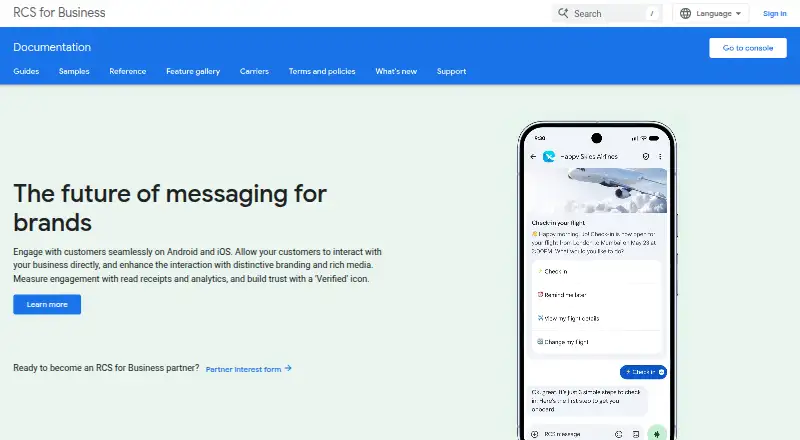
What Google RCS for Business is
Google RCS for Business lets brands send branded rich-media messages to customers on Android and iOS, with read receipts, analytics, and a Verified icon. Agents can deliver one-way notifications or support two-way conversations about transactions, customer service, promotions, and other business needs. Rich cards, media, and suggested interactions can guide a conversation. Agents send messages through an API using HTTP requests with JSON payloads, while configured webhooks receive user messages and events. Agent logic can use a natural language understanding module such as Dialogflow to decide on responses. Google lists one-time password, transactional, promotional, and multi-use agent types, though rules can vary by country. Businesses typically work with messaging partners to build and maintain agents; launches require brand verification and approval by Google, carriers, or both. Carriers set rates through rate cards, with billing methods differing by message category. Unsupported devices receive a 404 response, so agents should use another channel such as SMS. RBM does not provide end-to-end encryption, and Google states it is not HIPAA compliant.
Who it suits
RCS for Business suits brands building customer messaging agents for Android and iOS, including notification and conversational use cases. Businesses should be prepared to work with messaging partners and meet launch approval requirements.
What it does well
- Supports branded rich media and Verified icons
- Offers API access and webhook support
- Supports one-way notifications and two-way conversations
- Provides read receipts and delivery analytics
What to know first
- Pricing depends on carrier rate cards
- Unsupported devices require another messaging channel
- Messages are not end-to-end encrypted
- Not HIPAA compliant
Limits
There is no fixed public price stated; carriers set rates through rate cards, based on destination region and conversational or non-conversational billing category. For unsupported devices, the agent should use another technology such as SMS. RBM does not provide end-to-end encryption and is not HIPAA compliant; healthcare messages must exclude protected health information.
Plans
| Plan | Billed and limits | Price |
|---|---|---|
| Carrier rate card billing | Carrier rate card; pricing depends on destination region and the agent’s conversational or non-conversational billing category. · No fixed public price stated · US carriers set prices · non-US rates follow carrier rate cards | On request |
As developers.google.com lists them, read 3 Oct 2026. The maker's own page has the final word.
Getting started
- Open the Google RCS for Business website.
- Work with a messaging partner to build and maintain an agent.
- Use the RCS Business Messaging API to send messages and configure webhooks for user messages and events.
- Complete brand verification and required Google or carrier approval before launch.
- Arrange a direct carrier agreement if pursuing a carrier-managed launch.
- Plan another messaging technology, such as SMS, for devices that do not support RCS.
Google RCS for Business is a developer-oriented channel for verified, branded customer messaging on Android and iOS. It fits organizations that can build agents themselves or work with an RCS partner and need interactive notifications, support, or promotions. The trade-off is operational: carrier billing, approval steps, device fallback, and limits around encryption and healthcare data all require planning.
Overview
Businesses can use agents for one-way alerts or two-way conversations covering transactions, customer service, promotions, and other needs. Verified sender identity, read receipts, and delivery analytics make messages more recognizable and measurable than ordinary text. Rich cards, media, and suggested actions are useful when a customer needs to choose, confirm, or continue a conversation rather than simply receive an alert.
Reach is not universal. If a device cannot use RCS, the platform returns a 404 error, so the agent should hand the interaction to another channel such as SMS. That fallback is essential for dependable coverage across a customer base.
Key features
Agent workflows and integration
The RCS Business Messaging API accepts HTTP requests with JSON payloads, and webhooks deliver incoming messages and event notifications. This supports connections to transaction systems, support tools, and other business logic, but it is an implementation project rather than a no-code inbox. Response logic can incorporate a natural-language understanding service such as Dialogflow, which suits automated support and guided self-service.
Rich, measurable conversations
Rich cards, media, and suggested responses let an agent present structured choices and branded content. Two-way messaging supports replies, while delivery analytics and read receipts provide feedback on message progress and engagement. These features are most valuable for journeys where a customer must act; they add less value to simple bulk notices.
Use cases and reach
Google identifies one-time-password, transactional, promotional, and multi-use agent categories. Rules can vary by country, so a global rollout needs market-by-market review. Businesses generally work with aggregators, CPaaS providers, carriers, or other RCS solution providers to build and maintain agents. Launches require brand verification and approval from Google, carriers, or both; a carrier-managed launch also requires a direct carrier agreement.
Security and compliance
RBM and its RCS infrastructure are independently audited annually and hold ISO 27001, SOC 2, and SOC 3 certifications. Encryption protects traffic between user devices and Google servers and between Google servers and messaging partners, but there is no end-to-end encryption and businesses cannot control the keys. Google also states that RBM is not HIPAA compliant, so healthcare use must exclude protected health information.
Pricing
Carrier rate card billing
Pricing is custom rather than a fixed subscription. Messaging is billed under Standard or US models, with carriers setting rates through their rate cards. Conversational and non-conversational messages use different billing methods, and destination region affects the charge. US carriers set their own prices; outside the US, rates follow carrier rate cards. This model suits companies prepared to forecast volume by market, but it makes costs harder to compare or predict than a published per-message plan. There is no stated free plan, trial period, seat allowance, or included quota.
Platforms
Google supports Android, iOS, web, and API access. The API and webhook model is the practical center of the product, while the mobile and web reach depends on whether each recipient's device supports RCS.
Who it's for
Choose it if your organization needs a verified brand identity, rich two-way journeys, and programmable integration with customer or transaction systems, and can support agent development, partner coordination, approvals, and channel fallback. It is a poor fit for teams seeking a ready-made campaign interface, predictable public pricing, end-to-end encryption, or HIPAA-compliant handling of protected health information.
Pros and cons
- Pros: Verified senders, rich cards and media, suggested replies, read receipts, and delivery analytics make customer interactions more actionable and trackable.
- Pros: HTTP API, JSON payloads, webhooks, and optional Dialogflow integration allow detailed automation and integration with existing systems.
- Pros: Annual independent audits plus ISO 27001, SOC 2, and SOC 3 certifications provide a substantial security assurance baseline.
- Cons: Carrier rate cards and separate billing categories make destination-by-destination cost forecasting necessary.
- Cons: Brand and carrier approvals, and a direct carrier agreement for carrier-managed launches, can lengthen deployment.
- Cons: Unsupported devices require an SMS or other fallback, while the absence of end-to-end encryption and HIPAA compliance excludes some sensitive workloads.
Alternatives
For a broader shortlist, see RCS Business Messaging Software and RCS Messaging Platforms.
- nativeMsg RCS Business Messaging is worth considering when you need a free, permanent test mode with one RCS agent and unlimited messages to five registered test devices.
- Bandwidth Messaging API is the better choice when SMS APIs and a free trial matter more than RCS-specific reach; its listed US 10DLC outbound price is $0.00 per message and short-code outbound is $0.01 per message.
- Gupshup suits teams wanting API and web access with a free plan and a stated $0.001 per-message Gupshup fee, with WhatsApp fees billed at actuals.
- SimplyRCS fits buyers who prefer a freemium RCS builder, including pay-as-you-go access at $0 platform cost plus published messaging rates.
- Dotgo RCS is an alternative for businesses seeking a managed RBM hub with carrier coverage, API access, and analytics.
- Concepto Móvil RCS API is preferable if a 14-day, no-commitment free trial and credits that do not expire are useful.
- HighConnexion RCS is another paid RCS option with Android, API, and iOS support.
- BuzZync RCS Messaging is a paid, usage-based alternative for API and web deployments.
Verdict
Google RCS for Business is a strong choice for technically capable organizations that want verified, media-rich, programmable conversations and can manage carrier economics, approvals, and fallback channels. Look elsewhere if you need transparent subscription pricing, turnkey operation, end-to-end encryption, or compliant handling of protected health information.
Verdict
RCS for Business provides API-based branded messaging, with carrier pricing and launch approvals to plan for. Its encryption and healthcare compliance limits may rule it out for some uses.
Questions
How is Google RCS for Business priced?
Pricing is on request, and there is no fixed public price stated. Carriers set rates through rate cards, with billing depending on destination region and conversational or non-conversational category.
What platforms does it support?
The listed platforms are Android, API, iOS, and web.
Can agents handle two-way conversations?
Yes. Agents can send one-way notifications or support back-and-forth conversations.
How do businesses send messages and receive replies?
Agents send messages through the RCS Business Messaging API using HTTP requests with JSON payloads. Configured webhooks receive user messages and events.
What approval is needed to launch?
Launch requires brand verification and approval by Google, carriers, or both. Carrier-managed launches require a direct carrier agreement.
Does RBM provide end-to-end encryption or HIPAA compliance?
No. Google says RBM does not provide end-to-end encryption and is not HIPAA compliant; healthcare messages must exclude protected health information.
Facts from Google RCS for Business's own pages
- API and webhooks
- Agents send messages through the RCS Business Messaging API using HTTP requests with JSON payloads, and receive user messages and events through configured webhooks. · developers.google.com, 3 Oct 2026
- Billing
- Messaging is billable under Standard or US models, and carriers determine rates through their rate cards; conversational and non-conversational categories use different billing methods. · developers.google.com, 3 Oct 2026
- Business messaging
- Agents can send one-way notifications or support back-and-forth conversations about transactions, customer service, promotions, and other business needs. · developers.google.com, 3 Oct 2026
- Compliance limits
- Google states that RBM is not HIPAA compliant; healthcare messages are supported only when they exclude protected health information. · developers.google.com, 3 Oct 2026
- Encryption limits
- Messages are encrypted between user devices and Google servers and between Google servers and messaging partners, but RBM does not provide end-to-end encryption and businesses cannot control the encryption keys. · developers.google.com, 3 Oct 2026
- Fallback
- If a user’s device does not support RCS, the platform returns a 404 error and the agent should use another technology such as SMS. · developers.google.com, 3 Oct 2026
- Integration
- Agent logic can use a natural language understanding module such as Dialogflow to decide how to respond to a user. · developers.google.com, 3 Oct 2026
- Launch requirements
- Launching an agent involves brand verification and approval by Google, carriers, or both, and carrier-managed launches require a direct carrier agreement. · developers.google.com, 3 Oct 2026
- Partner access
- Businesses typically work with messaging partners such as aggregators, CPaaS providers, carriers, and other RCS solution providers to build and maintain agents. · developers.google.com, 3 Oct 2026
- Purpose
- RCS for Business lets brands engage customers on Android and iOS with branded rich media messaging, read receipts, analytics, and a Verified icon. · developers.google.com, 3 Oct 2026
- Rich interactions
- Agents use rich cards, media, and suggestions to guide conversations with users. · developers.google.com, 3 Oct 2026
- Security certifications
- Google says RBM and its RCS infrastructure are independently audited annually and hold ISO 27001, SOC 2, and SOC 3 certifications. · developers.google.com, 3 Oct 2026
- Support
- Google provides an RCS for Business support page with a contact option for support and expertise. · developers.google.com, 3 Oct 2026
- Use cases
- Google lists four agent use cases: one-time passwords, transactional, promotional, and multi-use, with rules that can vary by country. · developers.google.com, 3 Oct 2026
Where Google RCS for Business stands on Freedom251
- RCS Messaging Platforms#8 of 34
- RCS Business Messaging Software#8 of 29