Freedom251 › Guitar Amp Software
Gjalla
What Gjalla is
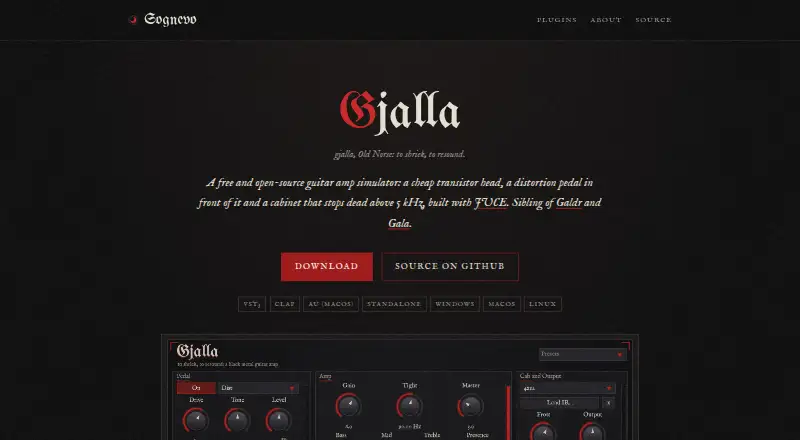
Gjalla is a free, open-source guitar amp simulator from Sognevo, a one-person audio plugin project focused on black metal and other dark music. Its signal chain runs from input trim and noise gate through pedal, preamp, tone stack, power section, presence, cabinet, frost, and output trim. The pedal offers three voicings: 90s-style distortion, an HM-2-style chainsaw, and starved transistor fuzz. Three analytic cabinet voicings are included, and the simulator can load WAV or AIFF impulse responses up to two seconds. Users can also switch off its cabinet when using an external IR loader. Gjalla includes six factory presets, input and output meters, editable knob values, undo and redo, and a resizable interface with tooltips. It reports 6 samples of host latency, stated as 0.13 ms at 48 kHz. Plugin formats are VST3 and CLAP, with AU for macOS; standalone versions are available for Windows, macOS, and Linux. There is no packaged release yet: Sognevo directs users to build the software from source or follow the GitHub releases page. Building requires Git, CMake 3.22 or later, and a C++20 compiler. Gjalla is GPLv3 or later and has no telemetry, network access, update checks, or accounts.
Who it suits
Gjalla is for guitarists and producers seeking a free, open-source amp simulator for black metal or other raw, dark styles. It suits people who can build from source or use compatible plugin formats in a DAW, as well as those wanting a standalone app.
What it does well
- Free and licensed under GPLv3 or later.
- Available as VST3, CLAP, macOS AU, and standalone builds.
- Includes three pedal voicings and three cabinet voicings.
- Loads WAV or AIFF impulse responses up to two seconds.
- No telemetry, network access, update checks, or accounts.
What to know first
- There is no packaged release yet.
- Building requires Git, CMake 3.22 or later, and a C++20 compiler.
- AU and standalone builds vary by operating system.
Limits
There is no packaged release yet, so users need to build Gjalla from source or wait for the GitHub releases page to offer a release. The source build requires Git, CMake 3.22 or later, and a C++20 compiler.
Plans
| Plan | Billed and limits | Price |
|---|---|---|
| Free | Free and open-source; GPLv3 or later | Free |
As sognevo.com lists them, read 8 Oct 2026. The maker's own page has the final word.
Getting started
- Visit the Gjalla page at sognevo.com/gjalla/.
- Build Gjalla from source using Git, CMake 3.22 or later, and a C++20 compiler.
- Load the VST3 or CLAP plugin in a compatible DAW, or use AU on macOS.
- Alternatively, build and use the standalone version for Windows, macOS, or Linux.
- Load an optional WAV or AIFF impulse response, or disable the cabinet for an external IR loader.
Gjalla is a free, open-source guitar amp simulator aimed at black metal and other raw styles. It suits guitarists and producers who want a focused distortion chain, impulse-response flexibility, and both plug-in and standalone use on desktop systems. Its strongest practical advantage is the combination of specialized voicings, reported low latency, and a privacy-free design; the main obstacle is that installation currently requires building from source.
Overview
Gjalla provides a complete signal path: input trim, noise gate, pedal, preamp, tone stack, power section, presence, cabinet, frost, and output trim. That gives users control over the stages that shape an aggressive guitar sound without pretending to be an all-purpose amp collection. The design is a natural fit for abrasive, dark arrangements, while players seeking broad clean, blues, or studio-amp coverage may need a different tool.
Sognevo is a one-person project focused on free, open-source audio plugins for black metal and related music. Gjalla is licensed under the GNU GPL version 3.0 or later. It has no telemetry, network access, update checks, or account requirement, making it attractive to privacy-conscious musicians and anyone who wants software that can be inspected and built independently.
Key features
Purpose-built pedal and amp chain
The pedal offers three voicings: a 1990s distortion style, an HM-2-style chainsaw, and starved-transistor fuzz. These are useful, clearly differentiated starting points for saturated attack, dense chainsaw grit, and degraded fuzz textures. The limited selection is intentional, but it will feel narrow if you expect a large pedal catalogue or many conventional overdrive flavours.
Cabinet choices and impulse responses
Three analytic cabinet voicings cover the built-in options. Gjalla can also load WAV or AIFF impulse responses up to two seconds, allowing a much wider cabinet palette. You can disable its cabinet stage when using an external IR loader, which avoids stacking cabinet coloration in a larger recording setup.
Practical controls
Six factory presets provide starting points, while input and output meters help track level through the chain. Editable knob values make repeatable settings easier, and undo and redo reduce the cost of experimentation. The resizable interface and tooltips are useful in a plug-in window that must fit different screens and workflows.
Latency and formats
The simulator reports six samples of host latency, stated as 0.13 ms at 48 kHz. It is available as VST3 and CLAP, with AU on macOS, and as a standalone application. That combination supports DAW sessions as well as use outside a host, across Windows, macOS, and Linux.
Pricing
| Plan | Price | Includes |
|---|---|---|
| Free | free | Free and open-source software under GPLv3 or later |
There is one plan and no free trial because the software is free. It is the obvious choice for anyone comfortable with open-source audio tools and the current installation process. The important limitation is not a quota or seat count: there is no packaged release yet. Users must build from source or wait for a GitHub release. Building requires Git, CMake 3.22 or later, and a C++20 compiler, so musicians who want a conventional installer should look elsewhere.
Platforms
Gjalla supports Windows, macOS, and Linux. Windows, macOS, and Linux users can run the standalone build, while DAW integration uses VST3 or CLAP; AU is available on macOS. This is a strong cross-platform spread for a free project, though the source-build requirement applies before any of those formats can be used.
Who it's for
Choose Gjalla if your guitar parts benefit from raw, heavily saturated, or fuzzed textures and you want to shape the full chain rather than rely on a single amp control. It also fits users who value GPL software, no accounts, and no background network activity. It is less suitable for players who need a broad library of amp and effect models, a ready-to-install package, or a workflow centered on commercial support and turnkey updates.
Pros and cons
Pros
- Focused voicings: the 90s distortion, HM-2-style chainsaw, and starved-transistor fuzz target distinct raw-metal textures.
- Flexible cabinet stage: three analytic cabinets, WAV/AIFF IR loading up to two seconds, and a bypass for external loaders.
- Broad desktop coverage: VST3 and CLAP, AU on macOS, plus standalone builds for all three supported operating systems.
- Privacy by design: no telemetry, network access, update checks, or accounts.
- Low reported latency: six samples, or 0.13 ms at 48 kHz, is suited to responsive host monitoring.
Cons
- No packaged release yet: installation currently depends on building from source or waiting for a release.
- Limited built-in selection: three pedal voicings and three analytic cabinets will not replace a broad commercial modelling suite.
- Source-build prerequisites: Git, CMake 3.22 or later, and a C++20 compiler add technical setup work before playing.
Alternatives
Neural Amp Modeler is another free, open-source option, with Linux, macOS, Windows, and web availability; choose it if that wider platform mix and its permissively licensed, contribution-friendly repositories suit your workflow.
Amp Locker is a freemium Windows, macOS, and Linux choice whose free download includes the Prestige 1950 amp, seven FX pedals, and seven rack effects, while extra modules are purchased individually and owned outright.
AmpForge is a free, open-source amp plugin for Linux, Windows, and macOS; it is an alternative when you want a similarly no-cost cross-platform plugin.
Amplifikation 360 is a freemium option for macOS and Windows.
GENOME offers a free Intro tier with four TSM-Ai amplifiers, 14 pedals, five DynIR cabinets, and four studio effects, with a 89.99 USD one-time full plan; choose it for a larger preset-style ecosystem.
Helix Stadium Native has a free, no-time-limit Intro edition for macOS and Windows with five Agoura amps, five cabs, and 15 studio effects.
IK Multimedia ReSing is a freemium macOS and Windows product focused on voices and instruments rather than Gjalla's guitar amp chain.
Soundshed Guitar is a free, AGPL-3.0 project for Linux, macOS, and Windows with no licensing, paywall, or extra purchases.
For a wider category view, see Guitar Amp Software.
Verdict
Gjalla is a strong pick for metal guitarists, producers, and open-source users who want raw-style pedal voicings, flexible IR handling, low reported latency, and a standalone or DAW workflow without accounts or telemetry. Look elsewhere if building C++ software is outside your comfort zone or if you need a broad, immediately installable amp-and-effects catalogue. Its specialized sound path is the reason to choose it; its unfinished distribution is the reason to wait.
Verdict
Pick Gjalla if you want an open-source amp simulator with raw-style pedal voicings, cabinet options, and impulse response loading. It is available at no cost, but getting started currently requires building from source or waiting for a packaged release.
Questions
Is Gjalla free?
Yes. It is free and open-source under the GNU GPL version 3.0 or later.
Which operating systems does Gjalla support?
Standalone builds are available for Windows, macOS, and Linux. AU is available on macOS; VST3 and CLAP are also supported.
Can I load Gjalla in a DAW?
Yes. Gjalla supports VST3 and CLAP, plus AU on macOS.
Does Gjalla support impulse responses?
Yes. It can load WAV or AIFF impulse responses up to two seconds, or its cabinet can be disabled for an external IR loader.
Is there a download I can install now?
The maker says there is no packaged release yet. Users can build it from source or watch the GitHub releases page.
Who makes Gjalla?
Sognevo describes Gjalla as part of its one-person project making free, open-source audio plugins for black metal and other dark music.
Facts from Gjalla's own pages
- Build requirements
- Building from source requires Git, CMake 3.22 or later, and a C++20 compiler. · sognevo.com, 8 Oct 2026
- Cabinets and IRs
- It includes three analytic cabinet voicings and can load WAV or AIFF impulse responses up to 2 seconds, or disable the cabinet for an external IR loader. · sognevo.com, 8 Oct 2026
- Download status
- The maker says there is no packaged release yet and directs users to build Gjalla from source or watch the GitHub releases page. · sognevo.com, 8 Oct 2026
- Formats and operating systems
- It offers VST3, CLAP, AU on macOS, and standalone builds for Windows, macOS, and Linux. · sognevo.com, 8 Oct 2026
- Integrations
- Gjalla can be loaded in a DAW as VST3, CLAP, and, on macOS, AU; it also has a standalone version. · sognevo.com, 8 Oct 2026
- Latency
- The simulator reports 6 samples of latency to the host, stated as 0.13 ms at 48 kHz. · sognevo.com, 8 Oct 2026
- License
- Gjalla is licensed under the GNU GPL version 3.0 or later. · sognevo.com, 8 Oct 2026
- Maker and audience
- Sognevo describes itself as a one-person project making free, open-source audio plugins for black metal and other dark music. · sognevo.com, 8 Oct 2026
- Pedal voicings
- The pedal has three voicings: a 90s distortion style, an HM-2 style chainsaw, and starved transistor fuzz. · sognevo.com, 8 Oct 2026
- Presets and controls
- It includes six factory presets, input and output meters, editable knob values, undo and redo, and a resizable GUI with tooltips. · sognevo.com, 8 Oct 2026
- Privacy
- The maker states that Gjalla has no telemetry, network access, update checks, or accounts. · sognevo.com, 8 Oct 2026
- Signal chain
- Its processing chain includes input trim, noise gate, pedal, preamp, tone stack, power section, presence, cabinet, frost, and output trim. · sognevo.com, 8 Oct 2026
- Support
- The maker invites users to open an issue on the plugin repository or email [email protected] for problems or feature requests. · sognevo.com, 8 Oct 2026
- What it does
- Gjalla is a free, open-source guitar amp simulator aimed at black metal and other raw styles. · github.com, 8 Oct 2026
Where Gjalla stands on Freedom251
- Guitar Amp Software#8 of 35