Freedom251 › Spend Management Software

Float
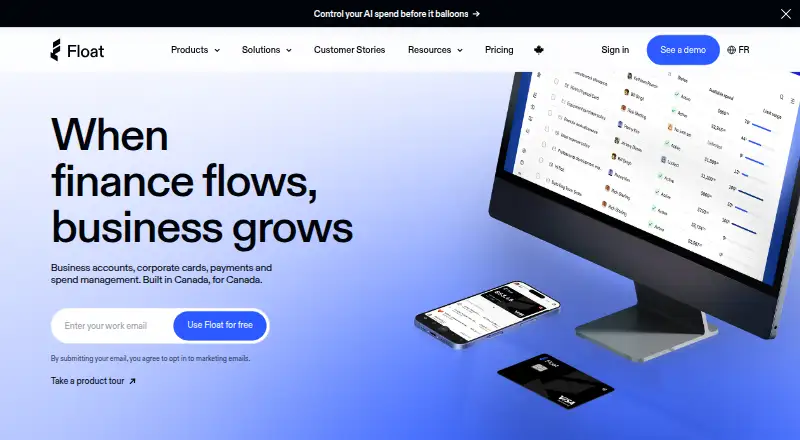
What Float is
Float is a finance platform for Canadian businesses that brings together corporate cards, expense management, bill payments, business accounts, and currency exchange. It offers physical and virtual CAD and USD cards with individual controls. For expenses, Float collects receipts, codes transactions automatically, and syncs spending to accounting software. The platform also advertises domestic and international vendor payments and CAD/USD conversion. Listed integrations include QuickBooks Online, Xero, and NetSuite, as well as HRIS tools and Slack for requests and approvals; NetSuite requires extra manual setup. Float says it is SOC 2 Type 2 and PCI-DSS compliant and uses TLS 1.2 or higher encryption for sensitive data. The company says customer funds are kept in segregated trust accounts and eligible deposits may have CDIC insurance subject to limits; it also states that it is not a bank. Essentials is free and includes up to 20 physical and unlimited virtual cards. Professional costs C$10 a month, billed at $10 per user monthly, with active-user pricing starting at $100 per month and the first 10 users included. The plan has a 90-day free trial.
Who it suits
Float describes Essentials as intended for small businesses and startups, and Professional as suited to growing teams. It is aimed at Canadian businesses seeking cards alongside expense, payment, and accounting tools.
What it does well
- Free Essentials includes up to 20 physical cards.
- Unlimited virtual cards are included with Essentials.
- Automatically codes transactions and syncs spending.
- Offers English- and French-language support.
What to know first
- NetSuite integration needs additional manual setup.
- Professional starts at $100/mo for active users.
- Float states that it is not a bank.
Limits
Essentials includes up to 20 physical cards and unlimited virtual cards. Professional is billed at $10 per user per month, with active-user pricing starting at $100 per month and including the first 10 users; conditions and fees apply.
Plans
| Plan | Billed and limits | Price |
|---|---|---|
| Essentials | $0 /user/mo · Up to 20 physical and unlimited virtual cards · QBO, Xero or custom exports · Conditions and fees apply | Free |
| Professional | $10 /user/mo; active user pricing starts at $100/mo and includes your first 10 users · Advanced controls and workflows · NetSuite integration · 90-day free trial · Conditions and fees apply | C$10 a month |
| Enterprise | Contact us · Custom pricing and cashback · Custom implementation and data migration · Dedicated Customer Success Manager | On request |
As floatfinancial.com lists them, read 2 Oct 2026. The maker's own page has the final word.
Getting started
- Open floatfinancial.com.
- Choose Essentials for the free plan or review Professional, which includes a 90-day trial.
- Use the web platform or select the Android or iOS app.
- Issue physical or virtual CAD and USD cards.
- Connect an accounting system such as QuickBooks Online or Xero; NetSuite requires additional manual setup.
Float is a Canadian-business finance platform that brings corporate cards, expense management, accounts and payments together. It is best suited to startups and growing teams managing both employee spend and vendor payments. Its breadth is useful, but costs rise with active users and NetSuite requires extra setup.
Overview
Float combines card spending, expense workflows, bill payments, business accounts and CAD/USD conversion in one platform. That is a compelling fit for a business that wants these functions coordinated; a team seeking only cards or expense tracking may find the scope more than it needs.
Float says it is SOC 2 Type 2 and PCI-DSS compliant and uses TLS 1.2 or higher encryption for sensitive data. It says customer funds are held in segregated trust accounts and eligible deposits have CDIC insurance subject to limits; Float is not a bank. Support is offered in English and French.
Key features
Cards and expense workflows
Physical and virtual CAD and USD corporate cards come with individual controls, giving teams a way to manage spending at the card level. Receipt collection, automatic transaction coding and accounting sync can reduce manual expense sorting. Approval workflows, budget controls and reimbursements add oversight, though teams should assess how those controls fit their own approval process.
Payments, accounts and integrations
Float advertises business accounts, domestic and international vendor payments, and CAD/USD conversion. QuickBooks Online, Xero and NetSuite integrations connect spending to accounting workflows; HRIS integrations and Slack support requests and approvals. NetSuite requires additional manual setup, making it a less turnkey choice for teams relying on that connection.
Pricing
Essentials is free and is intended for small businesses and startups. It includes up to 20 physical cards, unlimited virtual cards, and QuickBooks Online, Xero or custom exports. Those card allowances are generous for a small team, but Essentials does not list the advanced controls, workflows or NetSuite integration included with Professional. Conditions and fees apply.
Professional costs C$10 a month, billed at $10 /user/mo. Active-user pricing starts at $100/mo and includes the first 10 users, so the headline per-user rate does not tell the whole cost story for a team. It adds advanced controls and workflows and NetSuite integration, and includes a 90-day free trial. Conditions and fees apply.
Enterprise has custom pricing and includes cashback, custom implementation and data migration, premium support and a dedicated Customer Success Manager. It is the plan to consider when a business needs that implementation and support, but there is no published price to compare against Professional.
Platforms
Float is available on Android, iOS and the web, covering mobile and browser access.
Who it's for
Float is a strong fit for Canadian startups and growing businesses that want cards, expense management and vendor payments alongside business accounts and currency conversion. Businesses with larger teams should pay close attention to Professional's active-user minimum. Teams that need NetSuite should budget for extra setup; companies that need only a narrower card or expense tool may not benefit from the full platform.
Pros and cons
- Broad finance coverage: Cards, expense workflows, accounts, bill payments and CAD/USD conversion can bring several finance tasks together.
- Useful card and expense controls: Individual card controls, automatic coding, approvals and budgets support oversight without relying solely on manual sorting.
- Free entry tier: Essentials includes unlimited virtual cards and up to 20 physical cards, a substantial starting allowance for a small business.
- Active-user pricing has a floor: Professional starts at $100/mo despite its $10 /user/mo rate, which can weigh on smaller teams.
- NetSuite setup takes extra work: The connection requires manual setup steps, so it is not the simplest integration path.
- Enterprise cost is custom: Businesses must contact Float to assess the plan's price.
Alternatives
For a broader comparison, browse Spend Management Software and Corporate Card Software.
- Ramp AP is worth considering for smaller teams focused on simplifying finances with accounts payable features and automated invoice handling; it has a free plan.
- Brex may suit teams looking for a free tier with up to two entities, including one global entity, and one local card program.
- Jeeves is an option for teams that want a free Basic plan covering up to 10 users, with one card per user and unlimited virtual cards.
- Mesh Payments may suit a small team seeking a no-cost Pro plan for up to three users, with a paid Premium tier also available.
- Moss is an alternative for teams that can work within a free plan capped at three users and 20 invoices per month, with unlimited cards.
- Rho may appeal to teams seeking a free platform with no subscription, per-user or platform fees, while noting its 1% foreign-currency transfer fee.
- Airbase is another paid option, with a Premium plan for up to 500 employees and a Standard plan for up to about 200 employees.
- Corpay Complete is another paid alternative.
Verdict
Choose Float if your Canadian business wants card spending, expense oversight, vendor payments and CAD/USD activity in one platform, with a free Essentials tier to start. Its main trade-offs are Professional's $100/mo active-user starting point and the manual setup required for NetSuite. Teams needing fewer functions, or unwilling to take on those costs and setup demands, should look elsewhere.
Verdict
Float combines business cards, spending workflows, accounts, and payments in one platform. Review the active-user pricing and integration setup needs when weighing it for a team.
Questions
Is Float free?
Yes. Essentials is free and includes up to 20 physical and unlimited virtual cards. Conditions and fees apply.
How much does Professional cost?
Professional is billed at $10 per user per month. Active-user pricing starts at $100 per month and includes the first 10 users; conditions and fees apply.
Does Float offer a free trial?
Professional includes a 90-day free trial.
Which platforms does Float support?
Float is available on web, Android, and iOS.
Which accounting integrations are listed?
Float lists QuickBooks Online, Xero, and NetSuite. NetSuite requires additional manual setup.
Is Float a bank?
No. Float says it is not a bank. It says customer funds are held in segregated trust accounts, and eligible deposits have CDIC insurance subject to limits.
Facts from Float's own pages
- Cards
- Float offers physical and virtual CAD and USD corporate cards with individual card controls. · floatfinancial.com, 2 Oct 2026
- Expense automation
- Float collects receipts, automatically codes transactions and syncs spend to accounting software. · floatfinancial.com, 2 Oct 2026
- Founded
- 2020 · floatfinancial.com, 28 Sept 2026
- Funds and regulatory status
- Float says customer funds are held in segregated trust accounts and eligible deposits have CDIC insurance subject to limits; its footer says Float is not a bank. · floatfinancial.com, 2 Oct 2026
- Headquarters
- Toronto, Ontario, Canada · floatfinancial.com, 28 Sept 2026
- Integration limitation
- The NetSuite connection requires additional manual setup steps, according to Float’s integration page. · floatfinancial.com, 2 Oct 2026
- Integrations
- Float lists QuickBooks Online, Xero and NetSuite accounting integrations, plus HRIS integrations and Slack integration for requests and approvals. · floatfinancial.com, 2 Oct 2026
- Intended customers
- Float describes Essentials as intended for small businesses and startups, and positions Professional for growing teams. · floatfinancial.com, 2 Oct 2026
- Payments and accounts
- Float advertises business accounts, domestic and international vendor payments, and CAD/USD conversion as part of its platform. · floatfinancial.com, 2 Oct 2026
- Product
- Float is a finance platform for Canadian businesses that combines corporate cards, expense management, bill payments, business accounts and currency exchange. · floatfinancial.com, 2 Oct 2026
- Security
- Float states it is SOC 2 Type 2 and PCI-DSS compliant and uses TLS 1.2 or higher encryption for sensitive data. · floatfinancial.com, 2 Oct 2026
- Support
- Float advertises customer support in English and French; Enterprise includes premium support and a dedicated Customer Success Manager. · floatfinancial.com, 2 Oct 2026
Where Float stands on Freedom251
- Spend Management Software#2 of 29
- Corporate Card Software#4 of 23