Freedom251 › AI Video Upscalers
FlashVSR
What FlashVSR is
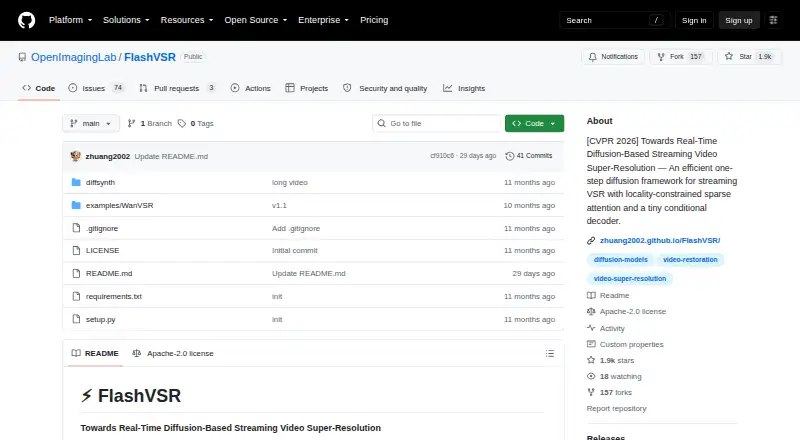
FlashVSR is a free, self-hosted framework for streaming video super-resolution. It uses a one-step diffusion approach built from a three-stage distillation pipeline, locality-constrained sparse attention, and a tiny conditional decoder. The project focuses on 4× video super-resolution and recommends that setting for results and stability. Its reported performance is about 17 FPS for 768 × 1408 video on a single A100 GPU.
The repository provides v1 and v1.1 model weights through Hugging Face and recommends v1.1. Enhancement modes include v1, v1.1, full, tiny, and tiny long video; batch processing and MP4, MOV, AVI, and MKV are supported. The project describes its VSR-120K training set as 120,000 videos and 180,000 images for joint image and video training. Running FlashVSR calls for Python 3.11.13 and the Block-Sparse Attention backend. The project reports that backend working correctly on A100 and A800 GPUs; H200 has limited acceleration, while compatibility on other listed GPUs is unknown. Implementations without the sparse attention module may lose noticeable quality, especially at higher resolutions. The repository identifies the project as Apache-2.0 licensed.
Who it suits
FlashVSR suits users who can run a self-hosted Python environment and have compatible GPU hardware for video enhancement. It is aimed primarily at 4× processing, with batch support and several enhancement modes for listed video formats.
What it does well
- Free, open-source code and model weights.
- Supports batch processing and MP4, MOV, AVI, and MKV.
- Offers v1, v1.1, full, tiny, and tiny long video modes.
- Recommends v1.1 model weights through Hugging Face.
- Reports about 17 FPS at 768 × 1408 on one A100 GPU.
What to know first
- Requires Python 3.11.13 and the Block-Sparse Attention backend.
- Backend compatibility is unknown on other listed GPUs.
- H200 is reported to have limited acceleration.
- Sparse-attention-free implementations may degrade quality at higher resolutions.
Limits
The free plan requires a local Python environment and Block-Sparse Attention backend, and GPU compatibility varies. The project recommends 4× processing for results and stability; implementations without its sparse attention module may show quality degradation, especially at higher resolutions.
Plans
| Plan | Billed and limits | Price |
|---|---|---|
| FlashVSR | Open-source code and model weights · Requires a local Python environment and Block-Sparse Attention backend · GPU compatibility varies | Free |
As github.com lists them, read 9 Oct 2026. The maker's own page has the final word.
Getting started
- Open the FlashVSR project repository.
- Prepare a local Python environment using Python 3.11.13.
- Install the required Block-Sparse Attention backend.
- Choose the recommended 4× setting and a model version; the project recommends v1.1.
- Process supported video formats, including MP4, MOV, AVI, and MKV.
Verdict
Choose FlashVSR if you want a free, self-hosted framework focused on 4× video super-resolution and can meet its environment and hardware requirements. Look elsewhere if you need a turnkey service or depend on GPU compatibility beyond the reported A100 and A800 support.
Questions
How much does FlashVSR cost?
The FlashVSR plan is free, with open-source code and model weights.
What platforms does it support?
FlashVSR is self-hosted and requires a local Python environment.
Which GPU hardware is reported to work?
The required Block-Sparse Attention backend is reported to work correctly on NVIDIA A100 and A800. H200 has limited acceleration, and compatibility on other listed GPUs is unknown.
Which model versions are available?
The repository provides v1 and v1.1 weights through Hugging Face and recommends v1.1.
What license does FlashVSR use?
The GitHub repository identifies its license as Apache-2.0.
Facts from FlashVSR's own pages
- Community integrations
- The README lists community ComfyUI implementations and WanVideoWrapper integration, and says WanVideoWrapper has known issues. · github.com, 9 Oct 2026
- Core methods
- Its framework combines a three-stage distillation pipeline, locality-constrained sparse attention, and a tiny conditional decoder. · github.com, 9 Oct 2026
- Hardware requirements
- The required Block-Sparse Attention backend is reported to work correctly on NVIDIA A100 and A800, while H200 runs with limited acceleration and compatibility on other listed GPUs is unknown. · github.com, 9 Oct 2026
- Install requirements
- The setup instructions use Python 3.11.13 and require installing the Block-Sparse Attention backend. · github.com, 9 Oct 2026
- License
- The GitHub repository identifies its license as Apache-2.0. · github.com, 9 Oct 2026
- Model versions
- The repository provides v1 and v1.1 model weights through Hugging Face, and recommends v1.1. · github.com, 9 Oct 2026
- Performance
- The project reports about 17 FPS for 768 × 1408 video on a single A100 GPU. · github.com, 9 Oct 2026
- Purpose
- FlashVSR is a one-step diffusion framework for streaming video super-resolution. · github.com, 9 Oct 2026
- Quality limitation
- The project says implementations without its sparse attention module may have noticeable quality degradation, especially at higher resolutions. · github.com, 9 Oct 2026
- Recommended setting
- The project is primarily designed and optimized for 4× video super-resolution, which it recommends for better results and stability. · github.com, 9 Oct 2026
- Support
- The maintainers welcome feedback and issues, and list Junhao Zhuang as a contact. · github.com, 9 Oct 2026
- Third-party inference
- The README lists third-party cloud and API deployments and cautions that their model versions or pipeline completeness may differ from the official implementation. · github.com, 9 Oct 2026
- Training dataset
- VSR-120K is described as containing 120,000 videos and 180,000 images for joint image and video training. · github.com, 9 Oct 2026
Where FlashVSR stands on Freedom251
- AI Video Upscalers#13 of 32