Freedom251 › Game Voice Generators
Fish Speech
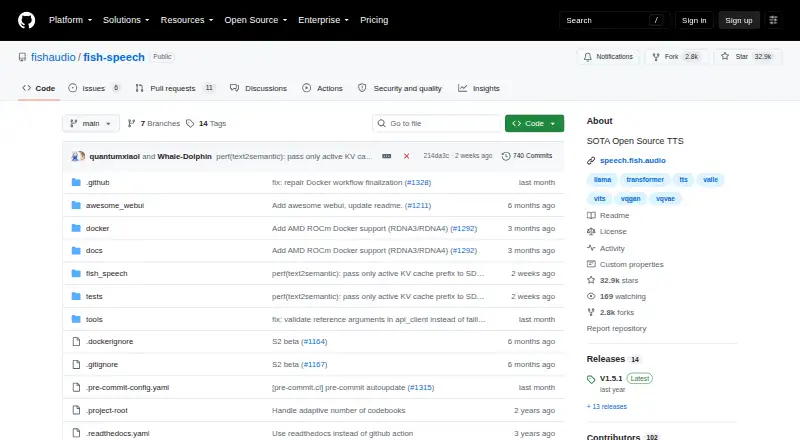
What Fish Speech is
Fish Speech is an open-source text-to-speech system for generating expressive speech in multiple languages. Its S2 model accepts natural-language tags to shape emotion and prosody, and can clone a voice from a short reference sample, typically 10–30 seconds, without extra fine-tuning. It can also use reference audio and speaker ID tokens to produce dialogue with multiple speakers in one generation. The repository describes S2 Pro as supporting more than 80 languages without phonemes or language-specific preprocessing.
You can run it through a command line, WebUI, server, or Docker, with API access available. The installation guide lists Linux or WSL and 24 GB of GPU memory for inference, as well as CPU installation and GPU deployment options. The research license allows free research and non-commercial use; commercial use requires a separate written license. A free tier is listed as free, with paid plans at $11 a month, $75 a month, and $749 a month.
Who it suits
Fish Speech suits developers and creators who need multilingual speech generation, voice cloning, or multi-speaker dialogue. Commercial users need a separate written license, and inference requirements include 24 GB of GPU memory and Linux or WSL.
What it does well
- S2 supports more than 80 languages, according to the repository.
- Voice cloning uses short reference samples without extra fine-tuning.
- Multiple speakers can be generated in one pass.
- Command-line, WebUI, server, and Docker setups are documented.
- API access is available.
What to know first
- Commercial rights require a separate written license.
- Inference lists 24 GB of GPU memory as a requirement.
- System requirements list Linux or WSL.
Limits
The free tier provides 8,000 credits monthly, up to 7 minutes of generation, and up to 500 characters per generation. It includes three public voice slots and standard generation speed. Commercial use requires a separate written license.
Plans
| Plan | Billed and limits | Price |
|---|---|---|
| Free Tier | 8,000 credits monthly · up to 7 minutes generation · up to 500 characters per generation · 3 public voice slots · standard generation speed | Free |
| Plus | $132 billed annually · 250,000 credits monthly · up to 200 minutes · up to 15,000 characters per generation · priority generation · 1 professional voice slot | $11 a month |
| Max | $8988 billed annually · 25,000,000 credits monthly · up to 6,250 minutes · 10 team seats · 15 professional voice slots | $749 a month |
| Pro | $900 billed annually · 2,000,000 credits monthly · up to 1,620 minutes · 3 team seats · up to 30,000 characters per generation · 5 professional voice slots | $75 a month |
| Enterprise | volume pricing billed annually · Pay as you go · zero data retention · on-premise deployment · SOC2 compliance · custom SSO coming soon | On request |
As github.com lists them, read 5 Oct 2026. The maker's own page has the final word.
Getting started
- Open the Fish Speech GitHub website.
- Choose a documented command-line, WebUI, server, or Docker setup.
- Use Linux or WSL; the guide lists 24 GB of GPU memory for inference.
- For API use, follow the server setup route.
- Use the free tier or select a paid plan for the listed generation allowances.
Overview
Fish Speech is an open-source text-to-speech system for generating expressive speech across languages. It is best suited to developers and teams that want fine control, voice cloning, or multi-speaker output and can run Linux or WSL with substantial GPU memory. Its capabilities are broad, but commercial use requires a separate written license.
Key features
S2 supports fine-grained emotion and prosody adjustments through natural-language tags, giving creators more control than a plain text-to-speech workflow. S2 Pro supports more than 80 languages without phonemes or language-specific preprocessing, a useful combination for multilingual production.
Voice cloning works from short reference samples, typically 10–30 seconds, without additional fine-tuning. S2 also accepts multi-speaker reference audio and speaker ID tokens, so a single generation can produce dialogue with multiple speakers. That makes it a stronger fit for voiced scenes and character exchanges than a workflow limited to one voice at a time.
The documented serving optimizations for SGLang include continuous batching, paged KV cache, CUDA graphs, and prefix caching. These matter most to teams building generation services. Fish Speech can be run through command-line tools, a WebUI, a server, or Docker; CPU installation is documented, but the guide lists 24 GB of GPU memory for inference and Linux or WSL as system requirements. The GPU requirement is a meaningful barrier for individuals without suitable hardware.
API access is available. Enterprise support includes real-time pipelines, WebRTC infrastructure, workflow automation, Vapi, Twilio, and Retell integrations, plus 24/7 production support, a technical account manager, and a 99% uptime SLA. Fish Audio says its SOC 2 Type II audit is underway and offers zero data retention, HIPAA-aligned configurations, and self-hosted deployments for enterprise workloads.
Pricing
The service offers a free tier and paid plans billed annually. The free tier costs nothing and includes 8,000 credits monthly, up to 7 minutes of generation, 500 characters per generation, 3 public voice slots, and standard generation speed. It is a constrained way to try the service, but the monthly allowance and short per-generation cap limit sustained work.
Plus costs $11 a month (billed $132 billed annually). It provides 250,000 credits monthly, up to 200 minutes, 15,000 characters per generation, priority generation, and 1 professional voice slot. This suits an individual who needs more capacity and priority over the free tier, but still has only one professional voice slot.
Pro costs $75 a month (billed $900 billed annually), with 2,000,000 credits monthly, up to 1,620 minutes, 3 team seats, 30,000 characters per generation, and 5 professional voice slots. It is the more appropriate tier for a small team sharing production work. Max costs $749 a month (billed $8988 billed annually) and includes 25,000,000 credits monthly, up to 6,250 minutes, 10 team seats, and 15 professional voice slots, targeting teams with much higher volume and seat needs.
Enterprise has custom pricing, billed by volume annually. It includes pay-as-you-go usage, zero data retention, on-premise deployment, and SOC2 compliance; custom SSO is coming soon. The model license permits research and non-commercial use free of charge, but does not grant commercial rights. Commercial use requires a separate written license from Fish Audio, so a paid service plan alone should not be treated as commercial permission.
Platforms
Fish Speech supports API, Linux, self-hosted, and web use. The documented setup paths suit users who are comfortable choosing between a local deployment, command-line workflow, browser interface, or server. Linux or WSL is required, and inference calls for 24 GB of GPU memory, narrowing its practical fit for hardware-constrained users.
Who it's for
Choose Fish Speech if you need expressive controls, short-sample voice cloning, or dialogue generation across multiple speakers, and have the technical capacity to deploy it. It is also a plausible enterprise option for teams needing self-hosting or defined support commitments. It is a poor fit for commercial projects that need immediate, unrestricted rights, or for users who cannot meet its system requirements.
Pros and cons
- Pros: Fine-grained emotion and prosody controls make output more adaptable than basic narration.
- Pros: Short-sample cloning and multi-speaker generation support character and dialogue workflows without additional fine-tuning.
- Pros: Command-line, WebUI, server, and Docker paths provide several deployment options, including self-hosting.
- Cons: The listed 24 GB GPU requirement and Linux or WSL system requirement put inference beyond many casual users.
- Cons: Commercial rights require a separate written license, even though paid plans are offered.
- Cons: The free tier's 7-minute monthly generation allowance and 500-character generation cap make it unsuitable for heavier recurring use.
Alternatives
Fish Audio is worth considering if you want the same 8,000-credit monthly free allowance with a freemium offering and broader listed platform coverage, including macOS and Windows.
Voicebox is an alternative with Android and iOS support as well as desktop and self-hosted platforms.
VoiceStudio is another free option with API, web, and self-hosted platform support across Linux, macOS, and Windows.
Kits AI may suit users looking for generative vocals and voice design or blending; its free tier includes 15 conversion minutes but no voice slots or download minutes.
Qwen3-TTS is a free alternative with Apache-2.0-licensed open-source models in 0.6B and 1.7B sizes and support for 10 languages.
VoxCPM is a free, open-source option with no paid tiers or usage limits stated.
Chatterbox TTS offers open-source models for research and development under the MIT license, on Linux, macOS, and self-hosted setups.
CosyVoice is another free, Apache-2.0-licensed self-managed option with downloadable source code and models.
Browse Voice Cloning Software for more cloning-focused options, or Game Voice Generators for tools aimed at game voice work.
Verdict
Fish Speech is a strong choice for technically capable users who need expressive multilingual generation, voice cloning, and multi-speaker dialogue in a deployable system. Its flexible controls and deployment paths are compelling, but the hardware threshold and separate commercial licensing requirement are decisive drawbacks. If you need commercial rights without a separate agreement or cannot provide the required GPU setup, choose another tool.
Verdict
Fish Speech combines expressive speech controls, voice cloning, and multi-speaker generation with several documented ways to run it. Check the license and listed hardware requirements before choosing it, especially for commercial use.
Questions
Is Fish Speech free?
The Free Tier costs nothing and includes 8,000 credits monthly. The research license permits research and non-commercial use free of charge.
What do the paid plans cost?
Plus is $11 a month, billed $132 billed annually. Pro is $75 a month, billed $900 billed annually, and Max is $749 a month, billed $8988 billed annually. Enterprise uses volume pricing billed annually; no price is listed.
Can I use Fish Speech commercially?
Commercial use requires a separate written license from Fish Audio; the model license does not grant commercial rights.
Which platforms and setup options does it support?
The listed platforms are API, Linux, self-hosted, and web. Documented setup options include command-line, WebUI, server, and Docker.
Can it clone a voice or generate dialogue?
S2 supports cloning from short reference samples, typically 10–30 seconds, without additional fine-tuning. It can also use multiple speaker references and speaker ID tokens for dialogue.
What is included with enterprise support?
Enterprise support includes 24/7 production support, a technical account manager, and a 99% uptime SLA. Enterprise offerings list zero data retention and on-premise deployment.
Facts from Fish Speech's own pages
- Commercial limits
- The model license does not grant commercial rights, which require a separate written license from Fish Audio. · github.com, 5 Oct 2026
- Emotion and prosody control
- S2 supports fine-grained inline control of prosody and emotion through natural-language tags. · speech.fish.audio, 5 Oct 2026
- Hardware requirement
- The installation guide lists 24 GB of GPU memory for inference and Linux or WSL as system requirements. · speech.fish.audio, 5 Oct 2026
- Integrations
- The enterprise page lists support for real-time pipelines, WebRTC infrastructure, workflow automation, Vapi, Twilio, and Retell. · fish.audio, 5 Oct 2026
- Languages
- The repository describes S2 Pro as supporting more than 80 languages without phonemes or language-specific preprocessing. · github.com, 5 Oct 2026
- License
- The Fish Audio Research License permits research and non-commercial use free of charge, while commercial use requires a separate written license. · github.com, 5 Oct 2026
- Multiple speakers
- S2 can use multi-speaker reference audio and speaker ID tokens to generate dialogue with multiple speakers in one generation. · speech.fish.audio, 5 Oct 2026
- Purpose
- Fish Speech is an open source multilingual text-to-speech system that generates expressive speech. · github.com, 5 Oct 2026
- Security and compliance
- Fish Audio says its SOC 2 Type II audit is underway and offers zero data retention, HIPAA-aligned configurations, and self-hosted deployments for enterprise workloads. · fish.audio, 5 Oct 2026
- Streaming
- The documentation describes SGLang serving optimizations including continuous batching, paged KV cache, CUDA graphs, and prefix caching. · speech.fish.audio, 5 Oct 2026
- Support
- Enterprise support includes 24/7 production support, a technical account manager, and a 99% uptime SLA. · fish.audio, 5 Oct 2026
- Voice cloning
- S2 supports voice cloning from short reference samples, typically 10–30 seconds, without additional fine-tuning. · speech.fish.audio, 5 Oct 2026
- Ways to run
- The installation guide documents command-line, WebUI, server, and Docker setups, including CPU installation and GPU deployment. · speech.fish.audio, 5 Oct 2026
Where Fish Speech stands on Freedom251
- Game Voice Generators#8 of 45
- Voice Cloning Software#5 of 25