Freedom251 › Test Data Generation Tools
Faker
What Faker is
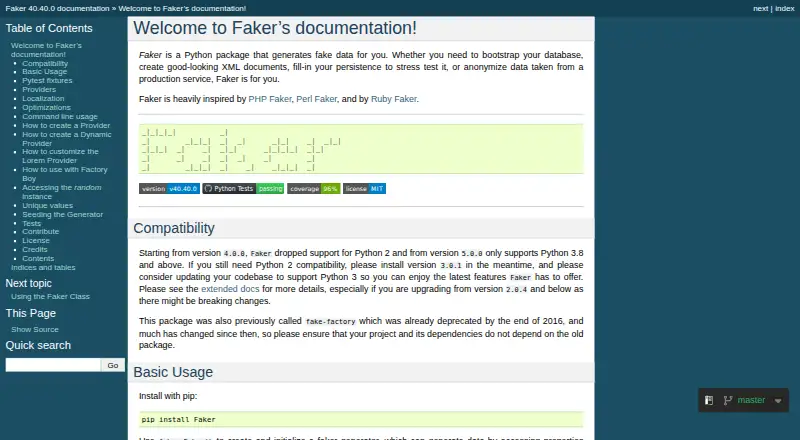
Faker is a free Python package for creating synthetic data for database bootstrapping, XML documents, stress testing, and anonymizing production data. Its built-in providers produce values such as names, addresses, and text, and it can generate data in formats including JSON, CSV, DSV, PSV, TSV, fixed-width, binary, and XML. Faker also supports API data generation, but does not generate relational data.
The package supports single or multiple locales. If a localized provider is unavailable, it falls back to en_US. Users can add custom providers, including ones that retrieve elements from an external source. Its command-line interface includes locale selection, repeated output, output-file redirection, and custom-provider options. For tests, a pytest plugin provides a faker fixture; Factory Boy also integrates with Faker through factory.Faker.
You can seed the generator to reproduce output for the same methods and Faker version, although dataset updates can change results between patch versions. The unique property enforces uniqueness for an instance, but can raise UniquenessException when no further value is available. Faker is self-hosted, installed with pip, and released under the MIT License. Current versions support Python 3.8 and above; Python 2 users are directed to version 3.0.1.
Who it suits
Faker suits Python developers who need synthetic values for bootstrapping databases, XML documents, stress tests, or anonymization. It can also fit test workflows that use pytest or Factory Boy, and projects that need localized values or custom providers.
What it does well
- Built-in providers create names, addresses, and text.
- Supports multiple locales with an en_US fallback.
- Custom providers can read elements from external sources.
- Includes a pytest fixture and Factory Boy integration.
- Supports JSON, CSV, TSV, XML, and other listed formats.
- MIT-licensed and available as a free Python package.
What to know first
- Does not generate relational data.
- Current versions require Python 3.8 or above.
- Unique values can raise an exception when no new value is available.
- Dataset updates may change seeded results between patch versions.
Plans
| Plan | Billed and limits | Price |
|---|---|---|
| Faker | Python package; no paid plans stated | Free |
As faker.readthedocs.io lists them, read 8 Oct 2026. The maker's own page has the final word.
Getting started
- Open the Faker documentation website.
- Install Faker with pip.
- Use its built-in providers or add custom providers.
- Choose a locale through the package or command-line interface.
- Use the faker fixture in pytest or Factory Boy's factory.Faker method if those tools are part of your workflow.
Verdict
Choose Faker if you need a free Python package for synthetic values, localization, custom providers, or test fixtures. Look elsewhere if you need relational data generation, or if your project runs Python 2 and requires a version newer than 3.0.1.
Questions
Is Faker free?
Yes. Faker has a free plan priced at $0, and no paid plans are stated.
Which platforms does Faker support?
Faker is self-hosted as a Python package and is installed with pip.
What data formats does Faker support?
Its listed formats are JSON, CSV, DSV, PSV, TSV, fixed-width, binary, and XML.
Does Faker generate relational data?
No. Relational data generation is listed as unsupported.
What license does Faker use?
Faker is released under the MIT License.
Which Python versions does it support?
Current Faker versions support Python 3.8 and above. Python 2 users are directed to version 3.0.1.
Facts from Faker's own pages
- Command line
- Faker includes a command-line interface with locale selection, repeated output, output-file redirection, and custom-provider options. · faker.readthedocs.io, 8 Oct 2026
- Community extensions
- The documentation lists community-written providers for areas including AI, air travel, biology, credit scores, ecommerce, and healthcare. · faker.readthedocs.io, 8 Oct 2026
- Compatibility
- Current Faker versions support Python 3.8 and above; Python 2 users are directed to version 3.0.1. · faker.readthedocs.io, 8 Oct 2026
- Customization
- Users can add custom providers, including dynamic providers that read elements from an external source. · faker.readthedocs.io, 8 Oct 2026
- Data types
- Built-in providers generate values such as names, addresses, and text. · faker.readthedocs.io, 8 Oct 2026
- Integration
- Factory Boy includes Faker integration through its factory.Faker method. · faker.readthedocs.io, 8 Oct 2026
- License
- Faker is released under the MIT License. · faker.readthedocs.io, 8 Oct 2026
- Localization
- Faker supports single and multiple locales and falls back to en_US when a localized provider is unavailable. · faker.readthedocs.io, 8 Oct 2026
- Package distribution
- The documentation instructs users to install Faker with pip. · faker.readthedocs.io, 8 Oct 2026
- Purpose
- Faker is a Python package for generating fake data for database bootstrapping, XML documents, stress testing, and anonymizing production data. · faker.readthedocs.io, 8 Oct 2026
- Repeatability
- The generator can be seeded to reproduce output for the same methods and Faker version, though dataset updates can change results across patch versions. · faker.readthedocs.io, 8 Oct 2026
- Security
- The project repository links to a security policy for reporting security issues. · github.com, 8 Oct 2026
- Testing
- Faker provides a pytest plugin with a faker fixture for use in tests. · faker.readthedocs.io, 8 Oct 2026
- Unique values
- The unique property can enforce uniqueness for an instance, but may raise UniquenessException when it cannot find another value. · faker.readthedocs.io, 8 Oct 2026
Where Faker stands on Freedom251
- Test Data Generation Tools#8 of 28