Freedom251 › Test Data Management Software

Faker.js
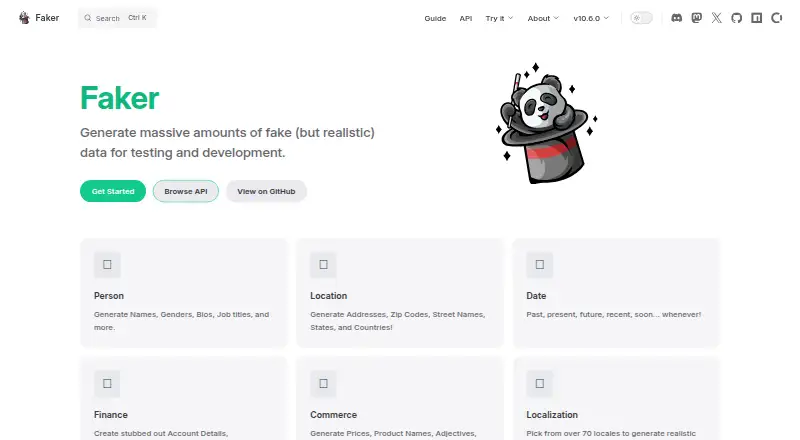
What Faker.js is
Faker.js generates synthetic data that looks realistic for testing and development. Its modules cover people, locations, dates, finance, commerce, and other data, making it useful for unit or performance testing, demos, and work that needs to proceed before a backend is complete. The JavaScript implementation runs in browsers and Node.js; Faker v10 requires Node.js 20 or above. It offers pre-built instances for more than 70 locales and lets users create custom locales, though coverage varies and some locale and method combinations use English fallback data or have no applicable data. A seed can make generated values repeatable, but the same seed may produce different results across Faker versions. Installation guidance covers npm, pnpm, yarn, and Deno, with framework examples for Vitest, Jest, Cypress, and Playwright. Faker is free under the MIT License for commercial and non-commercial use, and is self-hosted. The full package is over 5 MiB minified, and the guide advises against deploying it whole in a web app.
Who it suits
Faker.js suits developers who need synthetic data for tests, demos, or development before a backend is ready. It is available for browser and Node.js use, with installation options for common JavaScript package managers and Deno.
What it does well
- Generates data across person, location, date, finance, and commerce modules.
- Offers pre-built instances for more than 70 locales.
- Supports custom locales and seeded output.
- Provides examples for Vitest, Jest, Cypress, and Playwright.
- Free under the MIT License for commercial and non-commercial use.
What to know first
- Faker v10 requires Node.js 20 or above.
- The full package exceeds 5 MiB minified.
- Some locale coverage is limited or falls back to English.
- Seeded results can change between Faker versions.
Limits
The complete package is over 5 MiB minified, and the guide advises against deploying it whole in a web app. Some locales have limited coverage, may use English fallback data, or lack applicable data for particular methods.
Plans
| Plan | Billed and limits | Price |
|---|---|---|
| Faker | MIT licensed · commercial and non-commercial use | Free |
As fakerjs.dev lists them, read 7 Oct 2026. The maker's own page has the final word.
Getting started
- Visit the Faker.js website.
- Choose an installation route: npm, pnpm, yarn or Deno.
- Use the JavaScript implementation in a browser or Node.js; Faker v10 requires Node.js 20 or later.
- Choose a pre-built locale or build a custom locale.
- Set a seed if you want repeatable generated values.
- Consult the framework examples for Vitest, Jest, Cypress or Playwright.
Faker.js is a JavaScript library for producing realistic synthetic values for software development and testing. It is best for developers who need varied fixtures, demo records, or temporary data before a backend exists. The free MIT-licensed package is a strong JavaScript default when self-hosted generation is preferable to a managed service, provided its runtime, bundle size, and locale limitations fit the project.
Overview
Faker creates person, location, date, finance, commerce, and other categories of data through separate modules. It supports synthetic generation and API data generation, but it does not create relational data and is deployed in your own environment rather than as a hosted test-data platform.
Its documented uses cover unit tests, performance tests, demo applications, and development while an API or database is still unfinished. The MIT License permits both commercial and non-commercial use, making it suitable for proprietary products as well as open-source work.
Key features
Wide data modules and locales
The module range can produce more representative fixtures than a small set of manually maintained constants. Pre-built instances cover more than 70 locales, and custom locales can be assembled when the built-in options do not match a product’s needs. Coverage is uneven: some locales use English fallback values, and some locale-and-method combinations have no applicable data. Treat the locale count as broad reach, not a guarantee of complete regional realism.
Repeatable generation
Seeding lets a test or demo reproduce the same generated values, which helps diagnose failures and keep snapshots stable. The guarantee is version-sensitive: identical seeds can produce different results after upgrading Faker. Pin versions when reproducibility across builds matters.
JavaScript workflow support
The implementation runs in browsers and Node.js, and installation instructions cover npm, pnpm, yarn, and Deno. Framework examples for Vitest, Jest, Cypress, and Playwright reduce the work of fitting generated fixtures into common testing stacks. Faker v10 requires Node.js 20 or newer, so older Node projects need a compatible Faker release or a runtime upgrade.
Package footprint
The complete package exceeds 5 MiB minified. That is rarely a concern for server-side test tooling, but it can be wasteful in a browser bundle; the project guidance advises against deploying the whole package in a web application. Selective use or a server-side boundary is the sensible approach for front-end products.
Pricing
Faker’s only plan, Faker, costs free. It is MIT licensed for commercial and non-commercial use, with no paid tier, seat charge, renewal, quota, or trial term stated. This fits individual developers, open-source maintainers, and teams that want an embeddable generator without a service subscription. The trade-off is that hosting, runtime capacity, and any operational work remain yours because deployment is self-hosted.
Platforms
Faker is categorized for the web and runs in browsers and Node.js. The documented package managers and Deno route make it adaptable to JavaScript and TypeScript toolchains, while the Node.js 20 requirement in v10 sets a clear floor for server-side projects.
Who it's for
Choose Faker when your team needs generated fixtures inside JavaScript tests, browser demos, or development scripts; when data must be produced locally; or when a backend is not ready. It is particularly useful for broad categories such as identities, addresses, dates, financial values, and commerce records, and for tests that benefit from seeded repetition.
Look elsewhere when you need relational datasets, a managed service, guaranteed complete coverage for every locale, or a small browser payload without careful packaging. Teams supporting older Node versions should also verify compatibility before standardizing on v10.
Pros and cons
Pros
- Broad category coverage: person, location, date, finance, commerce, and other modules support varied fixtures and demos.
- More than 70 locales plus custom locales: useful for internationalized scenarios and teams able to fill coverage gaps themselves.
- Seeded output: repeatable values help reproduce test cases, as long as dependency versions are controlled.
- Fits mainstream JavaScript testing: examples for Vitest, Jest, Cypress, and Playwright shorten integration work.
- Permissive zero-cost licensing: the MIT License allows commercial and non-commercial use without a paid edition.
Cons
- Incomplete localization: English fallback and missing locale-method data can undermine region-specific tests.
- Version-sensitive determinism: upgrading Faker may change values for an existing seed.
- Large full package: more than 5 MiB minified makes shipping the entire library to browsers a poor fit.
- No relational generation: it does not model linked datasets for database-level scenarios.
- Self-hosted responsibility: your team supplies runtime and operations rather than relying on a hosted endpoint.
Alternatives
For a broader directory of products, browse Test Data Management Software or Test Data Generation Tools.
- FakerForge is a freemium API and database-oriented option with a free tier capped at one database, 50,000 AI tokens, 100 rows per table, 10 tables per database, 500 API requests, one mock API, and five endpoints per mock.
- Metasyn suits teams wanting a free, open-source Python package under the MIT license rather than a JavaScript library.
- Windocks is a database-image platform with a free tier limited to a 1 GB image, one simultaneous container, Windows and Linux, and no support.
- Data Maestro fits users who want a 30-day full trial followed by a limited free plan with 100 rows per export or database push and two saved connections.
- MOSTLY AI offers a free starting tier for API, self-hosted, and Linux use when a synthetic-data platform is preferred.
- Mockaroo is a hosted choice with a free tier of 1,000 rows per file, unlimited browser downloads, and 200 API requests per day.
- Tonic Fabricate provides a cloud-oriented free tier with $5 monthly credits, basic exports, and Discord support; its Plus plan costs $29 a month.
- Databucket is a free, open-source alternative for API and self-hosted use.
Verdict
Faker.js is the right choice for JavaScript developers who want a free, flexible, locally run source of varied test and demo data, especially when seeded fixtures and common test frameworks matter. Choose it for breadth and licensing simplicity; look elsewhere for relational modeling, hosted operations, exhaustive locale fidelity, or a smaller browser footprint.
Verdict
Faker.js provides broad synthetic data generation for development and testing, with multiple installation routes and framework examples. Check its Node.js requirement, package size, and locale coverage before choosing how to use it.
Questions
Is Faker.js free?
Yes. The Faker plan is free, under the MIT License for commercial and non-commercial use.
Which platforms and runtimes does it support?
The listed platform is web. The JavaScript implementation runs in browsers and Node.js; Faker v10 requires Node.js 20 or above.
Can generated values be repeated?
Users can set a seed to repeat generated values. Results for the same seed may change between Faker versions.
Which installation routes are documented?
The guide documents npm, pnpm, yarn and Deno.
What integrations have framework examples?
Examples are provided for Vitest, Jest, Cypress and Playwright.
Is Faker.js open source?
It is released under the MIT License.
Facts from Faker.js's own pages
- Data types
- Faker can generate person, location, date, finance, commerce, and other data through its modules. · fakerjs.dev, 7 Oct 2026
- Deterministic output
- Users can set a seed to repeat generated values, though results for the same seed may change between Faker versions. · fakerjs.dev, 7 Oct 2026
- Installation
- The guide documents installation through npm, pnpm, yarn, and Deno. · fakerjs.dev, 7 Oct 2026
- Integrations
- The framework guide provides examples for Vitest, Jest, Cypress, and Playwright. · fakerjs.dev, 7 Oct 2026
- Limited locales
- Some locales have limited coverage and may rely on English fallback data; some locale and method combinations have no applicable data. · fakerjs.dev, 7 Oct 2026
- Localization
- Faker provides pre-built instances for more than 70 locales and lets users build custom locales. · fakerjs.dev, 7 Oct 2026
- Package size
- The full Faker package is over 5 MiB minified, and the guide advises against deploying it whole in a web app. · fakerjs.dev, 7 Oct 2026
- Purpose
- Faker generates fake but realistic data for testing and development. · fakerjs.dev, 7 Oct 2026
- Runtime
- The JavaScript implementation runs in browsers and Node.js, and Faker v10 requires Node.js 20 or above. · fakerjs.dev, 7 Oct 2026
- Security and compliance
- The opened official pages state that Faker is released under the MIT License and do not list security certifications or compliance claims. · fakerjs.dev, 7 Oct 2026
- Support
- The project directs users with questions to its Discord community and GitHub Discussions. · fakerjs.dev, 7 Oct 2026
- Use cases
- The guide lists unit testing, performance testing, building demos, and working without a completed backend as use cases. · fakerjs.dev, 7 Oct 2026
Where Faker.js stands on Freedom251
- Test Data Management Software#7 of 25
- Test Data Generation Tools#9 of 28