Freedom251 › Test Data Management Software
Metasyn
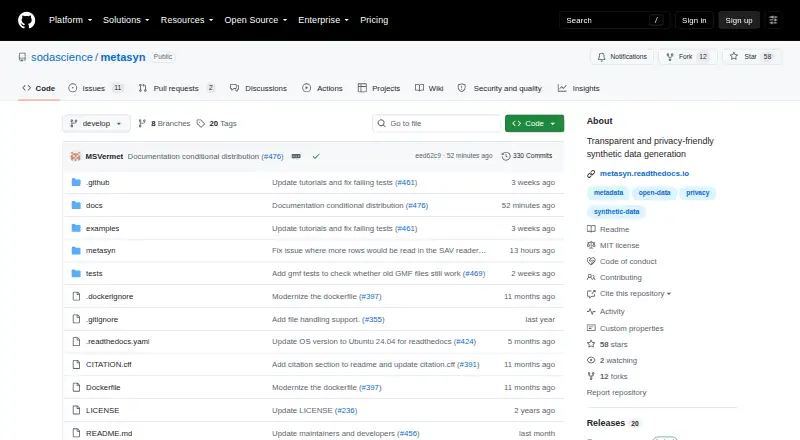
What Metasyn is
Metasyn is a free, open-source Python package for generating synthetic rows from tabular data. Its workflow fits a MetaFrame to a dataframe, saves the model and its settings as auditable JSON, and uses that saved model to create data. It supports pandas and Polars dataframes, multiple data types, missing values, categories, unique key columns, and structured strings such as postcodes or identifiers. Faker is used to generate localized names, email addresses, phone numbers, and other data.
By default, Metasyn leaves multivariate information out of the model to reduce certain disclosure risks. A disclosure-control plugin is also available, but the generated output still requires human review and is not guaranteed to be free of sensitive information. Users can add plugins to adapt the package. Generated dataframes can be exported to CSV, Parquet, Excel, and other formats. Installation is available through pip from PyPI or directly from GitHub for the development version. The project also provides a command-line interface and versioned Docker containers. Metasyn is self-hosted, runs on Linux, macOS, and Windows, and is distributed under the MIT License.
Who it suits
Metasyn is intended for public organizations, research groups, and individual researchers working with sensitive datasets. It suits users who can work with Python dataframes and want to generate synthetic tabular data in a self-hosted workflow.
What it does well
- Supports pandas and Polars dataframes.
- Handles missing values and structured strings.
- Exports to CSV, Parquet, Excel, and other formats.
- Plugin system allows extensions.
- Free under the MIT License.
What to know first
- Synthetic output needs human review.
- Output is not guaranteed to exclude sensitive information.
- Data masking and data subsetting are not supported.
Plans
| Plan | Billed and limits | Price |
|---|---|---|
| Metasyn | Open-source Python package · MIT license | Free |
As github.com lists them, read 4 Oct 2026. The maker's own page has the final word.
Getting started
- Open the Metasyn GitHub project page
- Install the package with pip from PyPI, or use the GitHub development version
- Fit a MetaFrame to a dataframe
- Save the model and settings as JSON, then generate new rows
- Export generated data to CSV, Parquet, Excel, or another format
Metasyn is a self-hosted Python package for generating synthetic tabular data from dataframes. It is best suited to researchers and public organizations working with sensitive datasets who want a reproducible workflow they can extend. Its strengths are dataframe support, auditable model settings and flexible exports; synthetic output still requires careful review.
Overview
Users fit a MetaFrame to a dataframe, save the model and settings as JSON, then generate new rows. That saved configuration supports an auditable, repeatable workflow rather than a one-off data export. Metasyn handles missing values, categorical fields, unique keys and structured strings such as postcodes or identifiers, making it relevant to varied tabular datasets.
By default, its model excludes multivariate information to reduce risks including identity, attribute and group disclosure. A disclosure-control plugin is also offered. Neither approach makes generated data automatically safe: output needs human review and is not guaranteed to be free of sensitive information. Metasyn is therefore a tool for responsible data preparation, not a substitute for privacy assessment.
Key features
Support for both Polars and pandas makes the workflow usable with two common Python dataframe libraries. Faker supplies localized names, email addresses, phone numbers and other data, while a plugin system lets users and organizations add extensions. That flexibility suits teams with specialized needs, though it makes Metasyn a better fit for Python-capable users than for people seeking a standalone point-and-click application.
Generated dataframes can be exported to CSV, Parquet, Excel and other formats. The package is available through pip from PyPI or directly from GitHub for the development version; versioned Docker containers and a command-line interface provide additional ways to build programs with Metasyn. API access is supported, and deployment is self-hosted. Data masking and data subsetting are not supported.
Pricing
Metasyn is free: its sole Metasyn plan costs nothing and is an open-source Python package under the MIT License. The license permits free use, modification, distribution and sublicensing subject to its conditions. There is no free trial because the package is already free. No paid tier or seat-based plan is described.
The free package gives users the software without a subscription, but they take responsibility for running it themselves and reviewing generated data. Bug reports and technical questions can go through GitHub issues, and users can contact Raoul Schram.
Platforms
Metasyn supports Linux, macOS and Windows, as well as self-hosted deployment. Its Python-package workflow and command-line option favor users comfortable building or running software in their own environment.
Who it's for
Public organizations, research groups and individual researchers who own sensitive datasets are the intended audience. It is a strong fit when teams need reproducible synthetic tabular data, dataframe-based work and control over deployment. It is less suitable for users who need masking or subsetting, or who expect synthetic output to remove the need for human privacy review.
Pros and cons
- Reproducible workflow: model and settings can be saved as auditable JSON, helping teams repeat and inspect their generation process.
- Broad tabular coverage: missing values, categories, unique keys and structured strings are supported, alongside Polars and pandas.
- Flexible output and extension: CSV, Parquet, Excel and other exports, plus plugins, accommodate varied workflows.
- Privacy remains a human responsibility: default exclusion of multivariate information and a disclosure-control plugin reduce some risks, but do not guarantee safe output.
- No masking or subsetting: teams needing either capability will have to look elsewhere.
- Self-hosted, Python-centered use: this offers deployment control but is not a turnkey hosted application for nontechnical users.
Alternatives
For a broader set of test-data tools, browse the Test Data Management Software category. Windocks is a freemium option with a free plan for a 1 GB database image and one simultaneous container, across Windows and Linux; choose it if those container limits and its no-support free tier match your needs. Data Maestro offers a free plan after a 30-day full trial, then limits exports or database pushes to 100 rows and saved database connections to two; consider it if that trial-led workflow fits better.
MOSTLY AI has a free plan with no further limits stated, making it an option to compare if you want another synthetic-data product. Faker.js is a free, MIT-licensed alternative for commercial and non-commercial use. Mockaroo offers a free plan capped at 1,000 rows per file and 200 API requests per day, with unlimited browser downloads; that may suit smaller browser-based generation needs.
Tonic Fabricate has a free plan with $5 monthly credits, basic data exports and Discord support on Tonic Cloud; consider it if a hosted, credit-based option suits your workflow. Databucket is a free open-source alternative. Synthetic Data Vault offers a free community plan with five data types, five basic constraints, nine models, CSV and Excel support, and local file types; its defined feature set may be preferable when those capabilities meet your needs.
Verdict
Choose Metasyn if you need a free, self-hosted Python workflow for reproducible synthetic tabular data, especially with Polars or pandas and extensible requirements. Its main advantage is the combination of auditable settings, broad data handling and multiple export formats. Look elsewhere if you need masking, subsetting or a hosted, nontechnical workflow—and in any case, review generated data before treating it as safe.
Verdict
Metasyn offers a self-hosted Python workflow for synthetic tabular data, with dataframe support, extensibility, and several export formats. Review generated data carefully, since the project does not guarantee that it contains no sensitive information.
Questions
Is Metasyn free?
Yes. The Metasyn plan costs nothing, and the package is distributed under the MIT License.
Which operating systems does it support?
Metasyn supports Linux, macOS, and Windows, with self-hosted deployment.
Which dataframe libraries does Metasyn support?
It supports pandas and Polars dataframes.
Can Metasyn output contain sensitive information?
It may. A disclosure-control plugin is available, but generated output still needs human review and is not guaranteed to be free of sensitive information.
How can I install Metasyn?
Install it with pip from PyPI or directly from GitHub for the development version. The project also points to versioned Docker containers and a command-line interface.
What license does Metasyn use?
Metasyn uses the MIT License, which permits free use, modification, distribution, and sublicensing subject to its conditions.
Facts from Metasyn's own pages
- Deployment
- The project points users to versioned Docker containers and a command-line interface for building programs with Metasyn. · github.com, 4 Oct 2026
- Exports
- Generated dataframes can be exported to CSV, Parquet, Excel, and other formats. · github.com, 4 Oct 2026
- Extensibility
- A plugin system lets users or organizations add extensions to adapt Metasyn to their needs. · github.com, 4 Oct 2026
- Installation
- The package can be installed with pip from PyPI or directly from GitHub for the development version. · github.com, 4 Oct 2026
- Integrations
- Metasyn supports Polars and pandas dataframes and uses Faker to generate localized names, emails, phone numbers, and other data. · github.com, 4 Oct 2026
- Intended users
- The documentation identifies public organizations, research groups, and individual researchers who own sensitive datasets as the intended audience. · metasyn.readthedocs.io, 4 Oct 2026
- License
- The software is distributed under the MIT License, which grants free use, modification, distribution, and sublicensing subject to its conditions. · github.com, 4 Oct 2026
- Privacy approach
- By default, Metasyn excludes multivariate information from its model to reduce risks such as identity, attribute, or group disclosure. · github.com, 4 Oct 2026
- Privacy plugin
- The maker offers a disclosure-control plugin, while warning that synthetic output still needs human review and is not guaranteed to be free of sensitive information. · github.com, 4 Oct 2026
- Purpose
- Metasyn generates synthetic tabular data to help make sensitive datasets more accessible, reproducible, and reusable. · github.com, 4 Oct 2026
- Support
- Users can report bugs or ask technical questions through GitHub issues and can contact Raoul Schram. · github.com, 4 Oct 2026
- Supported data
- Metasyn handles multiple data types, missing values, categorical data, unique key columns, and structured strings such as postcodes or identifiers. · github.com, 4 Oct 2026
- Workflow
- Users fit a MetaFrame to a dataframe, save its model and settings as auditable JSON, and synthesize new rows. · github.com, 4 Oct 2026
Where Metasyn stands on Freedom251
- Test Data Management Software#5 of 25