Freedom251 › Test Data Management Software

Windocks
What Windocks is
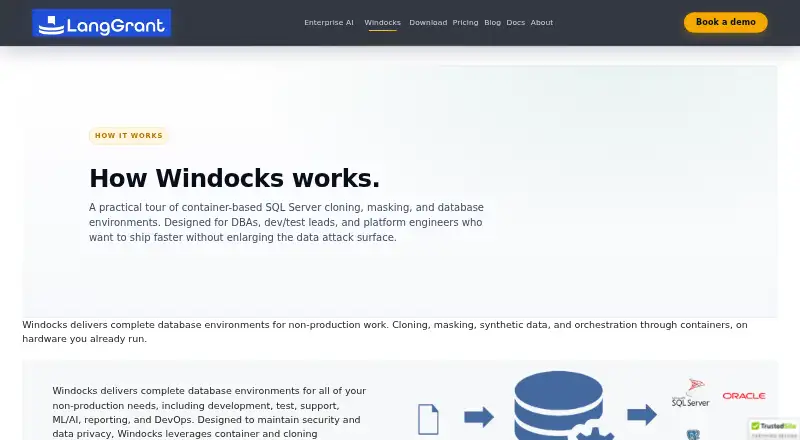
Windocks provides container-based database cloning, masking, synthetic data generation, and orchestration for non-production environments. Teams can request databases through a web application, command line, or REST API for development, testing, support, ML/AI, reporting, and DevOps. Supported databases include SQL Server, Oracle 11 and later, PostgreSQL, MySQL, and Azure SQL. Windocks says writable clones arrive in seconds regardless of database size and share disk blocks, so copies do not require additional storage. Production refreshes can be automated to keep clones aligned with current production data. Sensitive information can be obfuscated before delivery, and synthetic data is another privacy option. SQL Server containers support versions 2008, 2012, 2014, 2016, 2017, 2019, and 2022, with Agent, Analysis, Reporting, and Integration services. It runs on standard Linux and Windows servers without proprietary hardware. The Free plan allows a 1 GB database image and one simultaneous container, with no support. Standard is $499 a month, billed annually, and includes Linux, a 100 GB image limit, five containers, and email support.
Who it suits
Windocks suits development, testing, support, ML/AI, reporting, and DevOps teams that need database clones or synthetic data. It may also suit organizations seeking Linux or Windows server deployment and automated refreshes.
What it does well
- On-demand delivery through web, command line, or REST API
- Writable clones share disk blocks
- Automated production refreshes are available
- Sensitive-data obfuscation and synthetic data generation
- Runs on standard Linux and Windows servers
What to know first
- Free plan limits database images to 1 GB
- Free plan allows one simultaneous container
- Free plan includes no support
- Standard is $499 a month, billed annually
Limits
Free allows a 1 GB database image and one simultaneous container, supports Windows and Linux, and includes no support. Standard allows 100 GB and five simultaneous containers on Linux, with email support; it costs $499 a month billed annually.
Plans
| Plan | Billed and limits | Price |
|---|---|---|
| Free | Database image size: 1 GB · Simultaneous containers: 1 · Windows and Linux · No support | Free |
| Standard | Billed annually · Database image size: 100 GB · Simultaneous containers: 5 · Linux · Email support | $499 a month |
| Enterprise | Quoted per organization · Unlimited database image size and simultaneous containers · Multiple databases · SAN storage · Oracle · Windows and Linux · Email and Zoom support; 24/7 available at extra cost | On request |
As langgrant.com lists them, read 30 Sept 2026. The maker's own page has the final word.
Getting started
- Visit the Windocks how-it-works page.
- Choose the Free plan or review Standard at $499 a month billed annually.
- Select a supported deployment platform: Linux or Windows, subject to the plan.
- Request database delivery through the web application, command line, or REST API.
- Use Docker command-line integration or automate with PowerShell or Bash.
Windocks is a database cloning and test-data platform for teams that need to provision non-production environments repeatedly. It suits database, QA, and DevOps groups working with production-derived data; its strongest case is fast, writable clones with refresh and privacy controls, while plan caps narrow the affordable options.
Overview
Windocks brings database cloning, masking, synthetic data generation, and orchestration together for development, testing, support, ML/AI, reporting, and DevOps. Teams can request databases through a web application, command line, or REST API, making it relevant where developers and other users need self-service access to non-production data.
Clones are writable and the maker says they arrive in seconds regardless of database size. Sharing disk blocks avoids additional storage for multiple copies, a practical advantage for teams that provision clones often. Automated production refreshes help keep those environments current; masking sensitive data and generating synthetic data add privacy safeguards before delivery.
Key features
Cloning and data protection
Supported databases include SQL Server, Oracle 11 and later, PostgreSQL, MySQL, and Azure SQL. SQL Server containers cover versions 2008, 2012, 2014, 2016, 2017, 2019, and 2022, with Agent, Analysis, Reporting, and Integration services. This breadth serves teams with mixed database estates, though Oracle and Windows are reserved for Enterprise.
Windocks supports Docker command-line use, its REST API, and automation through PowerShell or Bash. Its documentation also names PureStorage, Cohesity, and NetApp for SAN storage, covers TDE encryption, and lists Active Directory authentication for SQL Server containers. These capabilities make it more relevant to managed enterprise environments than to teams seeking a standalone synthetic-data generator.
Deployment
The platform runs on standard Linux and Windows servers without proprietary hardware. That can suit organizations integrating database virtualization into existing infrastructure, although the Standard plan is Linux-only while Free and Enterprise include Windows and Linux.
Pricing
Windocks has a free tier and paid plans, with Standard starting at $499 a month, billed annually. The Free plan costs nothing and allows a 1 GB database image and one simultaneous container, on Windows and Linux, with no support. It is useful for a tightly scoped evaluation or a small workload, but the image and concurrency limits quickly constrain shared team use.
Standard costs $499 a month, billed annually, and raises the image limit to 100 GB and concurrency to five containers. It runs on Linux and includes email support. The jump in capacity makes it more plausible for a small team, but the annual billing commitment and Linux-only deployment matter, and five containers may not cover concurrent demand across multiple projects.
Enterprise has custom pricing, quoted per organization. It includes unlimited database image size and simultaneous containers, multiple databases, SAN storage, Oracle, Windows and Linux, and email and Zoom support; 24/7 support is available at extra cost. It fits larger estates that need broader database and infrastructure coverage, but requires a quote and incurs an extra charge for round-the-clock support.
Platforms
Windocks supports API, Linux, self-hosted, web, and Windows. Standard is limited to Linux; Free and Enterprise support both Windows and Linux. The maker describes deployment on standard servers, so teams can use existing infrastructure rather than proprietary hardware.
Who it's for
Windocks is a strong fit for organizations that repeatedly provision writable database copies for development, QA, support, reporting, or DevOps and need refresh automation or privacy controls. The on-demand interfaces and scripting integrations also suit teams that want to connect provisioning to existing workflows. It is less compelling for a single developer needing only a few synthetic rows, or for teams that need more than five concurrent containers without moving to Enterprise.
Pros and cons
- Pros: Writable clones, shared disk blocks, and rapid delivery make repeated provisioning more practical than maintaining separate full copies.
- Pros: Masking, synthetic data, and automated refresh combine privacy protection with current production-derived test environments.
- Pros: Multiple database engines, APIs, command-line access, and scripting support suit heterogeneous and automated workflows.
- Cons: Free is limited to a 1 GB image and one simultaneous container, with no support.
- Cons: Standard requires annual billing, is Linux-only, and caps usage at five simultaneous containers.
- Cons: Oracle, SAN storage, unlimited capacity, and Windows on a paid plan require Enterprise custom pricing; 24/7 support costs extra.
Alternatives
Browse Test Data Management Software for more options. Choose MOSTLY AI when a free, self-hosted or API-accessible option is a better fit; its Free plan has no further limits stated. Mockaroo suits lighter file- or API-based data generation, with its free plan capped at 1,000 rows per file and 200 API requests per day. Tonic Fabricate is an alternative with a free tier that includes $5 monthly credits, basic exports, and Discord support, while Plus is $29 a month with $25 monthly credits and metered additional usage.
Synthetic Data Vault offers a no-cost local option with five data types, five basic constraints, nine models, CSV and Excel support, and forum support. BlazeMeter is worth considering for API service virtualization; its APIs Small plan costs $79 a month and includes 250K requests and five team members. Curiosity Software Enterprise Test Data is another enterprise test-data option with custom quote pricing charged by data type rather than volume. DATPROF uses custom pricing independent of database size, with projects from 500GB to 100TB and a modular fixed license. Perforce Delphix Test Data Management is an enterprise test data management platform.
Verdict
Choose Windocks if your team needs repeatable, writable database clones that stay refreshed and can be protected before reaching non-production users. Its combination of shared-storage cloning, masking, and automation is the central advantage. Look elsewhere if a small synthetic-data task is all you need, or if your team cannot accept Standard's annual commitment, Linux-only environment, or five-container ceiling and does not have Enterprise budget.
Verdict
Windocks combines database cloning, masking, synthetic data, and refresh automation for non-production work. The Free plan has tight image and container limits; Standard adds capacity and email support for $499 a month, billed annually.
Questions
Does Windocks have a free plan?
Yes. Free costs nothing and allows a 1 GB database image and one simultaneous container, with no support.
How much does Standard cost?
Standard costs $499 a month, billed annually. It includes a 100 GB image limit, five simultaneous containers, Linux, and email support.
Which databases does Windocks support?
The how-it-works page lists SQL Server, Oracle 11 and later, PostgreSQL, MySQL, and Azure SQL.
Which platforms can it run on?
Windocks describes deployment on standard Linux and Windows servers. Free supports Windows and Linux, while Standard is Linux-only; Enterprise lists Windows and Linux.
Can Windocks mask or generate data?
Yes. Windocks can obfuscate sensitive data before clone delivery and generate synthetic data for additional privacy protection.
What support is included with the plans?
Free has no support. Standard includes email support; Enterprise includes email and Zoom support, with 24/7 support available at extra cost.
Facts from Windocks's own pages
- Automated refresh
- The maker says production refreshes are automated so database clones reflect current production data. · langgrant.com, 30 Sept 2026
- Cloning
- The maker says database clones are writable, delivered in seconds regardless of database size, and share disk blocks to avoid additional storage for multiple copies. · langgrant.com, 30 Sept 2026
- Database support
- The how-it-works page lists SQL Server, Oracle 11 and later, PostgreSQL, MySQL, and Azure SQL as supported databases. · langgrant.com, 30 Sept 2026
- Data protection
- Windocks can obfuscate sensitive data before clone delivery and generate synthetic data for additional privacy protection. · langgrant.com, 30 Sept 2026
- Deployment
- Windocks describes its cloning and virtualization as running on standard Linux and Windows servers and says it requires no proprietary hardware. · langgrant.com, 30 Sept 2026
- Headquarters
- Bellevue, Washington, USA · langgrant.com, 28 Sept 2026
- Integrations
- The documentation lists Docker command-line use, a Windocks REST API, and automation with PowerShell or Bash. · langgrant.com, 30 Sept 2026
- Maker history
- LangGrant says it was formerly Windocks and has been relied on by enterprises around the world since 2015. · langgrant.com, 30 Sept 2026
- On-demand delivery
- Databases can be delivered on demand through a web application, command line, or REST API. · langgrant.com, 30 Sept 2026
- Purpose
- Windocks provides container-based database cloning, masking, synthetic data, and orchestration for non-production environments. · langgrant.com, 30 Sept 2026
- Security
- The documentation includes a topic for TDE encryption, and the SQL Server container page lists Active Directory authentication. · langgrant.com, 30 Sept 2026
- SQL Server containers
- Windocks SQL Server containers support SQL Server versions 2008, 2012, 2014, 2016, 2017, 2019, and 2022, and include Agent, Analysis, Reporting, and Integration services. · langgrant.com, 30 Sept 2026
- Storage integrations
- The documentation names PureStorage, Cohesity, and NetApp in its SAN storage topic. · langgrant.com, 30 Sept 2026
- Support
- The pricing page lists no support for Free, email-only support for Standard, and email and Zoom support for Enterprise, with 24/7 available at extra cost. · langgrant.com, 30 Sept 2026
- Use cases
- The maker lists development, testing, support, ML/AI, reporting, and DevOps as non-production use cases. · langgrant.com, 30 Sept 2026
Where Windocks stands on Freedom251
- Test Data Management Software#10 of 25