Freedom251 › E-Signature Software
Esup-Signature
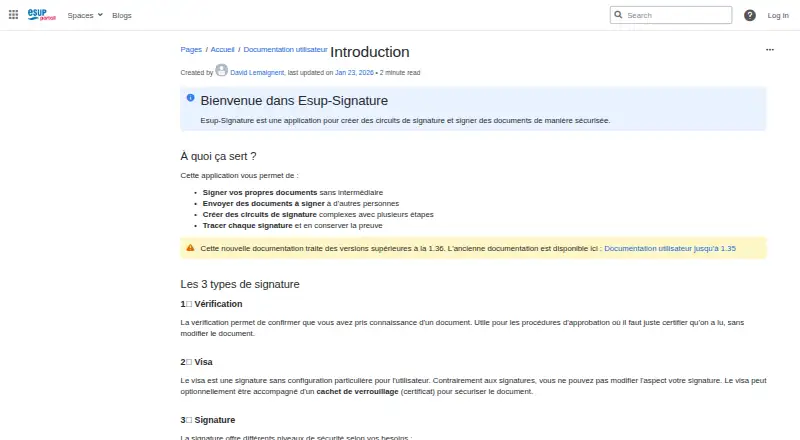
What Esup-Signature is
Esup-Signature is free, open-source software for creating document-signing workflows, sending documents for signature, and tracking completion with proof. Workflows can set the signers, signature types, and whether everyone at a step must sign. The software supports verification, visa, and simple, advanced, and qualified electronic signatures; in mixed-level workflows, simple signatures must come before advanced or qualified ones. It can sign documents in any format, though only PDFs display a visual signature and other formats use XAdES signatures. The application can verify signed documents, and Esup-DSS-Client supports signing with certificates kept on physical keys or cards. PDF forms can be converted into web forms and prefilled with institutional LDAP or custom data. Users can delegate signing or data entry and transfer pending and future requests. Internal users can authenticate through CAS or Shibboleth; invited external users can use ProConnect, FranceConnect, or SMS. Esup-Signature must be installed on an institution’s own server rather than used as a hosted service. Its listed price is free under the Apache 2.0 license.
Who it suits
It suits institutions that need configurable signing workflows for staff, students, and external partners. An institution must be able to install and operate it on its own server.
What it does well
- Supports simple, advanced, and qualified electronic signatures.
- Can verify signatures and display proof files.
- PDF forms can become prefilled web forms.
- Delegation and transfer of signing requests are supported.
What to know first
- Must be installed on the institution’s own server.
- Only PDFs support a visual signature.
- Simple signatures must precede advanced or qualified signatures.
Limits
The free Esup-Signature plan must be installed on the institution’s own server; it is not offered as a hosted service. In mixed-level workflows, simple signatures must come before advanced or qualified signatures.
Plans
| Plan | Billed and limits | Price |
|---|---|---|
| Esup-Signature (open source) | Apache 2.0 license · must be installed on the institution’s own server | Free |
As esup-portail.org lists them, read 12 Oct 2026. The maker's own page has the final word.
Getting started
- Open the Esup-Signature website.
- Install the software on the institution’s local server.
- Prepare the implementation using Java, Maven, Git, and PostgreSQL knowledge.
- Configure internal authentication with CAS or Shibboleth, or invited-user authentication with a listed external option.
- Set up workflows with signers, signature types, and step requirements.
Overview
Esup-Signature is open-source software for sending documents through signing workflows and checking their completion. It is best suited to institutions that need varied signature processes and can operate software on their own servers. Its workflow and verification options are broad, but the local-installation requirement makes it a poor fit for organizations seeking a hosted service.
Key features
Administrators can define who signs, which signature type each step uses, and whether every signer at a step must complete it. Users can launch predefined processes, fill documents online, and delegate signing or data entry; pending and future requests can also be transferred to someone else. This gives institutions room to model internal approvals and external requests, though mixed-level workflows have a strict sequence: simple signatures must come before advanced or qualified signatures.
Supported signature types include verification, visa, and simple, advanced, and qualified electronic signatures. With Esup-DSS-Client, signers can use certificates held on physical keys or cards without moving the certificate from the device. Any document format can be signed, but only PDFs support a visible signature; other formats use XAdES. That distinction matters when recipients need to see a signature mark on the page.
The software can check the integrity of simply signed documents and display their proof file, while DSS Signature verifies certificate-based signatures. Its DSS integration supports eIDAS signatures. PDF forms can be converted into web forms and prefilled from institutional LDAP or custom data sources, which can reduce repeat data entry. Documents can also be exchanged with systems such as Nuxeo or Alfresco through CMIS, network shares, local storage, or web services.
Authentication options include CAS and Shibboleth for internal users, and ProConnect, FranceConnect, or SMS for invited external users. Audit trails, templates, bulk sending, and API access round out the feature set, though institutions must fit these capabilities into their own deployment and operating environment.
Pricing
Esup-Signature (open source): free. The plan uses the Apache 2.0 license and must be installed on the institution’s own server. There is no paid hosted tier described; the zero-price license therefore does not remove the cost of providing and maintaining the infrastructure and technical expertise needed to run it.
The consortium’s minimum project support covers identifying project actors and applying security patches and fixes for defects that prevent normal operation. Implementation calls for knowledge of Java, Maven, Git, and PostgreSQL; Spring, CAS, Shibboleth, Apache, Tomcat, and LDAP knowledge is useful for full operation. This makes the free plan most practical for institutions with an established technical team.
Platforms
Esup-Signature is available for web use and is listed for Linux, macOS, Windows, API, and self-hosted environments. The local-server requirement is decisive: organizations need to manage deployment rather than sign up for a hosted service.
Who it's for
The software addresses internal agents, staff, and students, as well as external partners, citizens, and consultants. It is a strong fit for institutions with varied signing paths, document-management integrations, or online forms tied to institutional data. Small teams without server-administration capacity, or anyone who wants a ready-hosted service, should look elsewhere.
Pros and cons
- Pro: Multiple signature types, configurable steps, delegation, and transfers support complex institutional workflows.
- Pro: Certificate verification, proof-file checks, and physical-key signing provide options for evidence and hardware-backed certificates.
- Pro: Web forms, LDAP prefill, API access, bulk sending, and document-management exchanges support broader institutional processes.
- Con: Institutions must install and operate the software on their own server, with meaningful technical requirements.
- Con: Simple signatures cannot follow advanced or qualified signatures in a mixed-level workflow.
- Con: Non-PDF documents lack a visual signature, which may not suit workflows that require a visible mark on the document.
Alternatives
OpenSign is worth considering for teams seeking a free plan with unlimited digital signatures, unlimited templates, completion certificates, sequential signing, and OpenSign Drive. Sign.Plus may suit readers who prefer a freemium option with Android and iOS apps; its free plan allows three signature requests total and one template. Signaturely offers a free plan capped at one document or signature request per month, alongside audit trail and history.
BoldSign is another option for users who want a free plan with 25 envelopes per month, two templates, and one user. Certinal may be a better match for clinical and data-processing consent workflows, with multi-channel capture and EMR-native integration. Dropbox Sign offers a free plan capped at three signature requests per month. eSignly provides a lifetime free plan with five signing requests per month and a 5 MB PDF limit. Jotform may suit teams prioritizing forms, with a free Starter plan that includes five forms and 100 monthly submissions. Browse more options in E-Signature Software.
Verdict
Choose Esup-Signature if your institution needs configurable signing, verification, and form workflows and has the technical capacity to host them. Its open-source license and broad signature support are compelling for that audience; the need to run a local server is the main reason to choose a hosted alternative instead.
Verdict
Esup-Signature combines configurable signing workflows, verification, and form handling in free, open-source software. Its local-server deployment requirement and signature-order rule are important constraints to consider.
Questions
How much does Esup-Signature cost?
The open-source plan is free under the Apache 2.0 license.
Is Esup-Signature hosted?
No. It must be installed on an institution’s local server.
Which platforms are listed?
API, Linux, macOS, self-hosted, web, and Windows.
What signature types does it support?
It supports verification, visa, and simple, advanced, and qualified electronic signatures. Simple signatures must come before advanced or qualified signatures in a mixed-level workflow.
Can it sign non-PDF documents?
Yes. It can sign any document format; PDFs can display a visual signature, while other formats use XAdES signatures.
Which systems can exchange documents with Esup-Signature?
Documents can be exchanged with systems such as Nuxeo or Alfresco through CMIS, network shares, local storage, or web services.
Facts from Esup-Signature's own pages
- API access
- Yes · esup-portail.org, 23 Sept 2026
- Audience
- The documentation addresses internal agents, staff, and students, as well as external partners, citizens, and consultants. · esup-portail.org, 11 Oct 2026
- Audit trail
- Yes · esup-portail.org, 23 Sept 2026
- Authentication
- Internal users can authenticate through CAS or Shibboleth, while external users can use ProConnect, FranceConnect, or SMS codes. · esup-portail.org, 12 Oct 2026
- Bulk sending
- Yes · esup-portail.org, 23 Sept 2026
- Delegation
- Users can delegate signing or data entry, and transfer pending and future requests to another person. · esup-portail.org, 11 Oct 2026
- Deployment
- The FAQ says Esup-Signature is not offered as a hosted service and must be installed on an institution’s local server. · esup-portail.org, 12 Oct 2026
- Document formats
- It supports signatures on all document types; visual signatures are available on PDFs, while other formats use XAdES signatures. · esup-portail.org, 12 Oct 2026
- Document templates
- Yes · esup-portail.org, 23 Sept 2026
- Document verification
- The application can check the integrity of simply signed documents and display their proof file, and it can verify certificate-signed documents with the DSS Signature engine. · esup-portail.org, 12 Oct 2026
- Document workflows
- Users can send documents for signature, start predefined processes, fill documents online, and manage signature workflows. · esup-portail.org, 12 Oct 2026
- Forms
- PDF forms can be turned into web forms and prefilled using institutional LDAP data or custom data sources. · esup-portail.org, 11 Oct 2026
- Founded
- 2019 · esup-portail.org, 4 Oct 2026
- Hardware keys
- With Esup-DSS-Client, users can sign using certificates on physical keys or cards, keeping the certificate on the device. · esup-portail.org, 11 Oct 2026
- Hosting limit
- The FAQ says Esup-Signature is not offered as a hosted service and must be installed on an institution's local server. · esup-portail.org, 11 Oct 2026
- Integrations
- Documents can be integrated manually, retrieved from a folder, or injected through a web service; document stores such as Nuxeo and Alfresco can connect through CMIS. · esup-portail.org, 12 Oct 2026
- Intended users
- The documentation identifies internal agents, staff, and students, as well as external partners, citizens, and consultants, as users. · esup-portail.org, 12 Oct 2026
- Price and licensing
- The FAQ describes Esup-Signature as free and open-source software. · esup-portail.org, 11 Oct 2026
- Purpose
- Esup-Signature is a web application for signing documents and creating multi-step signature workflows. · esup-portail.org, 12 Oct 2026
- Security
- For hardware-backed signing, Esup-DSS-Client can use a certificate stored on a physical key so the certificate does not leave that key. · esup-portail.org, 12 Oct 2026
- Security and verification
- The product integrates the European Commission's DSS solution for eIDAS signatures and can verify certificate-based signatures with DSS Signature. · esup-portail.org, 11 Oct 2026
- Signature order
- both · esup-portail.org, 23 Sept 2026
- Signature order limit
- A simple signature cannot follow an advanced or qualified signature in the same workflow. · esup-portail.org, 11 Oct 2026
- Signature types
- The application supports verification, visa, simple image-based signatures on PDFs, advanced eIDAS signatures, and qualified eIDAS signatures. · esup-portail.org, 12 Oct 2026
Where Esup-Signature stands on Freedom251
- E-Signature Software#8 of 68
- E-signature tools#26 of 68