Freedom251 › Legal E-Filing Software

eFileTexas.gov
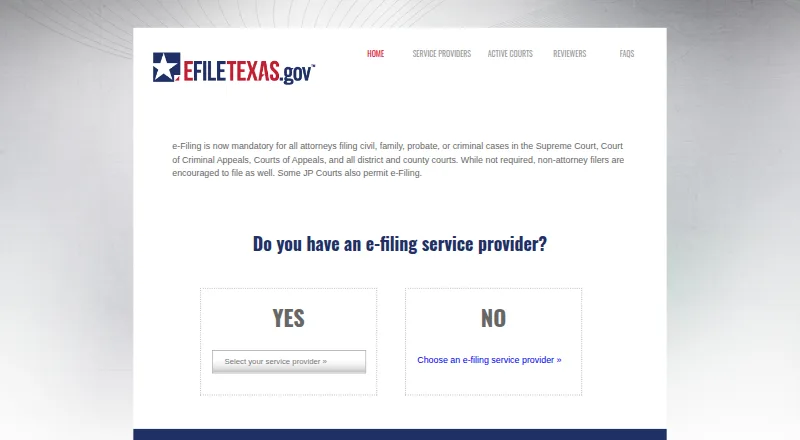
What eFileTexas.gov is
eFileTexas.gov manages the online flow of filing information between filers and court clerks in Texas. To submit case documents, filers use a certified electronic filing service provider (EFSP), which sends filings to participating courts. The service supports civil, family, probate, and criminal cases. Its eService feature sends case documents to other parties by email and tracks when recipients receive and open them. Attorneys must e-file at appellate, district, and county court levels; participating justice of the peace courts are listed separately. Pro Se filers can submit documents, and Guide-and-File Self-Help Services can help prepare and submit some frequently filed documents. The service is available 24 hours a day, seven days a week, though court review follows local schedules. All users must register first. The state-provided EFSP has no usage fee, but submissions with court costs are subject to a convenience fee, and commercial EFSPs may add charges. The FAQ lists a 2.89% credit card processing fee. EFSPs are independent services, so their additional services and fees vary.
Who it suits
eFileTexas.gov suits Texas filers submitting documents to participating courts, including attorneys and Pro Se filers. It may also help filers who want electronic service and tracking for document delivery.
What it does well
- Supports civil, family, probate, and criminal cases.
- eService tracks when recipients receive and open filings.
- Available 24 hours a day, seven days a week.
- Pro Se filers can submit documents.
- State-provided EFSP has no usage fee.
What to know first
- Users must register before using the service.
- Court review follows local schedules.
- Court-cost filings incur a convenience fee.
- FAQ lists a 2.89% credit card processing fee.
Limits
The State Provided EFSP plan covers basic e-filing and e-service; transaction and service fees may apply. Electronic submissions with court costs are subject to a convenience fee, and the FAQ lists a 2.89% credit card processing fee.
Plans
| Plan | Billed and limits | Price |
|---|---|---|
| State Provided EFSP | Basic e-filing and e-service functionality · Transaction and service fees may apply | Free |
As efiletexas.gov lists them, read 28 Sept 2026. The maker's own page has the final word.
Getting started
- Open the eFileTexas.gov website.
- Register before using the service.
- Choose a certified EFSP, such as the State Provided EFSP.
- Prepare and submit case documents through the EFSP to a participating court.
- Use eService to send documents to other parties and track receipt and opening.
Overview
eFileTexas.gov is a filing gateway for cases in participating Texas courts, used through a certified electronic filing service provider (EFSP). It is most useful to attorneys filing in courts where e-filing is required, while self-represented filers can also use it for supported matters. Its state-provided option covers basic filing and eService at no usage charge, but transaction and provider fees can still affect the bill.
Key features
The service passes documents from filers to court clerks through independent EFSP applications. It covers civil, family, probate, and criminal matters, but court participation remains the practical boundary: attorneys must e-file at appellate, district, and county levels, while participating justice-of-the-peace courts are identified separately. Confirming that a particular court participates is essential before relying on the gateway.
Electronic service sends case documents to other parties by email and tracks when recipients receive and open them. Filing status tracking and rejection alerts help users follow a submission and spot a filing that needs attention. These features are valuable for keeping a case moving, but users must still monitor status; sending a document is not the same as knowing it was accepted.
Pro Se filers may submit filings, and Guide-and-File Self-Help Services can prepare and submit some commonly filed documents. That offers a useful route for routine paperwork without extending the service to every filing need. The system is available 24 hours a day, seven days a week, although court review follows local schedules, so around-the-clock submission does not mean around-the-clock decisions.
eFileTexas says it follows state and federal security regulations, meets PCI DSS requirements, and encrypts filings both in transit and at rest. Those controls address protection during submission and storage; they do not remove the need to choose an EFSP carefully, since providers are independent and their services and fees differ.
Pricing
The State Provided EFSP plan costs nothing and includes basic e-filing and e-service functionality. It is the clearest fit for users who need core submission and service without paying a provider usage charge. All users must register first, and there is no free trial because the plan is free.
Free use does not mean every filing is cost-free. Electronic submissions involving court costs incur a convenience fee, and commercial EFSPs may add their own charges. The FAQ gives the credit card processing fee as 2.89%. The state option avoids commercial-provider usage fees, but users should still account for court charges and card processing when budgeting.
Platforms
eFileTexas is available on the web. Its 24/7 availability makes it suitable for submitting outside court-office hours, but local court review schedules determine when filings are considered.
Who it's for
Attorneys handling cases in participating Texas appellate, district, or county courts are the strongest fit, particularly where electronic filing is mandatory. Pro Se filers with eligible matters can also use the service, with Guide-and-File support for some common documents. It is less suitable for anyone who needs a filing route in a nonparticipating court or expects submission to trigger immediate court review.
Pros and cons
- Basic filing and eService are free through the state-provided EFSP: a useful way to avoid provider usage fees for core tasks.
- Receipt and filing monitoring: eService tracking, filing status, and rejection alerts help users follow what happens after submission.
- Self-represented users are supported: Pro Se filing and Guide-and-File assistance cover some common paperwork.
- Total costs can exceed zero: court costs, the 2.89% card-processing fee, and commercial EFSP charges may apply.
- Court coverage and review are not universal: users must verify participation, and local schedules govern court review despite 24/7 access.
Alternatives
For a broader comparison, browse Legal E-Filing Software.
- LegalAtoms is a freemium alternative with a free domestic-violence application plan, online collaboration, and web, mobile, and browser-extension platforms; consider it when those tools better match the matter.
- CM/ECF is a free web and desktop filing option with no added charge for filing documents online, though existing court fees and PACER charges for viewing documents still apply.
- MyFileRunner offers free full-service eService and a paid Standard Self Service eFiling plan; it may suit users comparing standalone service or self-service filing costs.
- Court File America offers free self-administered e-filing using the user's own credit card, with an EFSP fee potentially added to court fees.
- eLawServices has a free basic plan with limits on word-processor files and fax service, plus a $2.99 a month plan that adds word-processor uploads.
- eLodgment charges no service fee, though court fees can apply to particular document types.
- iDocket eFile has no iDocket e-filing fee, while statutory court fees and a 2.89% state card transaction fee may apply.
- CrimsonLogic Digital Filing is another web-based option.
Verdict
eFileTexas.gov is the practical choice for attorneys and self-represented filers who need to submit supported documents to participating Texas courts, especially when the state-provided EFSP meets their needs. Its strongest case is the combination of free basic filing, eService, and status tracking. Look elsewhere if the court is not covered or if a different provider's service better fits your workflow, and budget for court and payment-related charges even when the EFSP itself is free.
Verdict
eFileTexas.gov provides an online route for submitting documents to participating Texas courts through an EFSP, with eService and filing tracking. Users should account for registration and possible transaction fees, which can vary by provider.
Questions
Does eFileTexas.gov have a free plan?
Yes. The State Provided EFSP plan is listed as free for basic e-filing and e-service. Transaction and service fees may apply.
What fees can apply?
Electronic submissions with court costs are subject to a convenience fee. The FAQ lists a 2.89% credit card processing fee, and commercial EFSPs may add fees.
Which platforms does it support?
The listed platform is web.
Do I need to register?
Yes. All users must register before using eFileTexas.
Which kinds of cases does it support?
The site says it supports civil, family, probate, and criminal cases.
Can people representing themselves use it?
Yes. Pro Se filers can submit e-filings, and Guide-and-File Self-Help Services can help prepare and submit some frequently filed documents.
Facts from eFileTexas.gov's own pages
- Availability
- eFileTexas is available 24 hours a day, seven days a week, though court review follows local schedules. · efiletexas.gov, 28 Sept 2026
- Case types
- The site says eFileTexas supports civil, family, probate, and criminal cases. · efiletexas.gov, 28 Sept 2026
- Court coverage
- E-filing is mandatory for attorneys at appellate, district, and county court levels, while the site lists participating JP courts separately. · efiletexas.gov, 28 Sept 2026
- eService
- Its eService feature electronically serves case documents to other parties by email and lets filers track when each party received and opened a filing. · efiletexas.gov, 28 Sept 2026
- Fees
- The state-provided EFSP does not charge usage fees, but electronic submissions with court costs are subject to a convenience fee; commercial EFSPs may add fees. · efiletexas.gov, 28 Sept 2026
- Filing process
- Filers use a certified electronic filing service provider (EFSP) to submit case documents online to participating Texas courts. · efiletexas.gov, 28 Sept 2026
- Headquarters
- Plano, Texas, United States · efiletexas.gov, 23 Sept 2026
- Non-attorney filers
- Pro Se filers can submit e-filings, and some frequently filed documents can be prepared and submitted through the eFileTexas Guide-and-File Self-Help Services. · efiletexas.gov, 28 Sept 2026
- Processing fee
- The FAQ lists the credit card processing fee as 2.89%. · efiletexas.gov, 28 Sept 2026
- Provider choice
- Certified EFSPs are independent applications that transmit filings to eFileTexas, and their additional services and fees vary. · efiletexas.gov, 28 Sept 2026
- Purpose
- eFileTexas manages the online flow of filing information between filers and court clerks. · efiletexas.gov, 28 Sept 2026
- Registration
- All users must register before using eFileTexas. · efiletexas.gov, 28 Sept 2026
- Security
- The system says it adheres to state and federal security regulations, meets PCI DSS, and encrypts filings in transit and at rest. · efiletexas.gov, 28 Sept 2026
- Support
- The State Provided EFSP lists phone support Monday through Friday, 7 a.m. to 9 p.m., live chat, and email support. · efiletexas.gov, 28 Sept 2026
Where eFileTexas.gov stands on Freedom251
- Legal E-Filing Software#4 of 22