Freedom251 › Integrated Development Environments
Ecere SDK
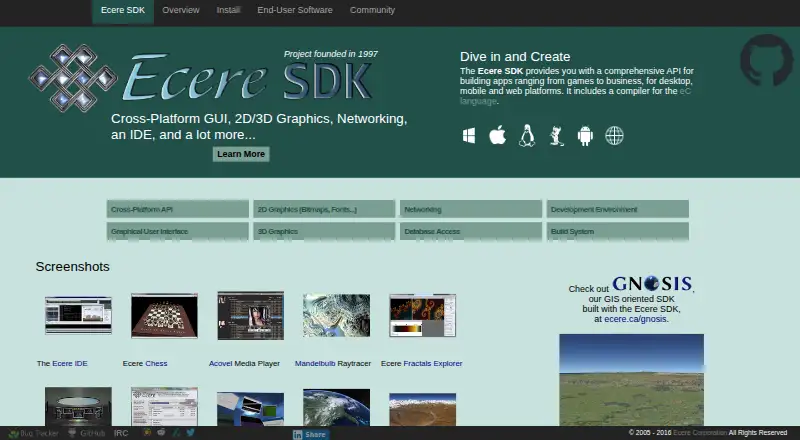
What Ecere SDK is
Ecere SDK is a free, open-source development kit for the eC programming language, released under the New BSD license. Its IDE includes a source editor with auto-completion and syntax highlighting, project management, a visual debugger, and a form designer. The runtime provides a GUI toolkit, 2D and 3D graphics APIs supporting Direct3D and OpenGL, sockets, distributed objects, file access, multithreading, synchronization, and date and time handling. Database drivers cover the Ecere RDBMS, SQLite—including an encrypted version using SQLCipher—and basic Oracle access. Other components include audio support, Windows scanning, SSL sockets through OpenSSL, and a 2D tiled game graphics engine. The project says it builds on Linux, Windows, Mac OS X, and FreeBSD; executables can be deployed to Android and the web. The eC project describes the language as a C89 superset that can use C libraries directly, and its bgen tool generates object-oriented bindings for C, C++, and Python from eC libraries. Documentation is a limitation: the programming guide is a work in progress, and the API Documentor is under development with limited descriptive information. Support options include forums, a bug tracker, and an IRC channel.
Who it suits
It suits developers using eC who need an IDE, runtime APIs, and database components. Its build and deployment options span desktop systems, Android, and the web.
What it does well
- IDE includes a visual debugger and form designer
- Runtime includes 2D and 3D graphics APIs
- SQLite support includes an SQLCipher-encrypted version
- Free open-source software under the New BSD license
What to know first
- Programming guide is a work in progress
- API Documentor is under development
- API descriptions are limited
Plans
| Plan | Billed and limits | Price |
|---|---|---|
| Ecere SDK | Free open-source software · New BSD license | Free |
As ecere.org lists them, read 11 Oct 2026. The maker's own page has the final word.
Getting started
- Visit https://ecere.org/
- Build on Linux, Windows with MinGW or MinGW-w64, Mac OS X with Xcode command line tools, or FreeBSD with gmake.
- Use the IDE source editor, project management, debugger, or form designer.
- Deploy executables to Android with the Android NDK or to the web with Emscripten.
- Use the project forums, bug tracker, or #ecere IRC channel on Libera.Chat for support.
Ecere SDK is a free, open-source development kit for the eC programming language. It suits developers who want one environment for eC projects spanning interfaces, graphics, networking, and data access. Its wide runtime is compelling, but the unfinished learning and API material raises the cost of adopting it for teams without eC experience.
Overview
The SDK combines an IDE and a broad runtime rather than serving as only a compiler or editor. Project management, source assistance, visual debugging, and form design sit alongside libraries for desktop interfaces, 2D and 3D rendering, communications, concurrency, storage, and device-related tasks. That concentration is useful when an application needs several of those layers in one eC codebase.
The main qualification is documentation. The Ecere Tao of Programming guide is still a work in progress, and the API Documentor is under development with limited descriptive information. Developers should expect to rely more heavily on existing code and community support when working beyond familiar components.
Key features
IDE and build workflow
The source editor provides auto-completion and syntax highlighting, while project management keeps the build structure in the same tool. An integrated visual debugger and form designer add practical support for diagnosing programs and laying out interfaces. Build tools are included, making this a coherent choice for eC development rather than a collection of unrelated libraries.
Graphics and application runtime
The runtime includes a GUI toolkit plus 2D and 3D graphics APIs with Direct3D and OpenGL support. This combination fits applications that need conventional forms as well as rendered visual content, and it gives game-oriented projects a 2D tiled graphics engine. Audio support covers DirectSound on Windows and ALSA on Linux.
Systems, networking, and data
Sockets, distributed objects, file access, multithreading, synchronization, and date/time handling cover substantial systems plumbing. The EDA layer connects to the Ecere RDBMS and SQLite, including an encrypted SQLite build using SQLCipher, with a basic Oracle driver. SSL sockets are provided through OpenSSL, and Windows WIA support adds scanning integration.
Language interoperability
eC is described as a C89 superset, so existing C libraries can be used directly. The bgen tool generates object-oriented bindings for C, C++, and Python from eC libraries, which can reduce isolation from established native code. That makes the SDK more practical for teams with C-family dependencies than a closed language ecosystem.
Pricing
Ecere SDK costs nothing. The plan is free open-source software under the New BSD license, with no paid tier or seat charge stated. It is therefore suitable for individuals and teams that can accept the documentation trade-off without budgeting for commercial tooling.
Platforms
The SDK supports Android, Linux, macOS, the web, and Windows. Development builds are supported on Linux, Windows with MinGW or MinGW-w64, Mac OS X with Xcode command-line tools, and FreeBSD with gmake. Executables can be deployed to Android through the Android NDK and to the web through Emscripten, extending an eC project beyond its development host.
Who it's for
Choose Ecere SDK if you specifically want to build in eC and value an integrated debugger, form designer, graphics stack, networking primitives, and database drivers in one free package. It is particularly suited to developers comfortable with C-oriented APIs and to projects targeting both native systems and Android or web deployment.
It is a weaker fit for teams that need mature, explanatory reference material, or for developers seeking a mainstream language and ecosystem with minimal ramp-up. The work-in-progress guide and limited API descriptions make independent discovery harder than the feature list might suggest.
Pros and cons
- Pros: Free New BSD-licensed software removes licensing cost and permits broad use.
- Pros: The IDE combines editing, project management, visual debugging, form design, and build tools.
- Pros: GUI, 2D, and 3D APIs plus Direct3D and OpenGL support cover varied visual applications.
- Pros: Networking, concurrency, database drivers, SQLCipher-backed SQLite, SSL, audio, and scanning support reduce the need to assemble separate components.
- Pros: Direct C access and bgen bindings connect eC with C, C++, and Python libraries.
- Cons: The programming guide is unfinished and API descriptions are limited, increasing onboarding and maintenance risk.
- Cons: The basic Oracle driver may not meet projects requiring deeper Oracle integration.
Alternatives
For a broader survey of comparable development environments, see Integrated Development Environments.
Omnis Studio is the better choice when a freemium tool with Android, iOS, Linux, macOS, web, and Windows support matters; its free Community Edition permits five concurrent users and limits deployment by concurrent users.
Pick LabVIEW instead for personal, non-commercial work using its free Community Edition across Linux, macOS, web, and Windows.
Qt Creator suits developers wanting a free open-source IDE option across more platforms, with Qt framework use subject to LGPL/GPL obligations.
TRAE is a better match for AI-assisted editing, offering 5,000 monthly autocomplete requests and two concurrent cloud tasks on its free plan.
Consider C++Builder for a paid commercial C++ tool that also has a free Community Edition.
Allegro CL provides a free Express Edition with limited technical support for Common Lisp development.
Apache NetBeans is a free Apache-licensed IDE and platform for Linux, macOS, and Windows.
Architect is a fully open-source option for Linux, Windows, and self-hosted deployments.
Verdict
Ecere SDK is a strong choice for eC developers who want a no-cost, New BSD-licensed stack that unifies tooling with graphics, systems, networking, and database facilities. Look elsewhere if dependable, fully developed documentation or a more established mainstream ecosystem is your priority.
Verdict
Ecere SDK combines eC development tools with graphics, networking, and database components. Developers should account for the project's stated documentation limits when evaluating it.
Questions
Is Ecere SDK free?
Yes. The SDK is free open-source software released under the New BSD license.
Which platforms can I build on?
The project lists Linux, Windows with MinGW or MinGW-w64, Mac OS X with Xcode command line tools, and FreeBSD with gmake.
Can applications be deployed to Android or the web?
Yes. Executables can be deployed to Android using the Android NDK and to the web using Emscripten.
Which databases does it support?
The EDA layer has drivers for Ecere RDBMS and SQLite, including an encrypted SQLite version using SQLCipher, plus a basic Oracle driver.
Is Ecere SDK open source?
Yes. The repository describes it as free open-source software under the New BSD license.
Where can developers get support?
The project lists support forums, a bug tracker, and the #ecere IRC channel on Libera.Chat.
Facts from Ecere SDK's own pages
- Database integrations
- The EDA layer has drivers for the Ecere RDBMS and SQLite, including an encrypted SQLite version using SQLCipher, and a basic Oracle driver. · github.com, 11 Oct 2026
- Deployment platforms
- Executables can be deployed to Android using the Android NDK and to the Web using Emscripten. · github.com, 11 Oct 2026
- Development platforms
- The project says it builds on Linux, Windows with MinGW or MinGW-w64, Mac OS X with Xcode command line tools, and FreeBSD with gmake. · github.com, 11 Oct 2026
- Documentation limit
- The Ecere Tao of Programming guide is described as a work in progress, and the API Documentor is under development with limited descriptive information. · github.com, 11 Oct 2026
- GUI and graphics
- The runtime includes a GUI toolkit, 2D graphics API, and 3D graphics API supporting Direct3D and OpenGL. · github.com, 11 Oct 2026
- IDE
- Its IDE includes a source editor with auto-completion and syntax highlighting, project management, a visual debugger, and a form designer. · github.com, 11 Oct 2026
- Language interoperability
- The eC project describes eC as a C89 superset that can use C libraries directly and provides bgen to generate object-oriented bindings for C, C++, and Python from eC libraries. · github.com, 11 Oct 2026
- License
- The SDK repository describes the software as free open-source software released under the New BSD license. · github.com, 11 Oct 2026
- Networking and system APIs
- The runtime provides sockets, a distributed objects system, file access, multithreading, synchronization, and date and time handling. · github.com, 11 Oct 2026
- Other libraries
- Additional components include audio support for DirectSound on Windows and ALSA on Linux, Windows WIA scanning, SSL sockets through OpenSSL, and a 2D tiled game graphics engine. · github.com, 11 Oct 2026
- Purpose
- The Ecere SDK is a software development kit for the eC programming language. · github.com, 11 Oct 2026
- Support
- The project lists support forums, a bug tracker, and the #ecere IRC channel on Libera.Chat. · github.com, 11 Oct 2026
Where Ecere SDK stands on Freedom251
- Integrated Development Environments#11 of 65