Freedom251 › Time-Series Databases
DolphinDB
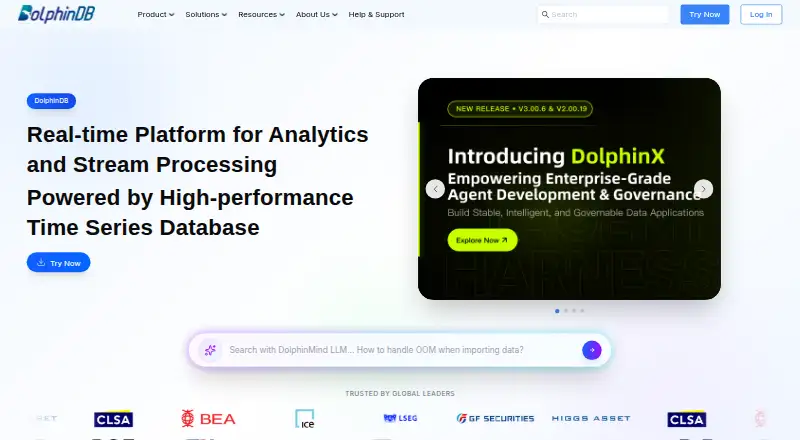
What DolphinDB is
DolphinDB is a real-time analytics and stream-processing platform built around a time-series database. It provides storage engines for time-series, OLAP, and in-memory OLTP workloads, along with more than 1,500 built-in analytical functions and more than 10 streaming engines. Batch and stream processing can use the same metric expression. Users can program with imperative, vectorized, functional, and SQL approaches. Its distributed system supports horizontal scaling, load balancing, fault tolerance, distributed transactions, and high availability across data nodes, controllers, streaming, and API clients. Deployment options include cloud, on-premise, and hybrid environments. The maker describes uses in finance, energy, power, transportation, industrial manufacturing, and scientific research. DolphinDB Community Edition is free under a perpetual license, limited to two nodes with two CPU cores and 8 GB RAM per node. The free Enterprise Trial supports high-availability clusters and includes expert technical support. Available platforms include API, extension, Linux, self-hosted, web, and Windows.
Who it suits
DolphinDB may suit teams handling time-series analytics or streaming workloads across the listed industries. Its deployment choices and programming options also fit organizations with varied infrastructure and development needs.
What it does well
- More than 1,500 built-in analytical functions
- More than 10 streaming engines
- Supports horizontal scaling and fault tolerance
- Cloud, on-premise, and hybrid deployment options
What to know first
- Community Edition is limited to two nodes
- Each Community Edition node is limited to two CPU cores and 8 GB RAM
- Kafka plugin has specified ARM Linux limitations
Limits
The perpetual free Community Edition supports up to two nodes, with two CPU cores and 8 GB RAM per node. The Enterprise Trial supports high-availability clusters and includes expert technical support.
Plans
| Plan | Billed and limits | Price |
|---|---|---|
| DolphinDB Community Edition | Perpetual license · Up to 2 nodes · 2 CPU cores and 8 GB RAM per node | Free |
| DolphinDB Enterprise Trial | Supports high-availability clusters · Expert technical support | Free |
As dolphindb.com lists them, read 3 Oct 2026. The maker's own page has the final word.
Getting started
- Visit the DolphinDB website.
- Choose a deployment route: cloud, on-premise, or hybrid.
- Select the Community Edition or Enterprise Trial.
- Use the web, Linux, Windows, API, or extension option.
DolphinDB is a real-time analytics and stream-processing platform built around a high-performance time-series database. It is best suited to teams handling demanding, mixed workloads that need streaming, batch analysis, and distributed deployment in one system. The trade-off is a broad platform to operate, with a free edition sized for small deployments.
Overview
DolphinDB combines storage engines for time-series databases, OLAP, and in-memory OLTP. That makes it a candidate for organizations that would otherwise assemble separate systems for market or sensor series, analytical warehousing, and low-latency transactional work. Cloud, on-premise, and hybrid deployment are supported, with horizontal cluster scaling when a small installation is no longer sufficient.
The breadth is worthwhile when several of those workloads must share data and operational controls. A team needing only a narrowly focused time-series store may find the extra engines, languages, and integrations unnecessary.
Key features
More than 1,500 built-in analytical functions and more than 10 streaming engines give DolphinDB substantial scope for real-time analysis. Batch and stream processing can use the same metric expression, helping teams avoid maintaining separate definitions for historical and live calculations.
Programming is flexible: imperative, vectorized, functional, and SQL styles are supported. Query choices include DolphinDB SQL, ANSI SQL/SQL-92, and the DolphinDB scripting language. Data can be ingested from text, binary, JSON, HDF5, Parquet, Arrow, ODBC, APIs, Kafka, MQTT, ZeroMQ, MySQL, MongoDB, HBase, and kdb+. This is a strong fit for heterogeneous pipelines, although each connector adds another component to govern.
Distributed features include horizontal scaling, load balancing, fault tolerance, distributed transactions, and high availability across data nodes, controllers, streaming services, and API clients. Retention policies and SQL support are included. Security controls cover users and groups, multiple privilege types, function views, RSA encryption, and HTTPS.
The DolphinDB VS Code extension supports writing and executing scripts, code completion, multi-user connections, version control, and debugging. The Python API documents Windows amd64, Linux x86_64 and aarch64, and Mac x86_64 and arm64 environments. Kafka publishing and subscription support JSON, DolphinDB, and string formats; on ARM Linux, SASL authentication and zstd compatibility are absent, a material constraint for those deployments.
Additional components target particular workloads: Swordfish embeds DolphinDB, Shark provides a GPU version, Starfish supports quantitative research workflows, and Octopus is a complex event-processing engine.
Pricing
DolphinDB Community Edition
The Community Edition costs free on a perpetual license. It is limited to up to two nodes, with two CPU cores and 8 GB of RAM per node. That is useful for evaluation, development, and compact production workloads, but the node and per-node resource caps make it unsuitable as a no-cost path to a larger highly distributed deployment.
DolphinDB Enterprise Trial
The Enterprise Trial also costs free and supports high-availability clusters with expert technical support. It is the more appropriate starting point for an organization assessing resilient multi-node operation, while the Community Edition is better for a constrained, self-directed setup. A free trial is available.
Platforms
DolphinDB is offered through APIs, extensions, Linux, self-hosted deployment, the web, and Windows. Both cloud and on-premise deployment options are supported, as well as hybrid arrangements. The documented Python environments also include macOS architectures, making the API practical across common development machines.
Who it's for
Finance, energy, power, transportation, industrial manufacturing, and scientific-research teams are the clearest fits. Choose DolphinDB when one platform must combine time-series data, analytical and transactional engines, streaming calculations, broad ingestion, and distributed availability. It is less compelling for a small project that needs one simple database and has no use for cluster operations or multiple programming models.
Pros and cons
- Pro: Time-series, OLAP, and in-memory OLTP engines cover materially different workloads in one platform.
- Pro: Shared expressions for batch and streaming analysis can reduce duplicated metric logic.
- Pro: High availability, fault tolerance, load balancing, and distributed transactions support serious clustered deployments.
- Pro: The integration surface is unusually broad, including Kafka, MQTT, files, databases, and kdb+.
- Con: Community Edition capacity stops at two nodes and 2 CPU cores plus 8 GB RAM per node, limiting free production scale.
- Con: The many engines, languages, connectors, and deployment modes demand more operational discipline than a focused database.
- Con: ARM Linux Kafka deployments lack SASL authentication and zstd compatibility.
Alternatives
For a conventional analytical database with published pay-as-you-go sizes, consider Exasol, whose XS plan provides 8 vCPUs and 64 GB of memory for $3.30 a month and whose S plan doubles those resources for 6.60 USD.
InfluxDB is a better fit when a time-series-focused product is preferable; its InfluxDB 3 Core plan is single-node, while Cloud Serverless charges for what you use.
Choose QuestDB for an Apache 2.0, self-managed single instance with community support. TDengine suits teams wanting an AGPL open-source time-series database with clustering in its OSS edition.
Timeplus is an alternative for lightweight streaming SQL through its Apache 2.0 Proton single binary. Apache Druid offers an open-source analytics database for self-hosting, while DuckDB UI is aimed at local SQL notebooks with optional MotherDuck connections. Teradata VantageCloud is the enterprise-oriented alternative.
For broader category browsing, see OLAP Software, Multimodel Databases, and Time-Series Databases.
Verdict
Choose DolphinDB if your organization needs a distributed platform that unifies time-series, analytical, transactional, and streaming workloads, especially in finance or industrial data operations. Its main reason to look elsewhere is complexity—or the Community Edition’s tight two-node resource ceiling when you need a larger free deployment.
Verdict
DolphinDB combines database engines, analytical functions, and streaming tools in one platform. Its free Community Edition has explicit node and per-node resource limits.
Questions
Is DolphinDB free?
Yes. The Community Edition is listed as free under a perpetual license. An Enterprise Trial is also listed as free.
What are the Community Edition limits?
It supports up to two nodes, with two CPU cores and 8 GB RAM per node.
What platforms are listed?
API, extension, Linux, self-hosted, web, and Windows.
Which query languages does it support?
DolphinDB SQL, ANSI SQL/SQL-92, and the DolphinDB scripting language.
What deployment options are described?
Cloud, on-premise, and hybrid deployment, with horizontal cluster scaling.
What does the Enterprise Trial include?
It supports high-availability clusters and includes expert technical support.
Facts from DolphinDB's own pages
- Analytics
- The product page says DolphinDB offers more than 1,500 built-in functions for analytical tasks. · dolphindb.com, 3 Oct 2026
- Database engines
- It provides storage engines for time-series databases, OLAP, and in-memory OLTP use cases. · dolphindb.com, 3 Oct 2026
- Deployment
- The maker describes cloud, on-premise, and hybrid deployment options with horizontal cluster scaling. · dolphindb.com, 3 Oct 2026
- Editor integration
- The DolphinDB VS Code extension lets users write and execute DolphinDB scripts and supports code completion, multi-user connections, version control, and debugging. · dolphindb.com, 3 Oct 2026
- Enterprise components
- Swordfish is an embedded version of DolphinDB, Shark is its GPU version, Starfish supports quantitative research workflows, and Octopus is a complex event processing engine. · dolphindb.com, 3 Oct 2026
- Kafka integration
- The Kafka plugin can publish or subscribe to Kafka streams using JSON, DolphinDB, or string formats; on ARM Linux it lacks SASL authentication support and zstd compatibility. · docs.dolphindb.com, 3 Oct 2026
- Product
- DolphinDB is a real-time analytics and stream-processing platform powered by a high-performance time-series database. · dolphindb.com, 3 Oct 2026
- Programming
- DolphinDB supports imperative, vectorized, functional, and SQL programming paradigms. · dolphindb.com, 3 Oct 2026
- Python API
- The DolphinDB Python API supports Windows amd64, Linux x86_64 and aarch64, and Mac x86_64 and arm64 in the documented environments. · docs.dolphindb.com, 3 Oct 2026
- Scaling and availability
- Its distributed system supports horizontal scaling, load balancing, fault tolerance, distributed transactions, and high availability across data nodes, controllers, streaming, and API clients. · dolphindb.com, 3 Oct 2026
- Security
- The maker documents user and group access controls, multiple privilege types, function views, RSA encryption, and HTTPS support. · docs.dolphindb.com, 3 Oct 2026
- Streaming
- DolphinDB provides more than 10 streaming engines and lets batch and stream processing use the same metric expression. · dolphindb.com, 3 Oct 2026
- Support
- The Enterprise Trial listing includes expert technical support. · dolphindb.com, 3 Oct 2026
- Use cases
- The maker describes use in finance, energy, power, transportation, industrial manufacturing, and scientific research. · dolphindb.com, 3 Oct 2026
Where DolphinDB stands on Freedom251
- Time-Series Databases#4 of 36
- OLAP Software#7 of 32
- Multimodel Databases#8 of 26