Freedom251 › Streaming Analytics Software
Timeplus
What Timeplus is
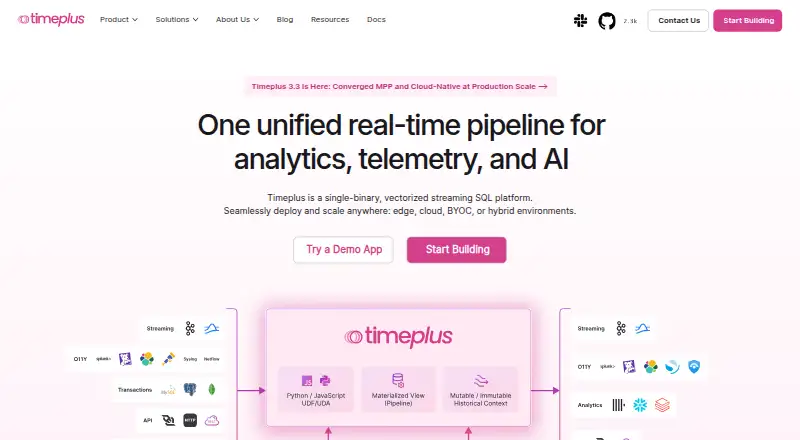
Timeplus is a streaming SQL platform for building real-time data pipelines in analytics, telemetry, and AI/ML. It processes streaming and historical data through one engine, supported by an internal write-ahead log and historical store. Its SQL features cover streams, views, incremental materialized views, joins, aggregations, enrichment, and downsampling. Data can be routed to different sinks with SQL criteria, and the console provides lineage views for derived streams. The platform also supports push-based dashboards and SQL alerts for services including PagerDuty and Slack. Native connections include Apache Kafka, Apache Pulsar, Redpanda, ClickHouse, Splunk, Elastic, MongoDB, S3, and Apache Iceberg. Other interfaces include SDKs for Java, Go, and Python, JDBC/ODBC, WebSockets, REST APIs, and Redpanda Connect access to 200+ systems. Enterprise can run at the edge, in cloud, BYOC, or hybrid environments on bare metal or Kubernetes. Timeplus Proton, the open-source core under Apache 2.0, is free. Cloud costs $199 a month and includes a 14-day trial; the custom-quoted self-hosted or BYOC option has an annual term billed monthly.
Who it suits
Timeplus is aimed at data engineers and platform teams handling streaming and historical data with streaming SQL. Its deployment choices suit teams considering cloud, edge, BYOC, hybrid, or self-hosted environments.
What it does well
- Processes streaming and historical data in one engine.
- SQL supports joins, aggregation, enrichment, and downsampling.
- Offers dashboards and SQL-based alerts.
- Native connections include Kafka, Pulsar, and ClickHouse.
- Proton is free and open source under Apache 2.0.
What to know first
- Cloud costs $199 a month.
- Self-hosted or BYOC pricing requires a custom quote.
- Cloud support is within one business day, versus four hours for self-hosted or BYOC.
Limits
The free Proton plan is the open-source streaming SQL engine. The Cloud plan is listed at $199 a month and includes up to 20 team members. Its listed resources include 1–32 CPU, 4GB–128GB memory, and storage starting from 250GB SSD.
Plans
| Plan | Billed and limits | Price |
|---|---|---|
| Timeplus Proton | Open source under Apache 2.0 License · Lightweight streaming SQL engine · single binary under 500MB · no JVM, ZooKeeper, or other dependencies | Free |
| Cloud | Monthly subscription · 1–32 CPU · 4GB–128GB memory · starting from 250GB SSD storage · daily backup, 2 versions · up to 20 team members · enterprise support within 1 business day | $199 a month |
| Self-Hosted or Full-Managed BYOC | Annual term billed monthly; contact us for a custom quote · Custom CPU, memory, and storage · Kubernetes or bare-metal deployment · multi-node cluster · enterprise training and onboarding · support within 4 hours | On request |
As timeplus.com lists them, read 30 Sept 2026. The maker's own page has the final word.
Getting started
- Open https://www.timeplus.com/ and choose Proton, Cloud, or the self-hosted or BYOC option.
- Use Proton for the free open-source engine under Apache 2.0, or start the 14-day trial.
- For Cloud, review its listed 1–32 CPU and 4GB–128GB memory resources.
- For Enterprise, choose an edge, cloud, BYOC, or hybrid deployment; deployment is available on bare metal or Kubernetes.
- Connect a listed data source and use streaming SQL to process and route data.
Overview
Timeplus is a streaming SQL platform for building real-time data pipelines alongside historical analysis. It is best suited to data engineers and platform teams that want SQL to cover event processing, routing, and operational monitoring. Its unified engine and flexible deployment options are strong draws; the paid Cloud plan starts at $199 a month.
Key features
Timeplus processes live streams and historical data in one engine, with an internal write-ahead log and historical store. That gives teams a way to query incoming events alongside retained data without splitting those tasks across separate engines. Streaming SQL supports streams, views, incremental materialized views, joins, aggregations, enrichment, and downsampling, making it useful for teams that want familiar SQL constructs across pipeline transformations.
SQL criteria can direct data to different sinks, and a console lineage view shows derived streams. Push-based, low-latency dashboards and SQL-based alerts for PagerDuty and Slack extend processing into operational response. These capabilities fit teams that need fresh event data to inform dashboards or notifications; they are less central for projects focused only on offline analysis.
Native connections include Apache Kafka, Apache Pulsar, Redpanda, ClickHouse, Splunk, Elastic, MongoDB, S3, and Apache Iceberg. Redpanda Connect reaches 200+ systems, while Java, Go, and Python SDKs, JDBC/ODBC, WebSockets, and REST APIs provide additional integration routes. This breadth can help teams connect existing systems, though the value depends on whether their specific sources and destinations are covered.
Pricing
Timeplus Proton costs nothing and is the open-source core engine under the Apache 2.0 License. Its lightweight single binary is under 500MB and requires no JVM, ZooKeeper, or other dependencies. It is the sensible starting point for teams comfortable with the open-source engine, but does not include the managed Cloud capacity or enterprise support described for paid plans.
Cloud costs $199 a month on a monthly subscription. It includes 1–32 CPU, 4GB–128GB memory, storage starting from 250GB SSD, daily backups with two versions, up to 20 team members, and enterprise support within one business day. The included range and team cap make it a defined option for teams that want a managed subscription; the entry price is a meaningful commitment compared with Proton.
Self-Hosted or Full-Managed BYOC has custom pricing, on an annual term billed monthly. It offers custom CPU, memory, and storage, Kubernetes or bare-metal deployment, multi-node clusters, enterprise training and onboarding, and support within four hours. It is aimed at organizations with deployment or scale requirements beyond the Cloud plan, but requires a custom quote and an annual commitment.
Platforms
Timeplus supports API, Linux, macOS, self-hosted, web, and Windows environments. Enterprise can run at the edge, in the cloud, in BYOC, or in hybrid environments, on bare metal or Kubernetes. That deployment choice is useful for teams with infrastructure constraints; it also leaves platform operations in the customer's hands for self-hosted deployments.
Who it's for
Timeplus is a strong fit for data engineers and platform teams building real-time pipelines for analytics, telemetry, or AI/ML, particularly when they need to combine streaming and historical data, route events, and monitor outcomes. Teams that only need batch analytics, or that cannot justify a streaming-focused platform's Cloud starting price, should consider a narrower or open-source alternative.
Pros and cons
- Pros: A unified engine covers streaming and historical data, with SQL features spanning transformations and incremental materialized views.
- Pros: Routing, lineage, dashboards, and SQL alerts connect pipeline processing to monitoring and response.
- Pros: Proton is free under Apache 2.0, and Enterprise offers cloud, edge, BYOC, hybrid, bare-metal, and Kubernetes deployment options.
- Cons: Cloud begins at $199 a month, which may be difficult to justify for small or occasional workloads.
- Cons: Cloud limits teams to 20 members, while self-hosted or BYOC requires custom pricing and an annual term billed monthly.
Alternatives
Apache Beam is a free, open-source programming model; choose it when you want that model and can select the runner and infrastructure, with execution costs depending on those choices. Apache Druid is a free, downloadable open-source analytics database, a better fit when a self-hosted analytics database is the priority. Apache Storm is free and open source under Apache License 2.0, making it an option for teams seeking that licensing and cost profile.
Feldera offers a free open-source edition with a single node and container, full SQL support, all connectors, datasets larger than memory, and community support; choose it when those edition characteristics suit the workload. Apache Spark is a free distributed data analytics engine available through download, PyPI, Maven Central, and Docker, a fit for teams seeking that distribution model. Confluent Cloud has a free Basic plan with serverless managed clusters, autoscaling Kafka resources, and 80+ managed connectors; choose it when those managed Kafka capabilities are the priority.
kdb+ offers a free personal, non-commercial On Demand Personal Edition for up to two computers and 24 cores per computer. Materialize has a Community License for self-managed use up to 24GiB memory and 48GiB disk, with chatbot and Community Slack support; choose it when those limits and support channels fit.
For broader comparisons, browse Streaming Analytics Software, OLAP Software, and Stream Processing Software.
Verdict
Choose Timeplus if your engineering team needs SQL-driven streaming pipelines that combine live and historical data, with routing, lineage, dashboards, and deployment flexibility in one platform. Proton provides a free way to use the open-source core; Cloud adds managed capacity and support at a clear monthly cost. Look elsewhere if your needs do not center on streaming, or if the Cloud entry price and custom-priced annual deployment are poor fits.
Verdict
Timeplus brings streaming SQL, historical data processing, integrations, dashboards, and alerts into a platform with several deployment options. Proton is free; Cloud is $199 a month, while self-hosted or BYOC pricing is custom.
Questions
Does Timeplus have a free plan?
Yes. Timeplus Proton is free and open source under the Apache 2.0 License.
How much does Timeplus Cloud cost?
The Cloud plan is listed at $199 a month. It lists up to 20 team members.
Is there a free trial?
Yes. A 14-day trial is listed.
Which platforms are supported?
The listed platforms are API, Linux, macOS, self-hosted, web, and Windows. The Enterprise download page lists Linux, macOS, and Windows availability.
Can Timeplus be self-hosted?
Timeplus Enterprise can run on bare metal or Kubernetes, including self-hosted or BYOC deployments. The Self-Hosted or Full-Managed BYOC plan requires a custom quote.
What does the Cloud plan include for support?
The Cloud plan lists enterprise support within one business day.
Facts from Timeplus's own pages
- Additional connectors
- The product page describes Redpanda Connect access to 200+ systems and support for Java, Go, and Python SDKs, JDBC/ODBC, WebSockets, and REST APIs. · timeplus.com, 30 Sept 2026
- Dashboards and alerts
- Timeplus supports push-based, low-latency dashboards and SQL-based alerts for systems such as PagerDuty and Slack. · timeplus.com, 30 Sept 2026
- Deployment
- Timeplus Enterprise can run at the edge, in the cloud, in a BYOC environment, or in hybrid environments, on bare metal or Kubernetes. · timeplus.com, 30 Sept 2026
- Integrations
- Native connections include Apache Kafka, Apache Pulsar, Redpanda, ClickHouse, Splunk, Elastic, MongoDB, S3, and Apache Iceberg. · timeplus.com, 30 Sept 2026
- Intended users
- Timeplus describes the platform as designed for data engineers and platform teams processing streaming and historical data with streaming SQL. · docs.timeplus.com, 30 Sept 2026
- Open-source edition
- Timeplus Proton is the open-source core engine, available under the Apache 2.0 License. · docs.timeplus.com, 30 Sept 2026
- Purpose
- Timeplus is a vectorized streaming SQL platform for real-time data pipelines used in analytics, telemetry, and AI/ML. · timeplus.com, 30 Sept 2026
- Routing and lineage
- Data can be routed to different sinks using SQL criteria, and the console provides a lineage view of derived streams. · timeplus.com, 30 Sept 2026
- SQL features
- Streaming SQL supports streams, views, incremental materialized views, joins, aggregations, enrichment, and downsampling. · timeplus.com, 30 Sept 2026
- Support
- The pricing page lists enterprise support within one business day for Cloud and within four hours for self-hosted or BYOC. · timeplus.com, 30 Sept 2026
- Supported operating systems
- The Enterprise download page lists Linux, macOS, and Windows availability. · timeplus.com, 30 Sept 2026
- Unified processing
- The platform processes streaming and historical data through a unified engine with an internal write-ahead log and historical store. · timeplus.com, 30 Sept 2026
Where Timeplus stands on Freedom251
- Streaming Analytics Software#14 of 25
- OLAP Software#18 of 32
- Stream Analytics Software#16 of 26
- Stream Processing Software#18 of 26