Freedom251 › Streaming Analytics Software
Apache Storm
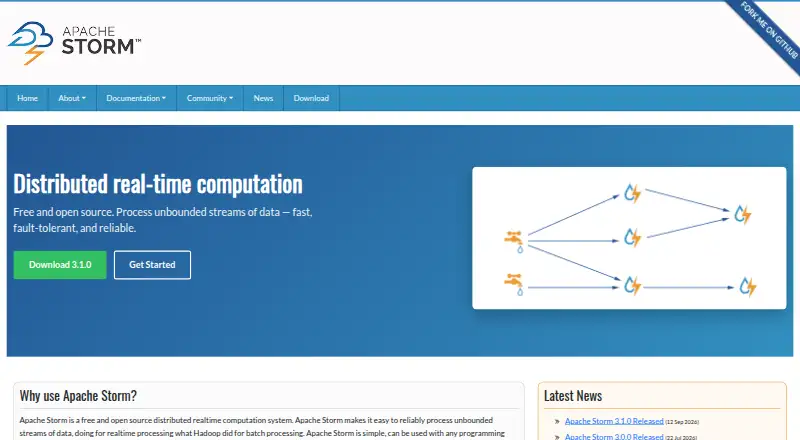
What Apache Storm is
Apache Storm is a distributed system for processing unbounded data streams in real time. It builds multi-stage computations from spouts, bolts and topologies, supporting uses such as realtime analytics, online machine learning, continuous computation, distributed RPC and ETL. The project describes Storm as scalable and fault-tolerant, with guaranteed data processing, and reports a benchmark above one million tuples per second per node.
Integrations include Apache Kafka, HDFS, JDBC databases, JMS and Redis. Developers can use local mode for in-process development or submit topologies to a remote cluster. Storm is free and open source under Apache License 2.0, and supports stateful processing. Listed languages include JavaScript, Python, Ruby and C#. Security options include pluggable Kerberos/SASL authentication and SimpleACLAuthorizer authorization, both disabled by default. TLS is available for Thrift RPC and worker-to-worker messaging using mutual TLS. Release 3.1.0 is available in source and binary distributions, through Maven Central and as an official Docker image. Release files have OpenPGP signatures and SHA-512 checksums.
Who it suits
Storm suits developers and operators building real-time stream computations, including analytics, ETL or distributed RPC workloads. It offers local development mode as well as remote cluster deployment.
What it does well
- Supports unbounded data streams in real time.
- Integrates with Kafka, HDFS, JDBC, JMS and Redis.
- Offers local and remote deployment modes.
- Free under Apache License 2.0.
- TLS is available for RPC and worker messaging.
What to know first
- Kerberos/SASL authentication is disabled by default.
- Authorization is disabled by default.
- Remote deployment requires a cluster.
Limits
The listed plan is free and open source under Apache License 2.0. Kerberos/SASL authentication and SimpleACLAuthorizer authorization are disabled by default.
Plans
| Plan | Billed and limits | Price |
|---|---|---|
| Apache Storm | Free and open source · Apache License 2.0 | Free |
As storm.apache.org lists them, read 1 Oct 2026. The maker's own page has the final word.
Getting started
- Visit the Apache Storm website.
- Choose source or binary distributions, Maven Central, or the official Docker image.
- Use local mode for in-process development, or prepare a cluster for remote submission.
- Build stream computations from spouts, bolts, and topologies.
- Enable and configure security options if needed; authentication and authorization are disabled by default.
Apache Storm is a self-hosted system for building distributed applications that process continuous data streams. It suits engineering teams that need multi-stage realtime workloads and control over cluster deployment. Its composable topology model and broad integration set are compelling, but operators must plan for reliability and security configuration themselves.
Overview
Storm handles unbounded streams rather than waiting for a bounded batch to finish. Its use cases span realtime analytics, online machine learning, continuous computation, distributed RPC, and ETL, so it can fit both data pipelines and continuously running services.
The project reports a benchmark above one million tuples per second per node. That figure indicates the performance target Storm can reach in a benchmark, not a promise for every workload. The current release is 3.1.0, available as source and binary distributions, through Maven Central, and as an official Docker image. OpenPGP signatures and SHA-512 checksums are published for release files. Storm is licensed under Apache License, Version 2.0.
For broader category browsing, see Streaming Analytics Software and Stream Processing Software.
Key features
Multi-stage topologies
Storm applications combine spouts and bolts into topologies: spouts provide streams, while bolts process them. The model supports arbitrarily complex, multi-stage computations, giving teams a clear way to compose continuous workloads. Its design aims for scalability, fault tolerance, and guaranteed processing, which matters when dropped or interrupted work is unacceptable.
Connectors and deployment
Out-of-the-box integrations cover Apache Kafka, HDFS, JDBC databases, JMS, and Redis. That range can simplify connections to common data systems, though it does not remove the work of operating a self-hosted deployment. Local mode supports in-process development; remote mode submits topologies to a cluster, separating development from cluster execution.
Security and release integrity
Storm supports Kerberos/SASL authentication and SimpleACLAuthorizer authorization, but both are disabled by default. Operators should enable and configure them rather than assume a new deployment is protected. TLS is supported for Thrift RPC and worker-to-worker Netty messaging through mutual TLS. Published signatures and checksums also let operators verify release files.
Pricing
Apache Storm costs nothing. The free plan is open source under Apache License 2.0, with no paid tier or seat-based allowance described. This suits teams able to provide their own infrastructure and operations; the trade-off is that deployment and security configuration remain their responsibility.
Platforms
Storm is listed for API, Linux, macOS, self-hosted, web, and Windows environments. Its deployment model is self-hosted, so platform breadth should not be mistaken for a managed service. Supported languages include JavaScript, Python, Ruby, and C#; stateful processing is supported.
Who it's for
Storm is a strong fit for teams building continuous, multi-stage stream computations that need a self-managed cluster, established connectors, and a free open-source license. It is less suitable for readers seeking a managed service or a deployment with security controls enabled out of the box.
Pros and cons
- Pros: Spouts and bolts support complex multi-stage topologies, making the system adaptable to varied streaming workloads.
- Pros: Integrations for Kafka, HDFS, JDBC, JMS, and Redis cover several common data sources and destinations.
- Pros: Local and remote modes support in-process development and cluster submission, while the free Apache-licensed distribution avoids software fees.
- Cons: Authentication and authorization are disabled by default, requiring deliberate setup before relying on them.
- Cons: Self-hosting means teams must operate the cluster rather than delegate that work to a managed Storm service.
Alternatives
Apache Beam is another free, open-source programming model; choose it when you want execution costs to depend on the runner and infrastructure you select.
Apache Druid is a free, open-source analytics database for self-hosting; it may fit better when a database is the desired form of analytics software.
Feldera offers a free open-source edition with full SQL support and all connectors in a single-node, single-container setup; consider it when that compact SQL-oriented arrangement fits better than Storm's cluster topology model.
Timeplus offers a free Apache 2.0 open-source streaming SQL engine as a lightweight single binary; it may suit teams who prefer that packaging.
Apache Spark is a free, open-source distributed data analytics engine; consider it for distributed analytics rather than Storm's stream-topology approach.
Confluent Cloud has a free serverless managed-cluster plan with autoscaling Kafka resources and more than 80 managed connectors; choose it when managed infrastructure is a priority.
Materialize offers a self-managed community license capped at 24GiB memory and 48GiB disk, as well as a cloud capacity option; consider it if those deployment choices better match your needs.
Apache Flink is a free, open-source option under Apache License v2; consider it as another open-source stream-processing choice.
Verdict
Choose Apache Storm if you need a free, self-hosted foundation for complex continuous computations and value its topology model and built-in integrations. Look elsewhere if you want managed operations or security protections enabled by default.
Verdict
Apache Storm provides a free, open-source approach to multi-stage stream processing with a range of integrations and deployment modes. Operators should account for security options being disabled by default.
Questions
How much does Apache Storm cost?
The listed plan is free.
Is Apache Storm self-hosted?
Yes. Its deployment model is self-hosted.
What deployment modes does it provide?
Storm provides local mode for in-process development and remote mode for submitting topologies to a cluster.
Which languages does Storm support?
The listed languages are JavaScript, Python, Ruby, and C#.
What integrations are included?
Out-of-the-box integrations include Apache Kafka, HDFS, JDBC databases, JMS, and Redis.
What license does Apache Storm use?
Apache Storm is licensed under Apache License, Version 2.0.
Facts from Apache Storm's own pages
- Current release
- The current Apache Storm release is 3.1.0, with source and binary distributions available. · storm.apache.org, 1 Oct 2026
- Deployment
- Storm provides local mode for in-process development and remote mode for submitting topologies to a cluster. · storm.apache.org, 1 Oct 2026
- Distribution
- Apache Storm is available through Maven Central and as an official Docker image on Docker Hub. · storm.apache.org, 1 Oct 2026
- Encryption
- Storm supports TLS for Thrift RPC and Netty worker-to-worker messaging through mutual TLS. · storm.apache.org, 1 Oct 2026
- Integrations
- Out-of-the-box integrations include Apache Kafka, HDFS, JDBC databases, JMS, and Redis. · storm.apache.org, 1 Oct 2026
- License
- Apache Storm is licensed under the Apache License, Version 2.0. · storm.apache.org, 1 Oct 2026
- Performance
- The project says a benchmark processed over one million tuples per second per node. · storm.apache.org, 1 Oct 2026
- Programming model
- Storm uses spouts, bolts, and topologies to build arbitrarily complex multi-stage stream computations. · storm.apache.org, 1 Oct 2026
- Purpose
- Apache Storm is a distributed realtime computation system for reliably processing unbounded data streams. · storm.apache.org, 1 Oct 2026
- Release integrity
- Storm publishes OpenPGP signatures and SHA-512 checksums for every release file. · storm.apache.org, 1 Oct 2026
- Reliability
- Storm is designed to be scalable, fault-tolerant, and to guarantee data processing. · storm.apache.org, 1 Oct 2026
- Security
- Storm supports pluggable Kerberos/SASL authentication and SimpleACLAuthorizer authorization, both disabled by default. · storm.apache.org, 1 Oct 2026
- Support
- Users can get help through the user mailing list at [email protected]. · storm.apache.org, 1 Oct 2026
- Use cases
- Storm supports realtime analytics, online machine learning, continuous computation, distributed RPC, and ETL. · storm.apache.org, 1 Oct 2026
Where Apache Storm stands on Freedom251
- Streaming Analytics Software#5 of 25
- Stream Analytics Software#6 of 26
- Stream Processing Software#8 of 26
- Big Data Analytics Software#11 of 30