Freedom251 › DNS Monitoring Software

DNSai
What DNSai is
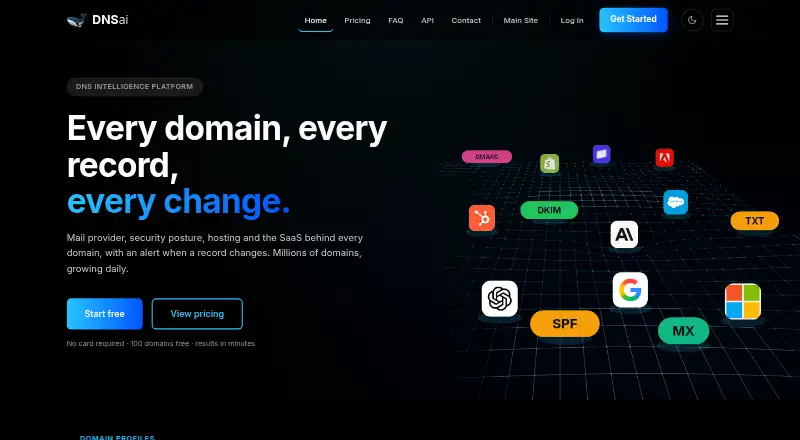
DNSai profiles domains from public DNS records to show mail providers, security posture, hosting, platforms, and record changes. Its Domain Manager scans more than 50 record types, including A, MX, SPF, DKIM, DMARC, BIMI, and DNSSEC. It tracks DNS history and can alert users when records change. The maker says DNSai does not crawl behind authentication. A vendor record shows that a domain published that vendor’s record; it does not establish seat counts, spending, or whether a contract is active. DNSai is available on the web and through DNS Explorer for Windows 11 and macOS; the maker says desktop processing keeps domain data on the user's machine. Listed integrations and data options include Salesforce and HubSpot sync, a Claude MCP connector, CSV export, and SIEM webhooks. The REST API is available on Enterprise plans and above. The Free plan costs nothing and includes 100 domains, 100 scans per day, one seat, limited AI, and no API or MCP. Pro is $79 a month; Enterprise is $499 a month.
Who it suits
DNSai suits IT administrators, cybersecurity analysts, researchers, and operations teams who rely on DNS data. Its domain profiles and change alerts may help teams reviewing domain records and published vendors.
What it does well
- Scans more than 50 DNS record types
- Tracks DNS history and alerts on record changes
- Free plan includes 100 domains and 100 scans daily
- Desktop processing keeps domain data on the user's machine
What to know first
- Free plan has no API or MCP
- Pro plan has no API or MCP
- REST API starts with Enterprise plans and above
- DNS Explorer lacks traditional technical assistance
Limits
The Free plan covers 100 domains, 100 scans per day and one seat, with limited AI and no API or MCP. Pro covers 50,000 domains and 5,000 scans per day for one seat, and also has no API or MCP.
Plans
| Plan | Billed and limits | Price |
|---|---|---|
| Free | 100 domains · 100 scans/day · 1 seat · limited AI · no API or MCP | Free |
| Enterprise | $499 /mo · 500,000 domains · 10,000 scans/day · 5 seats plus add-ons · API and MCP · Salesforce and HubSpot sync | $499 a month |
| Pro | $79 /mo · 50,000 domains · 5,000 scans/day · 1 seat · no API or MCP | $79 a month |
| Enterprise Max Premium | Contact for pricing · Unlimited domains · 50,000 scans/day · 5 seats plus add-ons · global domain view · annual billing | On request |
| Enterprise Max | Contact for pricing · 3,000,000 domains · 50,000 scans/day · 5 seats plus add-ons · API and MCP | On request |
As app.dnsai.com lists them, read 9 Oct 2026. The maker's own page has the final word.
Getting started
- Open the DNSai website at https://app.dnsai.com/.
- Choose the Free, Pro or Enterprise plan based on its domain and scan quotas.
- Use DNSai on the web or download DNS Explorer for Windows 11 or macOS.
- Connect through the REST API on an Enterprise plan or above, or use listed integrations and export options.
DNSai builds domain profiles and watches public DNS for changes. It fits IT administrators, security analysts, researchers and operations teams that need visibility across many domains. Choose it for DNS-centered inventory and alerts; look elsewhere if you need authenticated-system evidence or conventional support.
Overview
DNSai’s Domain Manager scans more than 50 DNS record types, including A, MX, SPF, DKIM, DMARC, BIMI and DNSSEC. Profiles cover mail providers, security posture, hosting and platforms, while resolution checks and change history help teams identify shifts in published infrastructure. Webhooks provide an alert route when records change.
The service relies on public DNS and does not crawl behind authentication. That makes collection broad and non-intrusive, but it also defines what conclusions are safe: a vendor record proves only that a domain published that vendor’s record. It does not establish seat count, spending or a live contract.
Key features
Monitoring and integrations
Change history and record-change alerts turn periodic DNS inspection into an ongoing signal, useful for security investigations, domain inventories and operational handoffs. DNSai lists Salesforce and HubSpot synchronization, a Claude MCP connector, REST API, CSV export and SIEM webhooks. The API is reserved for Enterprise plans and above, while Free and Pro exclude both API and MCP, so workflow automation may require a substantial upgrade.
Privacy and desktop processing
DNSai’s privacy policy says sensitive information is encrypted in transit and at rest, stored primarily in the United States, and not sold or shared as personal information, customer data or user queries. It may license aggregated public DNS datasets and says it honors applicable requirements such as GDPR and CCPA. DNS Explorer runs on Windows 11 and macOS; the maker says desktop processing keeps domain data on the user’s machine. Support is a weakness for that desktop product: its support page says there is no traditional technical assistance, training or ticketing.
Pricing
DNSai uses a freemium model, with paid access advertised from $30/mo. The published tiers make the trade-offs clear:
| Plan | Price | Included limits and access |
|---|---|---|
| Free | free | 100 domains, 100 scans/day, 1 seat, limited AI; no API or MCP |
| Pro | $79 a month, billed $79 /mo | 50,000 domains, 5,000 scans/day, 1 seat; no API or MCP |
| Enterprise | $499 a month, billed $499 /mo | 500,000 domains, 10,000 scans/day, 5 seats plus add-ons; API, MCP, Salesforce and HubSpot sync |
| Enterprise Max Premium | Contact for pricing, annual billing | Unlimited domains, 50,000 scans/day, 5 seats plus add-ons and global domain view |
| Enterprise Max | Contact for pricing | 3,000,000 domains, 50,000 scans/day, 5 seats plus add-ons; API and MCP |
Free is suitable for a small inventory or an initial evaluation, but its 100-domain and 100-scan daily caps and single seat constrain regular team use. Pro greatly expands volume while remaining a one-seat, non-API plan, making it better for an individual analyst than an integrated operation. Enterprise is the first listed tier with automation and CRM synchronization. Max tiers target very large inventories; Premium adds unlimited domains, global view and annual billing, while Max retains a 3,000,000-domain ceiling.
Platforms
DNSai is offered through web, Windows and macOS desktop tools, plus an API. DNS Explorer specifically supports Windows 11 and macOS.
Who it's for
IT administrators can use it to inventory DNS-backed services, while cybersecurity analysts can watch posture-related records and unexpected changes. Researchers and operations teams benefit from bulk domain profiling and exports.
Pros and cons
Pros
- Broad DNS coverage: More than 50 record types, including SPF, DKIM, DMARC, BIMI and DNSSEC, support detailed domain profiling.
- Useful change visibility: History, resolution checks and webhook alerts expose changes without manual comparison.
- Scalable upper tiers: Enterprise reaches 500,000 domains, while Max plans support up to 3,000,000 or unlimited domains.
- Workflow options: CRM sync, SIEM webhooks, CSV, MCP and API can connect findings to existing systems when the plan permits.
- Clear data protections: Encryption, stated non-sale of customer information and local desktop processing address common handling concerns.
Cons
- Public-DNS boundary: Records cannot prove seats, spend or an active contract, limiting commercial conclusions.
- Automation is expensive: API and MCP begin at Enterprise, while Free and Pro omit them.
- Low-tier collaboration: Free and Pro provide one seat, and Free has only 100 domains and 100 scans per day.
- Limited desktop support: DNS Explorer does not offer traditional technical assistance, training or ticketing.
Alternatives
For a broader infrastructure-monitoring suite with Android, iOS, Linux, macOS, self-hosted, web and Windows options, consider Paessler PRTG Network Monitor. Its Freeware Edition covers up to 100 sensors and about 10 devices, making it a better fit when sensor-based monitoring matters more than DNS intelligence.
Dotcom-Monitor is a better choice for multi-location target checks: its free tier supports up to 25 targets, five-minute frequency, two monitoring locations and email alerts.
Choose Dynatrace Kubernetes Monitoring when Kubernetes observability is the priority; it uses hourly pod-based billing rather than DNS-domain quotas.
Visual Sentinel suits teams wanting a low-cost freemium monitoring product with a $6.00-per-month Solo plan.
Checkmate is preferable for self-hosted monitoring with all features, no monitor limits and 12 alert channels on its free plan.
ManageEngine Applications Manager fits application and server monitoring, with a free allowance of five apps or servers.
StatusDrift is aimed at status pages and incident notifications, offering five monitors, five-minute checks and email, Slack and webhook notifications on Free.
TLDTrack is the more targeted option for website uptime, domain-expiry and SSL-expiry alerts, including one website and four extra monitors on Free.
For a wider comparison, browse DNS Monitoring Software.
Verdict
DNSai is a strong choice for professionals who need to profile and monitor large domain sets from public DNS, especially when Enterprise integrations and high-volume quotas justify the cost. Its decisive limitation is evidentiary: it shows published records, not authenticated business relationships, and its lower tiers restrict seats and automation. Choose it for DNS intelligence; choose an alternative when you need broader infrastructure monitoring, Kubernetes coverage, self-hosting or stronger support.
Verdict
DNSai turns public DNS records into domain profiles and change alerts, with plans that differ in quotas and access to integrations. Vendor records provide evidence of published records, not proof of seats, spending, or an active contract.
Questions
Is DNSai free?
Yes. Its Free plan costs nothing and covers 100 domains, 100 scans per day and one seat, with limited AI and no API or MCP.
What platforms does DNSai support?
DNSai lists API, macOS, web and Windows. DNS Explorer is downloadable for Windows 11 and macOS.
Which integrations are listed?
DNSai lists Salesforce and HubSpot sync, a Claude MCP connector, REST API, CSV export and SIEM webhooks. The REST API is available on Enterprise plans and above.
How much do the paid plans cost?
Pro costs $79 a month, and Enterprise costs $499 a month. Enterprise Max Premium and Enterprise Max have contact-for-pricing terms.
What does DNSai use to profile domains?
DNSai says its intelligence comes from public DNS and that it does not crawl behind authentication. A vendor record indicates publication of that record, not seats, spending or contract status.
What does DNSai say about privacy?
Its privacy policy says sensitive information is encrypted in transit and at rest, and data is stored primarily in the United States. It says it does not sell or share personal information, customer data or user queries, though it may license aggregated public DNS datasets.
Facts from DNSai's own pages
- API availability
- The REST API is available on Enterprise plans and above. · app.dnsai.com, 9 Oct 2026
- Change tracking
- The product tracks DNS change history and provides alerts when records change. · app.dnsai.com, 9 Oct 2026
- Data source
- DNSai says its domain intelligence comes from public DNS and that it does not crawl behind authentication. · app.dnsai.com, 9 Oct 2026
- Data use
- The privacy policy says DNSai does not sell or share personal information, customer data or user queries, while it may license aggregated public DNS datasets. · dnsai.com, 9 Oct 2026
- Desktop availability
- DNS Explorer is downloadable for Windows 11 and macOS, and the maker says its desktop processing keeps domain data on the user’s machine. · dnsai.com, 9 Oct 2026
- DNS coverage
- The Domain Manager scans 50+ DNS record types, including A, MX, SPF, DKIM, DMARC, BIMI and DNSSEC. · app.dnsai.com, 9 Oct 2026
- Integrations
- The maker lists Salesforce and HubSpot sync, a Claude MCP connector, REST API, CSV export and SIEM webhooks. · app.dnsai.com, 9 Oct 2026
- Intended users
- DNSai describes its users as IT administrators, cybersecurity analysts, researchers and operations teams who rely on DNS data. · dnsai.com, 9 Oct 2026
- Interpretation limit
- A vendor record indicates that a domain published that vendor’s record; it does not establish seats, spend or whether a contract is live. · app.dnsai.com, 9 Oct 2026
- Privacy
- DNSai’s privacy policy says sensitive information is encrypted in transit and at rest and data is stored primarily in the United States. · dnsai.com, 9 Oct 2026
- Product
- DNSai profiles domains from DNS records to show mail providers, security posture, hosting, platforms and record changes. · app.dnsai.com, 9 Oct 2026
- Security/compliance
- The privacy policy says DNSai honors applicable legal requirements such as GDPR and CCPA. · dnsai.com, 9 Oct 2026
- Support limit
- The DNS Explorer support page says it does not offer traditional technical assistance, training or support ticketing. · dnsai.com, 9 Oct 2026
Where DNSai stands on Freedom251
- DNS Monitoring Software#2 of 37