Freedom251 › Restaurant Recipe Costing Software

Dishboard
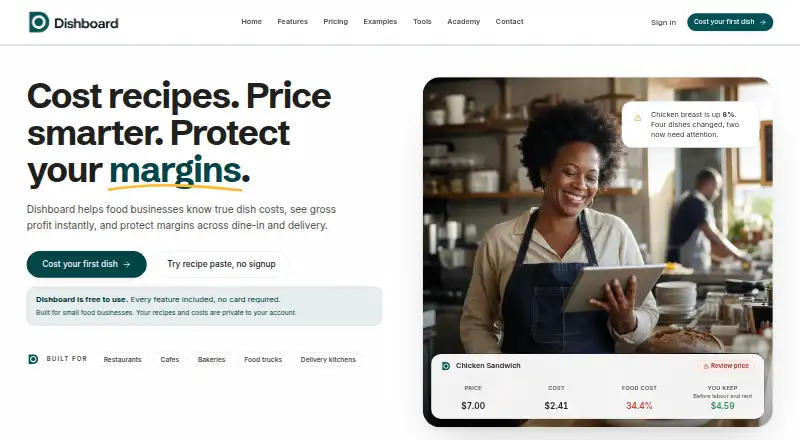
What Dishboard is
Dishboard is a web app for small food businesses to calculate dish costs, estimate gross profit, and track margins for dine-in and delivery. Each menu item can include ingredients, prep recipes, packaging, extra costs, notes, and method, with live calculations of per-portion cost and margin. Users can paste plain-text recipes for recognition of amounts, units, and ingredient names; entries needing a decision are flagged. For ingredients in its USDA-based catalog, cups, tablespoons, and teaspoons can convert to gram weights. Delivery profitability can be modeled for DoorDash, Uber Eats, Grubhub, or custom channels, with commissions and other channel assumptions. Printable Recipe Cards hide cost figures by default, while Costing Sheets show costs, margins, and suggested prices. Dishboard supports CSV ingredient import and CSV and Costing Sheet exports. Its free plan has no subscription or plan limits and includes every feature, with unlimited menu items, ingredients, supplies, prep recipes, and delivery partners. Dishboard does not provide POS, inventory counts, supplier ordering, accounting, payroll, or staff scheduling. Its headquarters are in Bangkok, Thailand.
Who it suits
Dishboard suits small restaurants, cafes, bakeries, food trucks, and delivery kitchens that need to calculate recipe costs and margins. It is not a replacement for POS, inventory, or staff-management tools.
What it does well
- Calculates per-portion costs and margins live
- Models delivery channels and their commissions
- Free plan includes every feature with no plan limits
- Supports CSV import and exports
What to know first
- Does not provide POS
- Does not provide inventory counts or supplier ordering
- Does not provide accounting, payroll, or staff scheduling
Limits
The free plan has no plan limits and includes unlimited menu items, ingredients, supplies, prep recipes, and delivery partners. Dishboard does not provide inventory counts, POS, supplier ordering, accounting, payroll, or staff scheduling.
Plans
| Plan | Billed and limits | Price |
|---|---|---|
| Dishboard | Free to use; no subscription · No plan limits · Unlimited menu items, ingredients, supplies, prep recipes, and delivery partners · Every feature included | Free |
As dishboard.co lists them, read 7 Oct 2026. The maker's own page has the final word.
Getting started
- Open the Dishboard website in a web browser.
- Use the free Dishboard plan; it has no subscription.
- Add ingredients and menu items, or paste a plain-text recipe for recognition.
- Enter packaging, extra costs, notes, and method to calculate portion costs and margins.
- Set up delivery channels and assumptions if you want to model delivery profitability.
- Import ingredient data by CSV or export CSV and Costing Sheets as needed.
Dishboard is a web app for costing recipes and weighing menu margins across dine-in and delivery. It is best suited to independent food operators who need clearer per-portion economics without adopting a larger restaurant system. Its focus is useful discipline; it is not a replacement for tools that run the rest of a business.
Overview
Dishboard brings recipe inputs together with delivery-channel assumptions to calculate costs, gross profit, and margins. That makes it practical for checking whether packaging, prep work, and delivery commissions change a dish’s economics enough to warrant a price or recipe adjustment. The trade-off is a narrow scope: there is no POS, inventory counting, supplier ordering, accounting, payroll, or staff scheduling.
Key features
For each menu item, operators can combine ingredients, prep recipes, packaging, other costs, notes, and method, with live per-portion cost and margin calculations. Yield and portion scaling and menu profitability are supported, as are ingredient price updates. This makes Dishboard more useful for revising a dish than a calculator that only totals ingredients, although it remains a costing workspace rather than an operational hub.
Plain-text recipe paste recognizes amounts, units, and ingredient names, then flags entries that need a decision. That can reduce manual setup, but ambiguous items still require human review. Cups, tablespoons, and teaspoons convert to gram weights when the ingredient is in its USDA-based catalog, so conversion coverage depends on that catalog.
Delivery modeling covers DoorDash, Uber Eats, Grubhub, and custom channels, including commissions and other assumptions. Operators can compare channel economics rather than treating a delivery menu as equivalent to dine-in. Printable Recipe Cards hide cost figures by default for kitchen use, while Costing Sheets show costs, margins, and suggested prices; CSV ingredient import, CSV export, and Costing Sheet exports support moving data in and out.
Dishboard says workspace data is held in isolated per-user cloud storage and encrypted in transit with HTTPS. It says it does not sell user data or share it with advertisers, and provides account deletion and data export. Contact messages reach a person, with replies usually arriving within one to two business days.
Pricing
The Dishboard plan costs nothing, billed Free to use; no subscription. It includes every feature and unlimited menu items, ingredients, supplies, prep recipes, and delivery partners, with no plan limits. There is no free trial because the product is free to use. For a small restaurant, cafe, bakery, food truck, or delivery kitchen that mainly needs costing, the absence of quotas or seat charges removes common reasons to outgrow an entry tier. The limitation is capability rather than price: businesses needing inventory or other daily operations still need separate software.
Platforms
Dishboard runs on the web, making it accessible through a browser rather than a dedicated desktop or mobile app.
Who it's for
Dishboard fits small food businesses that want to standardize recipe costs, scale portions, and protect margins across delivery and dine-in. It is a poor fit for operators seeking one system for stock control, purchasing, staffing, or accounts.
Pros and cons
- Pros: Unlimited free use includes all features, so a growing menu or larger ingredient list does not trigger a stated plan cap.
- Pros: Per-portion costing combines prep, packaging, and extra expenses with channel commissions, giving operators a fuller margin picture than ingredient-only costing.
- Pros: Kitchen cards can omit cost figures, while costing sheets retain them, allowing different printouts for kitchen work and pricing decisions.
- Cons: No inventory counts, POS, ordering, accounting, payroll, or scheduling means it cannot consolidate broader restaurant operations.
- Cons: Measurement conversion applies only to ingredients in its USDA-based catalog, and flagged recipe-paste entries need a decision.
Alternatives
Choose Chefy if you want free costing and recipes for a first core venue alongside bulk product import, wastage recording, real-time costing updates, and an included team. Cilurzo Foodcost is worth comparing if a free, per-module approach suits you and you are comfortable with volume limits; its Lite plan covers one module’s core features. For household recipe management rather than restaurant costing, Cucinovo offers a free single-household, single-user plan with unlimited recipes, ingredients, categories, and shopping lists. DishCost may suit someone who primarily needs free recipe-costing and nutrition tools, though most Pro features on its account tier are read-only.
Enplace is another option to compare for restaurant use. Freecost is an alternative with web and Android access. Ratatool is an alternative with a limited free trial tier. RistoBrain is an alternative with paid plans starting at €19 a month. Browse more options in Restaurant Recipe Costing Software.
Verdict
Dishboard is a strong choice for small food businesses that want detailed recipe and delivery-margin control without a subscription or usage caps. Its main reason to choose is the combination of channel-aware costing and an unrestricted free plan. Look elsewhere if inventory, POS, purchasing, accounting, or staff operations need to live in the same system.
Verdict
Dishboard focuses on recipe costing and menu profitability, including delivery-channel assumptions. Its free plan includes all listed features, but it does not cover several broader business operations.
Questions
How much does Dishboard cost?
The Dishboard plan is free, billed as free to use with no subscription.
Is there a free plan or free trial?
Yes. The free plan includes every feature and has no plan limits. There is no free trial.
Which platforms does Dishboard support?
Dishboard is available on the web.
Can Dishboard track inventory or update ingredient prices?
No. Inventory tracking and ingredient price updates are not provided.
Can it model delivery costs?
Yes. It can model DoorDash, Uber Eats, Grubhub, or custom channels using commissions and other channel assumptions.
Who founded Dishboard?
Dishboard's story page identifies Tal as its founder.
Facts from Dishboard's own pages
- Data import and export
- Dishboard supports CSV ingredient import and CSV export, as well as Costing Sheet exports. · dishboard.co, 7 Oct 2026
- Data use
- Dishboard says it does not sell user data or share it with advertisers, and it offers account deletion and data export. · dishboard.co, 7 Oct 2026
- Delivery channels
- Dishboard models delivery profitability for DoorDash, Uber Eats, Grubhub, or custom channels, including commissions and other channel assumptions. · dishboard.co, 7 Oct 2026
- Founder
- The story page identifies Tal as the founder of Dishboard. · dishboard.co, 7 Oct 2026
- Headquarters
- Bangkok, Thailand · dishboard.co, 28 Sept 2026
- Intended users
- Dishboard is built for small food businesses including restaurants, cafes, bakeries, food trucks, and delivery kitchens. · dishboard.co, 7 Oct 2026
- Kitchen cards
- Printable Recipe Cards hide cost figures by default, while Costing Sheets include costs, margins, and suggested prices. · dishboard.co, 7 Oct 2026
- Privacy and security
- The privacy policy says workspace data is stored in isolated per-user cloud storage and data in transit uses HTTPS. · dishboard.co, 7 Oct 2026
- Product limits
- Dishboard does not provide POS, inventory counts, supplier ordering, accounting, payroll, or staff scheduling. · dishboard.co, 7 Oct 2026
- Recipe costing
- It combines ingredients, prep recipes, packaging, extra costs, notes, and method for each menu item, with live per-portion cost and margin calculations. · dishboard.co, 7 Oct 2026
- Recipe paste
- Users can paste plain-text recipes for Dishboard to recognize amounts, units, and ingredient names, and it flags entries needing a decision. · dishboard.co, 7 Oct 2026
- Support
- The contact page says messages reach a real person and replies usually arrive within 1 to 2 business days. · dishboard.co, 7 Oct 2026
- Unit conversion
- Cups, tablespoons, and teaspoons convert to gram weights when the ingredient is in its USDA-based catalog. · dishboard.co, 7 Oct 2026
- What it does
- Dishboard helps food businesses calculate dish costs, see gross profit, and protect margins across dine-in and delivery. · dishboard.co, 7 Oct 2026