Freedom251 › Content Moderation Tools Software
Detoxify
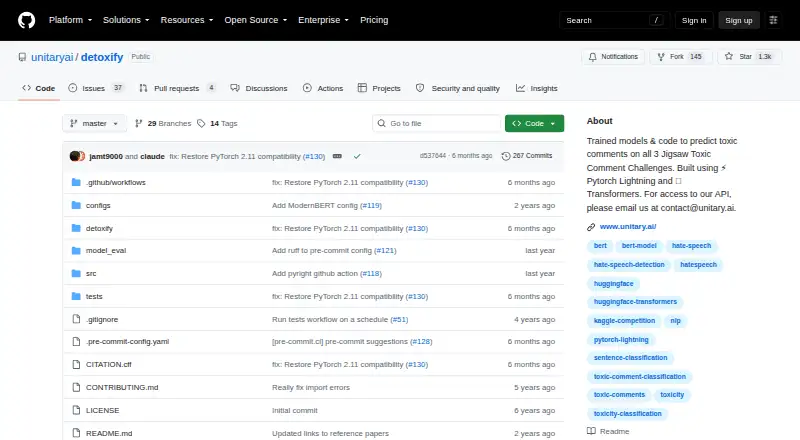
What Detoxify is
Detoxify is a free, open-source library of trained models and code for classifying toxic comments from three Jigsaw challenges. Its original, unbiased, and multilingual models use BERT, RoBERTa, and XLM-RoBERTa, respectively. Depending on the model, outputs can cover categories including threats, obscenity, insults, identity attacks, and explicit sexual content. The multilingual model is intended for English, French, Spanish, Italian, Portuguese, Turkish, and Russian. The project describes research, fine-tuning on carefully constructed representative datasets, and faster moderator flagging as intended uses. It can be installed with pip and called from Python to predict labels for a single string or a list. Inference runs on CPU by default and accepts a PyTorch device such as CUDA. Inference uses Hugging Face Transformers and PyTorch Lightning; training also requires the Kaggle API to download data. The README warns that profanity-associated words may be labeled toxic regardless of tone or intent, potentially biasing results against vulnerable minority groups. The project is distributed under Apache-2.0; API access is requested by email.
Who it suits
Detoxify suits researchers and moderators seeking text classification models they can run on their own infrastructure, or teams fine-tuning on representative datasets. Its documented scope is toxic-comment text classification, not broader media moderation or human review.
What it does well
- Offers original, unbiased, and multilingual models
- Classifies several toxicity-related categories
- Multilingual model targets seven listed languages
- Python use supports single strings or lists
- CPU inference is available by default
What to know first
- Profanity may be flagged regardless of tone or intent
- No image, audio, or video moderation
- No custom policies or human review workflow
- API access requires an email request
Limits
The open-source library provides text classification; image, audio, and video moderation, custom policies, and a human review workflow are not included. The README warns that profanity-associated words may be classified as toxic regardless of tone or intent.
Plans
| Plan | Billed and limits | Price |
|---|---|---|
| Open-source library | Trained models and code for toxic-comment classification; API access by email | Free |
As github.com lists them, read 8 Oct 2026. The maker's own page has the final word.
Getting started
- Open the project on GitHub.
- Install the library with pip in a Python environment.
- Use Python to submit one text string or a list of strings for predictions.
- Run inference on CPU by default, or provide a PyTorch device such as CUDA.
- Email [email protected] to request API access, if needed.
Detoxify is a free, self-hosted Python library for classifying toxic text. It is best suited to developers and researchers who can run models themselves and want to flag potentially harmful comments. Its model choices and multilingual coverage are useful, but profanity-linked bias makes its predictions unsuitable as unreviewed moderation decisions.
Overview
The library pairs trained models with code to classify comments, with intended uses spanning research, fine-tuning on representative datasets, and helping moderators identify harmful content faster. That makes it a focused text-classification component rather than a full moderation system: it has no custom policies or human-review workflow, and it does not handle images, audio, or video.
Models were trained for the 2018, 2019, and 2020 Jigsaw toxic-comment challenges using Wikipedia Comments and Civil Comments data. The README warns that words associated with profanity may be labeled toxic regardless of tone or intent, potentially biasing results against vulnerable minority groups. Treat scores as signals for review, not definitive judgments.
Key features
Three model variants
Detoxify offers original, unbiased, and multilingual models based on BERT, RoBERTa, and XLM-RoBERTa, respectively. Depending on the model, outputs include categories such as threats, obscenity, insults, identity attacks, and explicit sexual content. The range gives developers options for different classification needs, but category coverage varies by model; there is no custom-policy layer to tailor labels to a community's rules.
Python inference and runtime
Install the library with pip and use Python to predict labels for one string or a list of strings. Inference supports CPU by default and accepts a PyTorch device such as CUDA. It relies on Hugging Face Transformers and PyTorch Lightning, so it fits projects already able to manage that stack better than teams seeking a standalone moderation dashboard. Training additionally requires the Kaggle API to download data.
Multilingual coverage and API
The multilingual model is intended for English, French, Spanish, Italian, Portuguese, Turkish, and Russian. This is a useful reach for those languages, not evidence of broad coverage beyond them. The repository says API access can be requested by emailing [email protected], which is a separate route from running the self-hosted library.
Pricing
Open-source library: free. The plan includes trained models and code for toxic-comment classification, with API access by email. There is no free trial because the library is free. The price removes a software fee, but it does not change the practical requirements: teams need to run the Python stack themselves, and no request quota or seat allowance is part of this plan.
The project is distributed under the Apache-2.0 license. It is a strong fit when self-hosting and implementation work are acceptable; organizations needing managed moderation operations, configurable policies, or broader media coverage should look elsewhere.
Platforms
Detoxify supports Linux and self-hosted deployment. Its Python interface and local inference options suit teams integrating classification into their own systems, rather than buyers looking for a hosted web application. Text moderation is supported; image, audio, and video moderation are not.
Who it's for
Choose Detoxify if you are a developer or researcher who wants open-source toxic-text models, can work in Python, and values running inference in your own environment. The multilingual model can help with the seven intended languages, while CPU support provides a default runtime without requiring CUDA. It is a weaker fit for teams that need a turnkey queue, human escalation, custom rules, or moderation across media types.
Pros and cons
Pros
- Free, self-hosted code and models: useful for teams that want to integrate classification without a software subscription.
- Three model variants: offers choices based on BERT, RoBERTa, and XLM-RoBERTa, with toxicity-related labels that vary by model.
- Seven-language intent for the multilingual model: covers English, French, Spanish, Italian, Portuguese, Turkish, and Russian.
- CPU by default, with CUDA accepted: supports inference on CPU while allowing a PyTorch device to be supplied.
Cons
- Profanity can be a misleading signal: the project warns that tone and intent may not prevent profanity-associated words from being classified as toxic.
- Narrow moderation scope: it handles text only and provides neither custom policies nor a human-review workflow.
- Requires a Python environment and dependencies: inference uses Transformers and PyTorch Lightning; training adds the Kaggle API requirement.
Alternatives
AI Content Moderation Software is a broader directory for comparing moderation tools.
Pick Tisane API instead if you want a freemium option with API, web, desktop, and self-hosted platforms; its Community plan includes 50,000 requests per month at 10 hits per minute, but excludes technical support, CORS support, LM Direct Access, and customization.
Choose Google Cloud Vision API when image analysis is the priority; its pay-as-you-go plan bills by image and feature, unlike Detoxify's text classification focus.
WebPurify is another moderation option.
Amazon Rekognition Content Moderation may suit teams exploring a video-capable API; its Free Tier lasts 12 months from account creation and includes 60 video analysis minutes per month, including Content Moderation.
Hive Moderation is an alternative for teams seeking access to 10+ models and selected-model pay-as-you-go, with $50+ in free credits after adding a payment method.
PicPurify offers a freemium API and web option, with 2,000 free units on its FREE plan.
Sightengine is another freemium API and web alternative; its free plan allows 1 request per second and excludes video processing and live-stream support.
Consider Llama Guard if you want a free self-hosted model; its listed Llama Guard 3-8B option requires model weights.
Verdict
Detoxify is a sensible choice for developers and researchers who want free, self-hosted toxic-text classification and can treat model outputs as prompts for moderation rather than final calls. Its model variety, multilingual option, and Python integration are the main reasons to choose it. Look elsewhere if you need multimodal coverage, custom policies, a human-review workflow, or stronger assurance that context will be reflected in toxicity labels.
Verdict
Detoxify provides self-hosted text classification models with multiple model and language options. Its documented bias warning matters: profanity-associated terms may be labeled toxic irrespective of context.
Questions
Is Detoxify free?
Yes. The open-source library plan costs nothing.
Is it open source?
Yes. The project is distributed under the Apache-2.0 license.
Which languages does it support?
The multilingual model is intended for English, French, Spanish, Italian, Portuguese, Turkish, and Russian.
Can it run on my own infrastructure?
Yes. Detoxify is self-hosted and can run inference on CPU by default or on a PyTorch device such as CUDA.
Does Detoxify provide API access?
The repository says to email [email protected] to request access to its API.
Who makes Detoxify?
The project is published at github.com/unitaryai/detoxify.
Facts from Detoxify's own pages
- API access
- The repository says to email [email protected] to request access to its API. · github.com, 8 Oct 2026
- Bias limitation
- The README warns that profanity-associated words may be classified as toxic regardless of tone or intent, potentially creating bias toward vulnerable minority groups. · github.com, 8 Oct 2026
- Categories
- Model outputs include toxicity-related categories such as threats, obscenity, insults, identity attacks, and explicit sexual content, depending on the model. · github.com, 8 Oct 2026
- Dependencies
- Inference uses Hugging Face Transformers and PyTorch Lightning, while training also requires the Kaggle API to download data. · github.com, 8 Oct 2026
- Install
- The library can be installed with pip and used from Python to predict labels for one string or a list of strings. · github.com, 8 Oct 2026
- Languages
- The multilingual model is intended for English, French, Spanish, Italian, Portuguese, Turkish, and Russian. · github.com, 8 Oct 2026
- License
- The project is distributed under the Apache-2.0 license. · github.com, 8 Oct 2026
- Models
- The library offers original, unbiased, and multilingual models based on BERT, RoBERTa, and XLM-RoBERTa, respectively. · github.com, 8 Oct 2026
- Purpose
- Detoxify provides trained models and code to classify toxic comments from three Jigsaw challenges. · github.com, 8 Oct 2026
- Runtime
- Inference supports CPU by default and accepts a PyTorch device such as CUDA. · github.com, 8 Oct 2026
- Training data
- The models were trained for the 2018, 2019, and 2020 Jigsaw toxic-comment challenges using Wikipedia Comments and Civil Comments data. · github.com, 8 Oct 2026
- Use
- The project describes its intended uses as research, fine-tuning on carefully constructed representative datasets, and helping moderators flag harmful content faster. · github.com, 8 Oct 2026
Where Detoxify stands on Freedom251
- Content Moderation Tools Software#3 of 22
- AI Content Moderation Software#4 of 27