Freedom251 › Database Monitoring
dbWatch
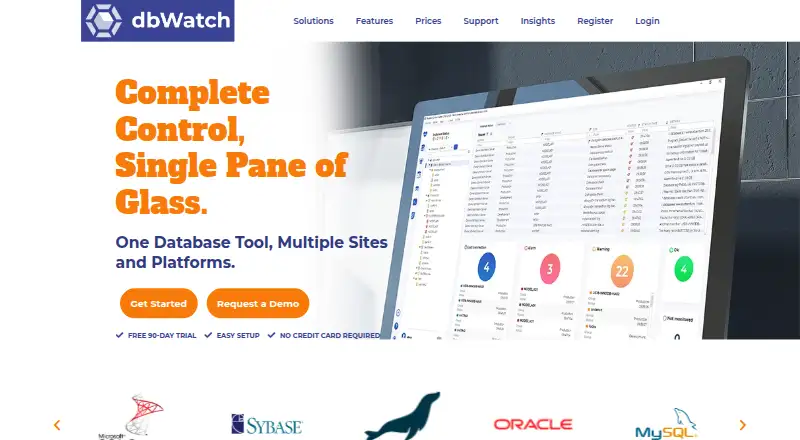
What dbWatch is
dbWatch Control Center brings monitoring, management, reporting, and maintenance for database environments into one interface. It includes over 100 monitoring jobs and provides real-time and historical performance information. Database teams can profile queries, examine waits and locks, and review execution plans. The product also supports automated maintenance routines and scheduled, customizable reports. Listed database engines are Oracle, Microsoft SQL Server, PostgreSQL, MySQL, MariaDB, Sybase ASE, and MongoDB. Its hybrid deployment model covers on-premises and off-premises environments, AWS RDS, Azure, and other clouds. The maker describes SMTP and ServiceNow alert integrations, webhooks, scripts, and CSV, JSON, and XML exports. Security features include two-factor authentication, encrypted communications, and DBA controls. dbWatch runs on Windows or Linux 64-bit servers, with Windows clients for its graphical interface. The company was founded in 2001 and is headquartered in Oslo, Norway. The product is paid, uses per-instance licenses, and is priced on request. A free trial is available, but there is no free plan.
Who it suits
dbWatch suits database teams managing environments from small businesses to large enterprises and database farms. It is relevant to teams working across the listed database engines that need monitoring, maintenance automation, and performance analysis in a hybrid deployment.
What it does well
- More than 100 monitoring jobs provide performance information.
- Supports seven listed database systems.
- Includes query profiling, wait and lock analysis, and execution plans.
- Automates maintenance and schedules customizable reports.
- Offers alerts, webhooks, scripts, and multiple export formats.
What to know first
- There is no free plan.
- Pricing is available on request.
- A two-node failover cluster requires two licenses.
Limits
There is no free plan. Licensing is per instance, and a two-node failover cluster requires one license for each node.
Plans
| Plan | Billed and limits | Price |
|---|---|---|
| dbWatch Control Center | Subscription normally 12 months; auto-renews · Per-instance licenses · Quote required | On request |
As dbwatch.com lists them, read 8 Oct 2026. The maker's own page has the final word.
Getting started
- Visit the dbWatch website.
- Request pricing for the per-instance subscription.
- Use the free trial to evaluate the product.
- Deploy on a Windows or Linux 64-bit server.
- Use a Windows client for the graphical interface.
Verdict
Choose dbWatch if your database team needs monitoring and analysis across its supported engines, with hybrid deployment options. Look elsewhere if you need a free plan or want a price before requesting a quote.
Questions
Which databases does dbWatch support?
The listed engines are Oracle, Microsoft SQL Server, PostgreSQL, MySQL, MariaDB, Sybase ASE, and MongoDB.
Is there a free plan or trial?
There is no free plan, but a free trial is available.
How is dbWatch priced?
It is a paid subscription with per-instance licenses, and pricing is available on request.
Where can dbWatch be deployed?
The listed supported environments include on-premises, off-premises, AWS RDS, Azure, and other clouds. The deployment model is hybrid.
What platforms does it run on?
The pricing page lists Windows or Linux 64-bit servers and Windows clients for the graphical interface.
What does Professional Support include?
It includes email ticketing, a stated response time within three days, premium LMS access, and an annual customer care session.
Facts from dbWatch's own pages
- Audience
- The maker describes dbWatch as a solution for database teams managing environments ranging from small businesses to large enterprises and database farms. · dbwatch.com, 8 Oct 2026
- Automation
- It supports automated maintenance routines and scheduled, customizable reports. · dbwatch.com, 8 Oct 2026
- Cloud and on-premises
- The pricing page says supported environments include on-premises, off-premises, AWS RDS, Azure, and other clouds. · dbwatch.com, 8 Oct 2026
- Database support
- The pricing page lists Oracle, MS SQL Server, MySQL, PostgreSQL, MariaDB, Sybase ASE, and MongoDB instances for licensing. · dbwatch.com, 8 Oct 2026
- Data handling
- The company says the software does not report home and that it retains only the license number and invoicing contact information. · dbwatch.com, 8 Oct 2026
- Deployment
- The pricing page lists Windows or Linux 64-bit servers and Windows clients for the graphical interface. · dbwatch.com, 8 Oct 2026
- Founded
- 2001 · dbwatch.com, 28 Sept 2026
- Headquarters
- Oslo, Norway · dbwatch.com, 28 Sept 2026
- Integrations
- The maker describes SMTP and ServiceNow alert integrations, webhooks, scripts, and CSV, JSON, and XML data exports. · dbwatch.com, 8 Oct 2026
- Licensing limit
- A two-node failover cluster requires two licenses, one for the active node and one for the standby node. · dbwatch.com, 8 Oct 2026
- Monitoring
- The product includes over 100 monitoring jobs and provides real-time and historical performance information. · dbwatch.com, 8 Oct 2026
- Privacy
- The maker says development, support, and compliance processes are managed in Norway, aligned with GDPR and European privacy standards. · dbwatch.com, 8 Oct 2026
- Purpose
- dbWatch Control Center monitors, manages, reports on, and maintains database environments from one interface. · dbwatch.com, 8 Oct 2026
- Security
- The maker says the product includes two-factor authentication, encrypted communications, and strict DBA controls. · dbwatch.com, 8 Oct 2026
- Support
- Professional Support includes email ticketing, a stated response time within three days, premium LMS access, and an annual customer care session. · dbwatch.com, 8 Oct 2026
Where dbWatch stands on Freedom251
- Database Monitoring#13 of 38
- Database Performance Monitoring Software#10 of 25