Freedom251 › Dock Scheduling Software
DataDocks
What DataDocks is
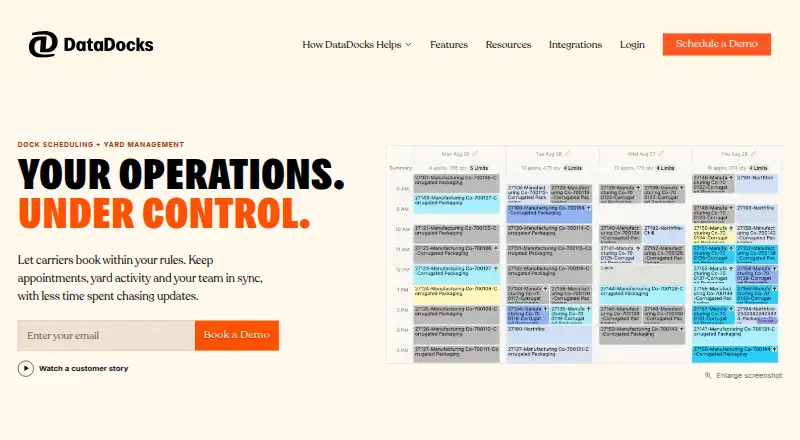
DataDocks provides dock scheduling and yard management software for warehouses and distribution centers. Carriers can schedule appointments themselves within facility capacity and booking rules, while automated rules, appointment validation and capacity controls help manage dock use. A live dashboard tracks arrivals, loading progress, waiting trailers and yard moves. The iOS and Android app supports schedule management, yard visibility, photo capture and quality-control checks; the platform also works in mobile browsers. Load documents and inspection records can be attached to appointments and synchronized with the web platform. Reporting covers detention and carrier performance. DataDocks connects with warehouse, transportation and ERP systems through APIs, and lists integrations including Microsoft Power BI, Microsoft Entra SSO, NetSuite ERP, Oracle Fusion Cloud, SAP Business ByDesign and SAP S/4HANA. The company describes the software as SOC 2 compliant and says its team helps configure facilities and onboard staff and carriers. Pricing is by quote based on facility and requirements; no fixed plan price is stated.
Who it suits
DataDocks suits warehouse and distribution center teams managing dock appointments, yard activity and carrier access. Its mobile tools are described for warehouse managers and coordinators.
What it does well
- Carriers can self-schedule within facility rules.
- Live dashboard tracks yard activity.
- Mobile app includes photo capture and QC checks.
- Appointment records can include documents and inspections.
- Connects with WMS, TMS and ERP systems through APIs.
What to know first
- Pricing requires a quote based on facility needs.
- No fixed plan price is stated.
Plans
| Plan | Billed and limits | Price |
|---|---|---|
| Custom quote | Quote based on facility and requirements | On request |
As datadocks.com lists them, read 30 Sept 2026. The maker's own page has the final word.
Getting started
- Visit https://datadocks.com/.
- Request a quote based on your facility and requirements.
- Work with the DataDocks team to configure facilities and onboard staff and carriers.
- Use the web platform, mobile browser, or iOS and Android app to manage schedules and yard activity.
- Connect relevant systems through APIs or listed integrations.
DataDocks is a dock-scheduling and yard-management system for warehouses and distribution centers. It fits operations where carriers must book within controlled rules and staff need one view of appointments, trailer activity, documents, and performance. The trade-off is a quote-based purchase rather than a published, self-serve price.
Overview
DataDocks connects carrier appointment booking with dock and yard operations. Carriers can request or schedule slots themselves, while the facility sets capacity limits and booking rules. That division can reduce back-and-forth for coordinators without giving up control over when and how freight arrives.
The product is narrowly aimed at warehouse and distribution workflows. It is a stronger fit for facilities that need scheduling, yard movement, and load records coordinated together than for a small site seeking only a basic booking page.
Key features
Controlled scheduling
Automated scheduling rules, appointment validation, and dock-capacity management let teams screen requests against operational constraints. Dock-door scheduling, appointment requests, recurring appointments, driver check-in, and support for both load types cover the core inbound workflow. Carrier self-service is useful when many transport providers need to find slots, but it still depends on the facility's defined rules and available capacity.
Live yard operations
A live dock dashboard follows arrivals, loading progress, waiting trailers, and yard moves. This gives warehouse managers and coordinators a shared operational picture instead of treating the appointment calendar as the whole process. It is most valuable where delays and trailer locations change throughout the day.
Mobile records and quality checks
The iOS and Android app supports schedule management, yard visibility, photo capture, and quality-control checks. Mobile browsers are also supported, so staff are not limited to a single device type. Load documents and inspection records stay with appointments and synchronize with the web platform, keeping evidence alongside the activity it documents.
Reporting and connections
Detention and carrier-performance reports help teams examine delay costs and provider execution. DataDocks says it connects to warehouse-management, transportation-management, and enterprise-resource-planning systems through APIs. Named integrations include Microsoft Power BI, Microsoft Entra SSO, NetSuite ERP, Oracle Fusion Cloud, SAP Business ByDesign, and SAP S/4HANA, which is relevant to facilities already using those systems.
The company describes the service as SOC 2 compliant and displays an AICPA SOC 2 certification badge. Its team also helps configure facilities and onboard staff and carriers, an important consideration for multi-party scheduling processes.
Pricing
Custom quote
Custom quote pricing is based on the facility and its requirements. No fixed amount, seat allowance, appointment quota, trial period, or renewal term is stated. This approach can suit organizations that need a tailored deployment and implementation support, but it makes budget comparison harder and offers no low-cost plan for proving the workflow independently.
Because there is only a custom-quote option, smaller facilities should ask specifically how capacity, users, integrations, onboarding, and ongoing terms affect the proposal. Larger operations with complex rules may find the individualized purchase more appropriate than forcing their process into a capped free tier.
Platforms
DataDocks runs on the web and provides iOS and Android apps. Mobile browsers are supported, and an API enables connections with WMS, TMS, and ERP systems. That combination suits teams working both at desks and around the yard, while API support gives existing enterprise systems a route into the scheduling workflow.
Who it's for
Warehouse managers, dock coordinators, and distribution-center teams are the clearest audience. It is particularly suitable for facilities that need carrier self-booking constrained by capacity, recurring appointments, driver check-in, and live visibility of trailers and dock work. Operations that only need a simple shareable booking link, or that require a transparent monthly price before engaging a vendor, should look elsewhere.
Pros and cons
- Pros: Carrier self-service operates within facility rules and capacity, reducing manual appointment handling without abandoning scheduling control.
- Pros: The dashboard covers arrivals, loading, waiting trailers, and yard moves, linking appointment planning to live yard activity.
- Pros: Mobile photo capture, QC checks, and synchronized load and inspection records keep operational proof with each appointment.
- Pros: API connectivity and named ERP, WMS-related, analytics, and identity integrations support established technology environments.
- Cons: Custom pricing gives buyers no published starting point, quota, seat terms, or trial to evaluate before requesting a quote.
- Cons: Its operational breadth may be unnecessary for a small facility that wants only uncomplicated appointment intake.
Alternatives
For a broader comparison, see Dock Scheduling Software.
- ProDocks is the better starting point when a permanent free plan for one warehouse, unlimited doors and appointments, carrier booking, and QR check-in matter more than a custom enterprise quote.
- LoadMetrics Dock Scheduling suits teams wanting a free tier with one facility and 25 dock appointments per month, plus a free trial.
- SimpleDock is preferable when a free one-location plan for up to three team members or a clearly priced $49 per location per month Pro plan is the priority.
- Inbound Connect is another paid option for teams needing Android, iOS, web, and API access.
- Mobiledock is worth considering when paid software with a free trial and the same broad Android, iOS, web, and API platform coverage is preferred.
- Agistix Cold Chain is an alternative paid product with custom pricing and a demo requirement.
- DockFlow is a paid, web-based alternative made by DelCom LLC.
- DockSlot is a paid alternative available on the web.
Verdict
Choose DataDocks if your warehouse needs controlled carrier booking tied to live dock and yard coordination, mobile records, and reporting, especially when existing systems must connect through APIs. Look elsewhere if transparent pricing, a free tier, or a lightweight booking link is more important than a configurable operational workflow.
Verdict
DataDocks combines appointment scheduling with yard visibility, mobile tools and reporting for warehouse operations. Facilities should request a quote based on their requirements, since no fixed plan price is listed.
Questions
How is DataDocks priced?
Pricing is by quote based on facility and requirements.
Which platforms can I use?
DataDocks supports web, mobile browsers, iOS, Android, and an API.
Can carriers book their own appointments?
Yes. They can self-schedule within facility capacity limits and booking rules.
What integrations are listed?
Listed integrations include Microsoft Power BI, Microsoft Entra SSO, NetSuite ERP, Oracle Fusion Cloud, SAP Business ByDesign, and SAP S/4HANA.
Can it connect to warehouse and transportation systems?
The company says it connects with WMS, TMS, and ERP systems through APIs.
What support is provided for setup?
The company says its team helps configure facilities and onboard staff and carriers.
Facts from DataDocks's own pages
- Carrier booking
- Carriers can self-schedule appointments within the facility’s capacity limits and booking rules. · datadocks.com, 30 Sept 2026
- Founded
- 2013 · datadocks.com, 23 Sept 2026
- Headquarters
- Bolton, Ontario, Canada · datadocks.com, 23 Sept 2026
- Integrations
- The integrations page lists Microsoft Power BI, Microsoft Entra SSO, NetSuite ERP, Oracle Fusion Cloud, SAP Business ByDesign, and SAP S/4HANA. · datadocks.com, 30 Sept 2026
- Mobile app
- The iOS and Android app supports schedule management, yard visibility, photo capture, and QC checks; the platform also works in mobile browsers. · datadocks.com, 30 Sept 2026
- Pricing
- The company says to request a quote based on facility and requirements; no fixed plan price is stated on the page opened. · datadocks.com, 30 Sept 2026
- Product
- DataDocks provides dock scheduling and yard management software for warehouses and distribution centers. · datadocks.com, 30 Sept 2026
- Records
- Load documents and inspection records can be kept with appointments and synchronized to the web platform. · datadocks.com, 30 Sept 2026
- Reporting
- DataDocks offers detention and carrier performance reports. · datadocks.com, 30 Sept 2026
- Scheduling controls
- The platform supports automated scheduling rules, appointment validation, and dock capacity management. · datadocks.com, 30 Sept 2026
- Security
- The company describes DataDocks as SOC 2 compliant and displays an AICPA SOC 2 certification badge. · datadocks.com, 30 Sept 2026
- Support and onboarding
- The company says its team helps configure facilities and onboard staff and carriers. · datadocks.com, 30 Sept 2026
- System connections
- DataDocks says it connects with WMS, TMS, and ERP systems through APIs. · datadocks.com, 30 Sept 2026
- Target users
- The mobile app is described for warehouse managers and coordinators, and the company describes its software as serving warehouses and distribution centers. · datadocks.com, 30 Sept 2026
- Yard visibility
- Teams can track arrivals, loading progress, waiting trailers, and yard moves through a live dock dashboard. · datadocks.com, 30 Sept 2026
Where DataDocks stands on Freedom251
- Dock Scheduling Software#6 of 24